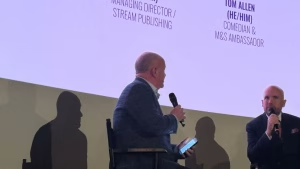
The Outvertising LIve 2025 conference brought together a panel of practitioners who are living the realities of LGBTQIA+ advocacy inside advertising and media organisations every day. The panel explored how the landscape has shifted, why optimism still matters and what concrete actions are needed to protect progress in an increasingly volatile environment.
Participants: Marty Davies, Founder, Smart Pants Consultancy and Trans plus History Week CIC; Rosie Kitson, Chief Impact Officer, Havas UK; Matthew Chew, Studio X EU Influencer Media Lead, EssenceMediacom and UK Co Chair of WPP Unite; Cassius Naylor, Advocacy Co Director, Outvertising.
Starting with optimism
Chairing the session, Cassius Naylor opened by observing how dramatically the landscape has changed since Outvertising first drafted its Advocacy Playbook. “The environment we launched the playbook into is totally different from the one we wrote it in,” he said, explaining that the industry is now focused less on defining inclusion and more on the tactics required to make it real.
Asked what was giving them hope, Rosie Kitson said the answer lay inside her own organisation. “I’ve seen a very human emotional connection to the experience and lack of psychological safety of our LGBTQ plus community,” she said. At Havas, colleagues are “stepping up not performatively, but really credibly”, demonstrating a personal commitment to protecting one another.
For Marty Davies, optimism comes from the strength of the advocacy ecosystem itself. “One of the things that brought me into Outvertising was its potential to drive change,” she said. “I’m optimistic because volunteers have built this organisation to what it is today, and we should all be grateful it exists and continue to invest in it.”
Matthew Chew echoed that sense of shared purpose. He highlighted the rise of intersectional conversations within WPP Unite, explaining that “some of the conversations we’re having now are things I never thought possible when I started in the industry eight years ago”. His own identity, he said, intersects across sexuality, ethnicity and faith, making this new openness especially meaningful.
A harsher political climate
When the discussion turned to the past year’s political events, the tone inevitably shifted. Davies described the impact of geopolitics on the advertising sector. “We’ve had the Trump administration come in for the second time, in a wave of persecution towards our community, specifically the trans plus community,” she said. She also cited the UK Supreme Court ruling that has raised uncertainties over trans rights, noting that “it has put a question mark over what trans people’s rights are”.
The combined effect, Davies argued, has been a chilling one. “What it has created is a freeze response and a sort of silencing,” they said, adding that there is now “less public inclusion specifically for trans people”.
Kitson said the shift is visible in client behaviour too. “We have seen a decline in brands specifically asking us to go out with that message,” she said. Agencies, she added, must equip their teams to raise concerns confidently with clients as advocacy becomes more sensitive.
Chew described 2024 as “a big wake up call”, particularly after a series of distressing events for LGBTQIA+ communities. “It’s been a difficult year,” he said. “People who were silent allies are now feeling that now is the time they have to be involved.”
From statements to substance
All speakers agreed that credible action inside organisations is now essential.
Kitson explained how Havas has updated its internal framework in response to employee feedback. “We were challenged that our charter wasn’t specific enough,” she said. The company has since standardised pronouns, created gender neutral spaces and introduced new transitioning at work policies.
One change that resonated particularly strongly was a system allowing transitioning employees to choose from two ID passes depending on how they wish to present. “These are small things that mean a lot,” she said, emphasising that “if our community isn’t feeling it internally, there’s no PR in the world that makes a difference.”
Chew highlighted the growing importance of senior sponsorship at WPP. “We now have a CEO willing to be our advocate,” he said. This, he argued, sends a powerful message across the network and ensures LGBTQIA+ employee groups are not left carrying the burden alone.
WPP Unite has also expanded its effort to provide psychological safety, increasing regular communications and protected spaces. “It’s about supporting all of our members from the ground up,” he said.
Kitson agreed, saying that Havas now hosts quarterly meetings where ERG leaders brief the UK chairman directly. “The first couple of meetings were pretty tense,” she said, “but it meant he heard firsthand what the experience is like. Signing off policies has been much easier because it feels personal.”
Davies also discussed the rapid rise of Trans plus History Week, the annual initiative celebrating gender diverse histories. “It has had remarkable success,” she said, noting support from corporate partners and 69 MPs. She described the initiative’s philosophy clearly: “Visibility without protection is a trap.” The goal, she explained, is advocacy rooted in safety, credibility and authentic storytelling, not seasonal performativity.
Visibility, credibility and what comes next
Naylor suggested that advocacy work has not disappeared but gone “underground”, becoming more internal as organisations prioritise employee protection. Davies challenged that framing. “If we become comfortable with a lack of visibility, that’s where shame grows,” she said. She stressed that private action is valuable but “we need to see a return to public declarations of support because that’s where pride exists”.
Kitson agreed that visibility must return, but only after organisations have done the groundwork. “We had to correct the imbalance between performative and credible,” she said. “But we then need to go out and talk about it again.”
Asked for one message for advocates in 2025, Davies kept it simple: “Listen. If we stop trying to jump to solutions and really listen to people who are suffering, we will build better solutions.”
Across the panel, one theme was clear. Advocacy in adland is not retreating, it is recalibrating. The political climate may be tougher than ever, but the discussion showed an industry refusing to step back.