With more brands shifting spend away from traditional advertising in favour of creator and affiliate-led strategies, performance marketing is undergoing a significant revival in 2025.
impact.com is a unified platform for partner-led marketing (encompassing affiliate, influencer and referral marketing), already powering campaigns for Uber, Levi’s and TUI, welcomed over 700 new clients in the first quarter of this year, including Monzo, Ocado and New Balance. The company has also released new research and product updates to support this growth, and is behind Best Buy’s new creator-powered Storefronts.
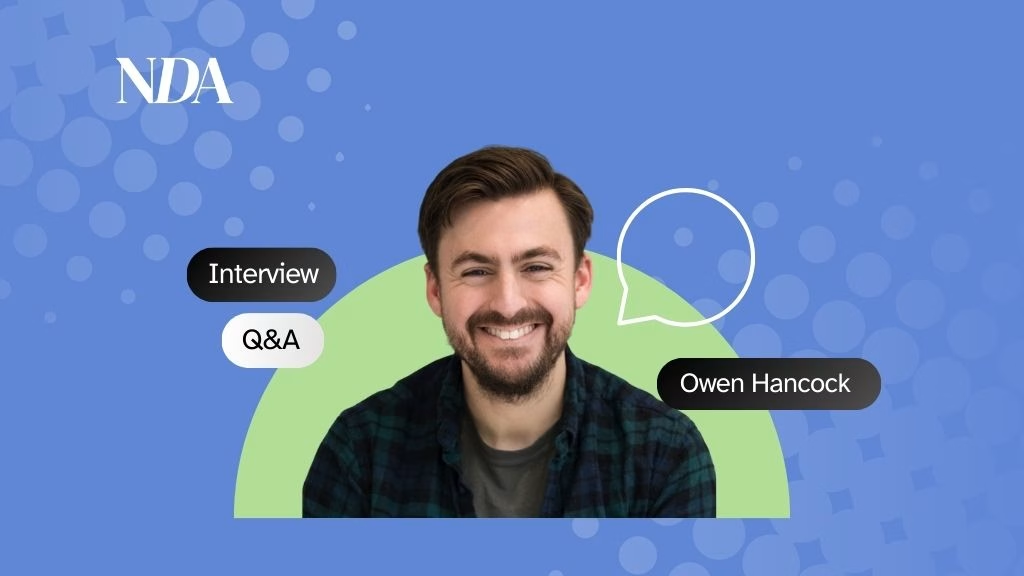
New Digital Age spoke to Owen Hancock, RVP, Marketing – EMEA at impact.com to find out more about the evolution of partner-led marketing…
Hi Owen. Tell me about your role at impact.com.
I’ve been at impact.com since 2019, leading our marketing efforts across EMEA. My team’s core mission is to show brands how partnerships are transforming the way they can connect, grow, and build that essential trust with their audiences. Through these authentic relationships, they are driving customer acquisition and delivering results that traditional methods can’t match. When I started six years ago, our EMEA operations were run only from London, but our expansion to have offices in Berlin, Milan, Olso, Copenhagen, Stockholm, Paris, and soon Madrid, is a direct result of European brands embracing this powerful new way to grow.
Why is partner-led marketing gaining ground on traditional advertising spend?
Partner-led marketing includes channels such as affiliate, influencer and creator marketing, advocate programmes and B2B partnerships. The point of it is to harness trusted voices, which are strong, important advocates for brands at a time when people are tuning out traditional advertising, or simply rejecting it.
There’s a growing distrust of traditional advertising, especially among younger audiences: 80% of Gen Z think brands lie about their products; 70% of millennials don’t trust what a brand says about itself. So people are doing their own research and looking to third parties, who they see as unbiased and neutral. That, for me, is a big part of why partner marketing has really taken off.
It has other real strengths too. It’s a much more accountable model than traditional advertising, which means brands really know what’s working and what’s not. And it provides much broader insights and opportunities. That’s why partner marketing is a great way for brands to enter new international markets – you leverage the trust of local partners, and they in turn persuade their audiences.
How does Impact.com work with brands and/or agencies to leverage Partner-Led Marketing? What sort of brands are most likely to explore the opportunity?
Our clients are predominantly brands, though about half of them also choose to work with an agency. But partnership marketing is an approach that works for companies at all stages. For young companies, it’s a way to become known and established, while more established companies can really power and grow their business through mature partnership programmes.
Different companies will always use different types of partnership: for niche players, advocacy programmes where passionate customers spread the word can be powerful. For mature companies, reviews and comparison sites may play a big role.
For all of them, a big part of the value we provide is in connecting brands with the right partners quickly and efficiently. It’s not necessarily about size and scale – it’s about fit. A creator with 10,000 followers who genuinely loves a product can be as powerful, if not more so, than someone with a million followers promoting something they don’t actually use.
Based on your work with clients, what marketplace trends do you think will be most significant in the near future?
We’re seeing a slowdown in consumer spending – not in the number of transactions, but in order values. People are being more intentional, doing more research, and making sure they’re getting the best deal. The message is that people are still buying, but they’re being much more considered.
What does success look like for impact.com over the next three years?
Success means leading the market’s transformation out of the “Ad-Led Era” and into the “Partner-Led” future. We are currently in a customer acquisition crisis; while global advertising spend surpassed $1 trillion in 2024, customer acquisition costs have skyrocketed 222% over the past decade. Brands are effectively spending three times more for the same result. Partner marketing is only about 2% of that total spend, and our goal is to grow that proportion significantly by proving that brands should reallocate their budgets toward partnerships. Partner-led marketing is more accountable and effective because it builds authentic connections in a world where consumers trust people, not ads.
We’re also investing a great deal in our technology to power this shift, building on our foundations as an AI-native platform. As a tech-led company, we’ve always been built on automation; now, we are embedding intelligence into the architecture itself, woven into every workflow. AI is only as valuable as the intelligence behind it, and our platform is powered by the largest proprietary dataset in the industry, which includes $100B in partner-driven commerce from more than 4,700 brands. For us, AI is not about bolting on a chatbot; it’s about creating “decision-grade models” that deliver genuine incremental impact and move toward ‘agentic automation’, where AI agents don’t just respond, they actively recruit, optimise, and guide.