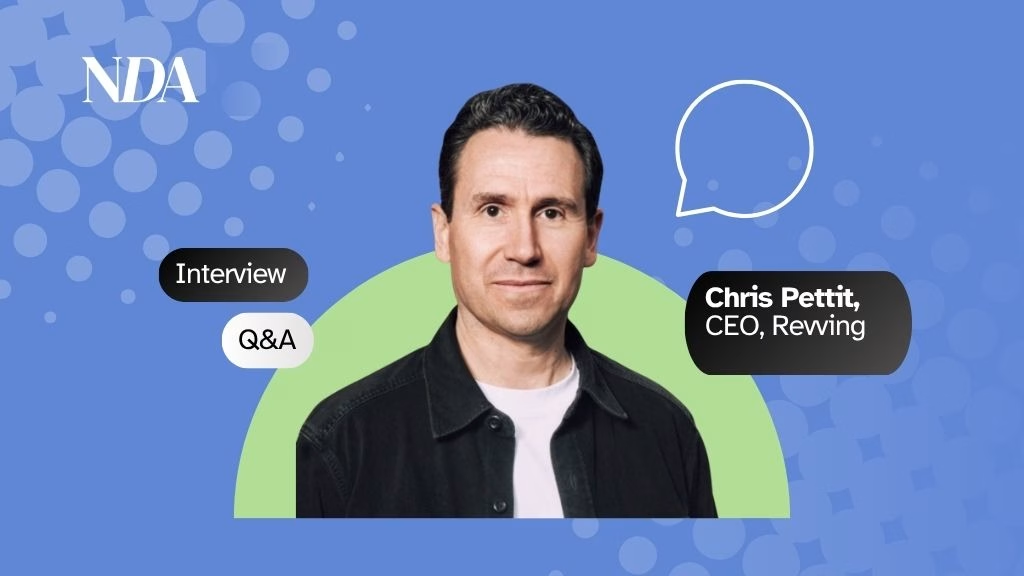
Chris Pettit is CEO and co-founder of Revving, a funding solution purpose-built for the digital economy, engineered to unlock cash flow and align funding with performance.
NDA recently spoke with Pettit to learn why payment terms have become such a problem in the digital economy, how Revving’s model works and why he believes the industry is ready for a more democratic approach to funding…
Why is cash flow such a particular issue for digital media companies?
There are a number of different factors at play here. First and foremost, it’s a really complex supply chain in the digital economy. If you look at ad tech specifically, there are so many layers to the supply chain — brands, agencies, DSPs, SSPs, publishers — and each of those participants has different contractual arrangements and different payment terms. Wherever you sit in that chain, you’re suffering from the fact there isn’t a joined-up approach across the whole ecosystem.
The second thing is that the ad industry moves at lightning speed, but the infrastructure behind finance and payments is still really analogue. It’s more like a carrier pigeon than a rocket ship. So you’ve got different participants operating in completely discrete ways, and if someone at the top of the chain is paying on 120-day terms, that has a domino effect downstream.
When did you launch the business?
We set the business up just over four years ago, and we started funding customers about two years ago. We began in the UK, initially doing a lot in affiliate, integrating with publishers and networks like Awin, CJ and Rakuten. Then we started funding our first ad tech customers last year, and launched in the US in Q4, where we’re seeing a lot of growth.
How does the Revving model work in practice?
We’ve pioneered a new liquidity model called Transactional-Based Funding. What that means is that we’ve built a technology layer that plugs directly into those intermediation platforms and reads the live signals — that could be impression-level data, revenue information or commission payments.
So instead of relying on a bank looking at whether a company is a good bet for a loan or a revolving credit facility, we can connect directly into platforms like SSPs, DSPs and affiliate networks, pull the data out in real time and fund against those signals. That’s really our secret sauce.
What makes that different from traditional funding?
Traditional funding is still very much built around invoices and a pretty analogue process. We felt that didn’t fit the reality of an ecosystem where data is moving at light speed. By plugging directly into the platforms, we can immediately fund customers or enable those platforms to fund their customers instantly.
The other benefit is that we look upstream. A lot of the big companies sit at the top of these supply chains, while smaller publishers are often at the bottom and last to get paid. Because we fund against the payments coming from those bigger companies, we can provide more funding to the smaller businesses that need it most.
What kind of businesses is Revving most relevant to?
It’s really most relevant for scaling businesses. If you’re growing fast, you’re constantly recycling cash flow. You might win a test campaign, then suddenly a brand wants to run 10 million through you — but if they’re not going to pay for 90 or 120 days, and you’ve got to spend the money upfront, you’re stuck.
Those are exactly the types of businesses we help, because they’re being asked to act like a bank. They need the free cash flow to pay suppliers before they’ve actually received the money themselves.
What are your priorities for the year ahead?
We’re always looking for new integrations and better use cases for customers. One of the key priorities is making sure the industry knows who we are, because a lot of people are still learning about us and what we do.
I think there’s a real democratisation of funding here. Big companies usually know where to go and have the relationships, but smaller businesses often don’t. We want to make sure top to tail that everyone knows this exists, so if they need it, they know where to come.
Are there other sectors you’re looking at?
Yes. We’re doing more in the creator economy, helping creator intermediation platforms get creators funded more quickly. Those people are often individuals, and they really rely on quick cash flow, but they can end up waiting up to 180 days to get paid by big brands.
We’re also looking at adjacent businesses like telco. For me, it’s really about educating the industry and showing that you don’t have to suffer in silence — you can actually find ways to solve it.
What’s the main message you’d give to CFOs and finance teams?
Don’t just accept that long payment terms are part of the deal. We’ve seen examples where companies are told they can win an RFP, but only if they accept 365-day payment terms, which is nonsense. There are only a handful of companies in the world that could weather that kind of relationship.
If you can remove payment terms as an issue, smaller companies can compete with the big players. Then the best company wins, not just the company with the deepest pockets.