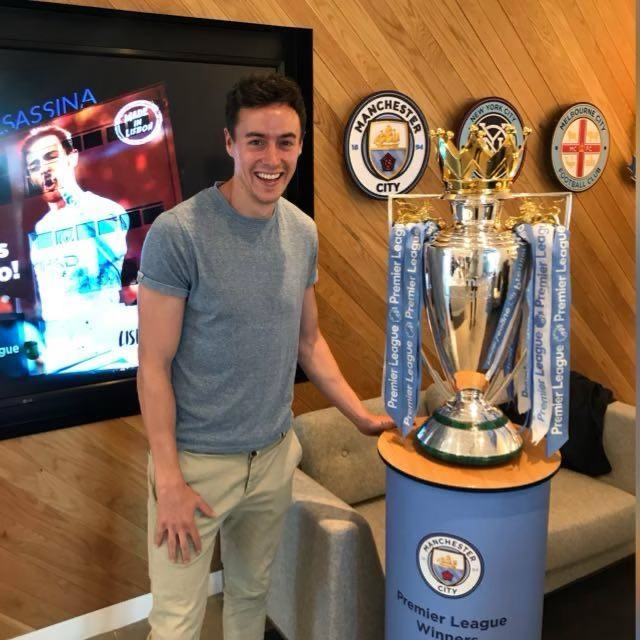
George Duncan is Head of Commercial Media at City Football Group, where he leads global digital strategy for brand partnerships and drives innovation in media revenue. With more than eight years at CFG, and previous experience at Mediacom London and Walker Media, Duncan helps partners unlock tangible business impact through smarter, data-driven digital campaigns.
A specialist in emerging technologies, including AI, AR and VR, Duncan is passionate about exploring how innovation can enhance fan engagement and commercial performance, positioning him as a thought leader in modern sports marketing.
NDA spoke to Duncan to find out more…
Tell me about your role.
As Head of Commercial Media at City Football Group, my role spans digital strategy for our existing partners and sales prospects, business development for City Studios (the group’s creative agency) as well as media monetisation.
I also oversee City Fan Labs, a recently launched business unit, exploring innovation and emerging platforms, including the metaverse. Alongside that, I lead strategic work with our broadcast partners, ensuring our media ecosystem continues to evolve in line with how fans consume content globally.
How did City Studios come into existence?
City Studios provides a full range of services across live programming, documentary production, photography, organic and branded content, podcast production and written editorial. With “Matchday Live” – the biggest matchday show in the Premier League and the acclaimed Netflix documentary “Together: Treble Winners” coming from the City Studios stable in recent years. In addition to this broad portfolio offering, a deliberate strategic focus on branded content has been in place since the agency’s launch in 2021. This was supported by investment in people from an eclectic mix of backgrounds, spanning digital publishers, media owners, production houses, and creative agencies. That diversity of experience gives City Studios a true point of difference in the agency market, particularly in its depth of audience understanding and ability to deliver tailored creativity.
Prior to the inception of City Studios in 2021, we were producing branded content on a small scale and outsourcing marquee projects. After early success with established partner brands, our ambition and confidence in the vision grew. We invested further in people and infrastructure, including state of the art studio facilities at the training ground, and steadily scaled the agency operation.
Today, alongside the wider club content that City Studios produces, we also deliver around 30 major projects a year for global brands such as EA, Etihad, Midea, Paramount + PUMA and OKX. We’re now competing in the wider UK agency market and taking on non-partner clients too. A genuinely unique proposition built on a varied mix of talent.
What are the key benefits to Man City operating its own in-house production and creative agency?
As an in-house production and creative hub, City Studios can benefit from the deep integration with the wider Manchester City ecosystem. We operate alongside specialist teams across partnerships, media, technology, data and insights, which creates a powerful multiplier effect.
There are clear efficiencies in terms of economies of scale, scope and control, but the real competitive advantage is our understanding of our audience. We know our fans better than anyone, and we apply this “audience first” philosophy to all aspects of club and brand marketing. When you combine this ethos with specialist internal services, the results can be incredibly powerful.
What can marketers in other sectors learn from sport’s approach to digital activation?
The biggest lesson is the depth and immediacy of audience understanding. Many brands rely on static research. Even the most sophisticated qualitative and quantitative research offers a snapshot in time. In sport, we have a 24/7, always-on bilateral relationship with fans, and so through content consumption, engagement and interaction, we’re able to see what resonates in real-time. That creates a level of live insight and personalisation most brands simply don’t have. When you layer in data enrichment and a strategic focus on first party data, this combination is incredibly powerful from a marketing perspective.
Sport is also naturally at the forefront of technology. From how the game is played, analysed, broadcast and consumed. That same technology can then be repurposed creatively. For example, the club has utilised skeletal player-tracking data, originally built for performance analysis, and transformed it into immersive fan-facing content. Our recent Etihad Beyond Borders campaign, which used this approach, delivered 74 million views and outperformed partner benchmarks by 2.5x. It shows what’s possible when innovation and storytelling meet.
Why is fan-led, native storytelling proving more effective than traditional ‘interruption’ formats?
Traditional advertising is largely about renting attention. You’re buying space in someone else’s environment and competing to be noticed. Fan-led, native storytelling is about earning that attention within a trusted relationship. Sport has a unique, bilateral relationship with its audience, built on passion and loyalty, which drives meaningful engagement for native content .
That doesn’t mean paid advertising is going away, it remains the backbone of the industry and still delivers outstanding creative work. But the most effective strategies now blend both. Native storytelling builds affinity by tapping into cultural passion points, while paid media drives scale, consideration and intent. It’s not either/or, it’s about balance.
A related point is the creator economy and influencer led marketing – worth $250bn globally. Brands see the ripple or multiplier effect of this native format, where authentic endorsement to fans or followers can deliver various benefits across the funnel… reach, engagement, direct link to purchase. The creator economy is a prime example of how modern marketing outputs shouldn’t be constrained to one or two outcomes, and the blurring of these dividing lines can be encouraged in a creative manner. Its growth in popularity also indicates the vast potential of tapping into fandom and the incremental gains brands can access through harnessing the emotional connection of consumers’ passion points. Balance and trust are paramount, though – the brand image and personality, often built over years of work, is in the hands of an individual, so influencer selection and fit are vital.
What would be your key piece of advice for marketers heading into 2026?
First, prepare for continued uncertainty. Geopolitics, tariffs and uneven economic growth have already impacted budgets in 2025, and that volatility will continue into 2026. The key lesson is not to retreat into short-termism. The most effective brands are protecting long-term brand building while still driving short-term impact in parallel.
Second, we’ll continue to see the evolution of marketing models. The traditional split between brand and performance is breaking down. Creative and media increasingly work together, and attention planning is becoming more sophisticated – optimising for real human attention, not just impressions. That’s better for budgets, effectiveness and the planet as scrutiny grows around carbon efficiency.
Finally, youth audiences and technology will define the next phase of growth. Gen Z and Gen Alpha purchasing power is accelerating, but many brands still lack a deep understanding of their media habits. At the same time, AI and creator-led are reshaping everything. The opportunity is huge, but only if technology remains in service of brilliant strategy, creativity and genuine human insight. Smart utilisation of technology, combined with compelling product, consumer and cultural truths will be a winning combination in 2026.