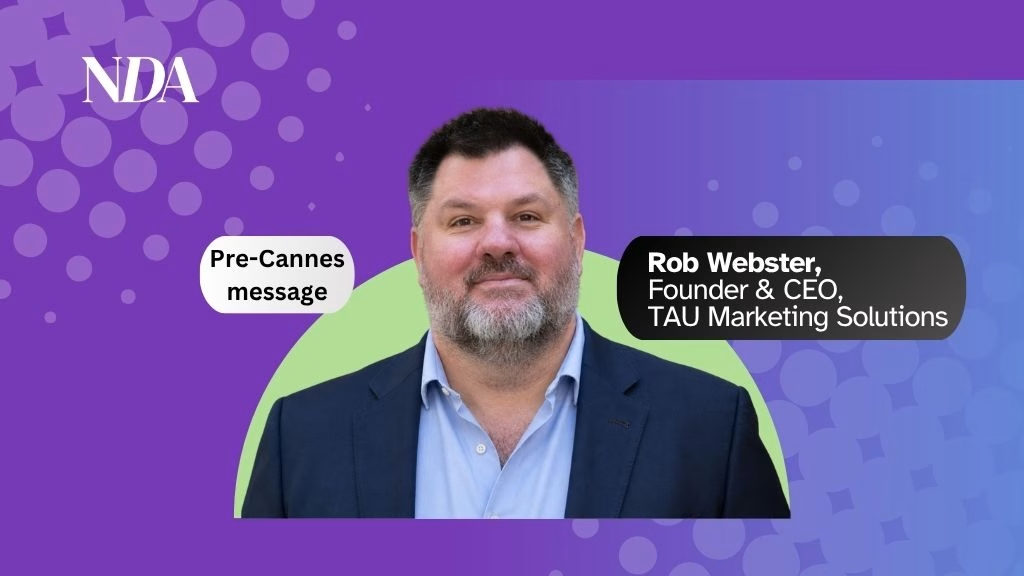
By Robert Webster, Founder and CEO, TAU Marketing Solutions
There are two Cannes. The creative one, in the conference theatres. And the tech one, all around it, on the beaches and in the bars. Both set the scene for the year, and while they can be very different, the good years are the ones where they rhyme. Last year you couldn’t move for talk of agents in tech land, and agents of a different sort building the creative. So here we are, in an agentic world, yet bottom-line growth and true transformation are still lagging behind.
That’s because AI deployed in point solutions, pilots and production processes might accelerate certain tasks, but without orchestration, every tool is playing its own tune. The instruments are there, but nobody is conducting.
This year, I hope the conversation on the Croisette shifts to something more fundamental: where the real decision nodes in your organisation actually sit. Because that’s where AI can drive bottom-line transformation: in those moments where judgement shapes what comes next. It’s no accident that every coding agent built this year ships with a plan mode. Claude even has an ultraplan. That’s because planning has long been recognised as the critical unlock for AI because unless thinking comes before the doing, chaos ensues.
In marketing, media planning has always been one of the most critical of those junctures. Upstream insight dictates vast expense in downstream output. Where that spend happens is largely unchanged (TV, in new forms and old. OOH, social, search, the rest of it), but the how, the who and, crucially, what good looks like, all of that is different.
The difference now is what the plan has to drive, and how much rests on it. Not one channel, not even all of media, but every agent and every person delivering across the whole of marketing. Get the plan right and a pile of capable agents becomes one coordinated effort. Get it wrong and you’ve just automated the chaos.
Last year we took agents to Cannes last year, and we’ve done nothing but double down since: on planning and orchestration across the whole of marketing. So, I’m not theorising about this from a deck. We’ve brought in some of the best people in the space to build it. When you put people who really know their craft on these tools, the work that comes out is genuinely different.
A great plan is not what most people think it is, and this is where it gets harder. It is not spend by channel. That’s the output, not the plan. A real plan carries the strategic understanding underneath the numbers: the reason the money sits where it sits. And it has to hold every channel at once, properly. I have never met a planner who can do all of them. Nobody carries search and TV and measurement in one head at the same depth, and nobody ever has. That was always the quiet flaw in the old way of working, and it’s the thing that breaks open now.
If no single person can hold the whole plan, then the plan itself has to become the thing that holds the knowledge. It has to be readable by a search agent that needs to know what to do, and by the TV expert, and by the measurement people, all from the same place. And it cannot be static. It doesn’t get written, booked and abandoned in the recycling the day the campaign starts. It stays alive. It updates. It becomes a living model of what good looks like, learning while the campaign runs. That’s the plan worth building. That’s the thing the agents serve.
Your measurement and your tech stack answer to the plan too, because a plan that can’t see what’s working is just a guess with a budget. Transparency isn’t a nice-to-have; it’s the whole thing. You cannot build a smart brain on bad data.
Once you see planning that way, the trouble the old model is in becomes obvious. Holdco agencies were built for a world that no longer exists: buying power at the centre, an army of operating staff around it — the people we called planner-buyers and channel managers. AI collapses both of those functions, which leaves the agency holding the same existential question about what it’s actually for.
Fortunately, I think the answer is more interesting than the panic suggests. If buying power stops being the moat, then strategy and service become the game again, and that’s a game a smaller team can win. I’d happily see independent agencies make a comeback, competing on the quality of their thinking rather than living in fear of being undercut on price by a holdco. A smaller, higher-skilled team, with a living plan and a stable of agents behind it, can do work that used to need a building full of people, but only if the orchestration is right.
So, what will Cannes deliver this year? We have the tech on the sand to manage the processes and cut through the mountain of complexity we’ve built up over the decades. The tech instruments are tuned on the beach and the creative vision is waiting in the theatres.
If Cannes truly sets the scene for the year ahead, I hope this is not only another rhyming year, but the catalyst for the orchestration that delivers real bottom-line growth. We know the music sheet (the plan) and we know the instruments, but what we’re still working out is the precise makeup of each section because every organisation needs a slightly different arrangement. That’s exactly what I want to talk to advertisers about this week. Come find me on the Croisette and let’s figure this out for your organisation.