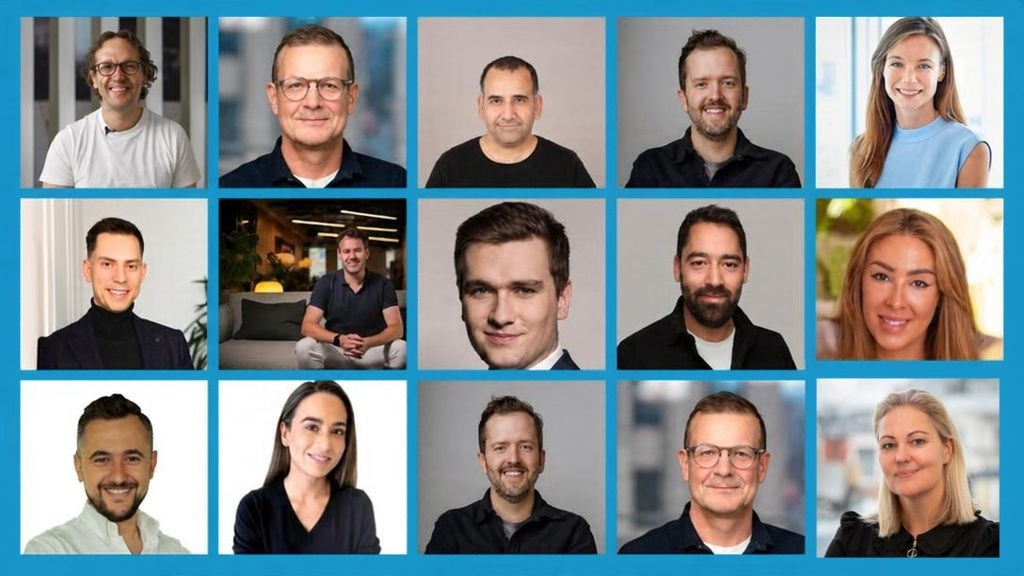
NDA gathered reactions to todays report from marketing experts across the industry. Here’s what they had to say about the new research:
Holly Dewsbury, Head of Agency Development, EMEA at Uber Advertising
“It’s encouraging to see advertising budgets bouncing back, particularly across online, video and out-of-home. But more spend doesn’t automatically mean more impact. As brands look to make the most of renewed investment, the challenge isn’t simply getting in front of more people. It’s making those interactions count.
“Consumers don’t live in channels; they live in moments. From the daily commute to deciding what to order or where to go next, people move between different needs and intentions throughout the day. These everyday moments reveal what people need, what they’re thinking about, and what they might do next. For brands, that’s an opportunity to move beyond simply being seen and become genuinely relevant.
“With investment in sales promotions also rising sharply, it’s important that brands don’t lose sight of long-term growth in the pursuit of immediate results. Brand-building and performance shouldn’t be treated as separate objectives. Great creative earns attention, context makes it relevant, and together they can turn everyday moments into meaningful business results.”
Adam Jabłoński, Head of Account Management Strategy, RTB House
“The latest IPA Bellwether report is an encouraging read as we head into the golden quarter. Total budgets reached a net balance of +14.3%, a nine-quarter high. As the report highlights, brands are seeing positive results from existing marketing campaigns and attracting greater investment.
“As spend increases, and AI search puts a premium on credibility and authenticity, brands need advertising that earns its place on the page. That starts with relevance: ads must meet people where their intention is. Deep Learning can read those intent signals at scale and turn them into more efficient, engaging campaigns.
“As we head into 2027, AI will continue to change how people search and discover. Brands that understand intent and respond with relevant creative will ensure extra ad investment drives incremental outcomes.”
Hannah Barnett, VP, Brand Sales, UK & MENA, LiveRamp
“With budgets increasing across every major media channel, there’s a real sense of renewed confidence in marketing investment. As brands look to capitalise on this momentum, the focus must be on understanding what’s working, making smarter investment decisions and ultimately driving measurable business growth.
“The sharp rise in sales promotion budgets is particularly interesting. While short-term activation plays an important role in driving immediate results, the greatest opportunity lies in balancing this with long-term brand building and customer value. Understanding which investments are delivering genuine incremental growth is key to achieving both.
“Proving results requires a clearer view of the customer journey, for which AI is a major opportunity. By streamlining processes and improving data readiness, marketers can see where spend is making an impact. Whether that’s in published brands, video, commerce media or AI search. That starts with first-party data that’s connected and ready to use through data collaboration partners. Without it, it’s hard to tell what these increased budgets are returning.”
Ed Wale, VP, International, LG Ad Solutions
Budgets rose in every main media category this quarter, with video budgets reaching their highest level in two years.
As investment grows, it’s a good moment to look at how people experience TV today. When viewers turn on their TV, the Home Screen is where they can discover what’s on. It’s one of the moments that sits alongside the programmes and services advertisers already know.
Understanding the full TV experience can help advertisers make more informed decisions about where video fits within their wider plans.
Thomas Ives, Co-founder of RAAS LAB
“UK marketing budgets hit a nine-quarter high, and video’s net balance of +9.8% is at a two-year peak. Advertisers are backing video, but it only delivers when the creative feels authentic and Relevant.
“Generative AI is lowering the barrier to entry, which creates the risk of returning to video’s old habit of chasing reach in any environment. Respondents are therefore right to point to human-centred experiences. In practice, this means using AI to fit creative to the moment a consumer sees it, not just produce more ads. This matters because bigger budgets rightfully bring closer scrutiny. Brands that match creative to the context it appears in will earn attention and be better able to show what their spend delivered. Those that simply use the extra budget for cheap volume will struggle to justify it.”
Mateusz Rumiński, VP of Product at PrimeAudience
“The latest Bellwether findings show marketing investment has remained resilient, making it increasingly important to get the most from that spend.
“In my Q2 comment, I talked about the importance of combining AI with high-quality data and human expertise. But the next step is thinking about the infrastructure that connects everything.
“Competitive advantage won’t come from AI alone or simply having access to more data. It will depend on how well the different parts of the advertising ecosystem work together. Too much programmatic budget still goes on broad audience segments built from historical behavioural data, which can quickly become outdated or lose accuracy.
“AI can help address this by understanding the meaning of each individual page in real time, rather than relying solely on keywords or domains. This gives advertisers another way to reach relevant audiences when they’re engaged with a topic, without relying on personal data.”
Kieran Greene, Founder & CEO, Shinka
“This latest IPA Bellwether report highlights continued growth in video investment and out-of-home budgets. But increased investment is only part of the picture. The industry also needs to ask whether the infrastructure used to buy and sell advertising is keeping pace with the market.
“In video and digital out-of-home, publishers are managing increasingly sophisticated inventory and multiple sources of demand. But more demand doesn’t automatically mean better returns. Fragmented technology and a lack of transparency can make it difficult for publishers to understand how their inventory is valued and whether different demand sources are competing on an equal footing.
“The key is making it easier for publishers to sell their inventory while retaining control over how it’s traded. Independent mediation allows different demand sources to compete in the same auction, giving publishers greater transparency into who is bidding and how their inventory is being valued. As investment grows, publishers need to ensure that growth translates into better returns, not just more complexity.”
Mateusz Kolodziejski, COO at GetResponse
“The latest IPA Bellwether Report shows UK marketing budgets recorded their largest upward revision in nine quarters, well above initial expectations for 2026/27. In particular, sales promotion budgets reached a net balance of +13.1% in Q3 2026. While it’s positive to see this renewed investment in marketing, businesses must ensure that it translates into tangible commercial results.
“Businesses are under increasing pressure to demonstrate the value of every pound they invest in marketing. Promotions can generate immediate sales, but the challenge is ensuring that initial engagement translates into long-term customer value.
“By having greater visibility over the customer journey, automating follow-ups and identifying where potential customers are dropping off, businesses can nurture promotional customers beyond their first purchase and encourage repeat buying. If brands want to see a return on their marketing spend, they need to look beyond short-term sales and focus on building lasting relationships that drive sustainable growth.”
Tom Ridges, CEO, Herdify
“It’s always exciting to see an increase in marketing budgets, but what stands out for me in the report is the recognition that brands need to build trust. AI is becoming an increasing part of everyday life, and while it is cited as both an opportunity and a threat, there is a chance for brands to differentiate through authentic, human experiences – which is why event budgets are still going strong.
“We’re seeing a broader shift back to the physical world. Consumers are actively seeking offline experiences, and the brands reaching audiences in the real world are building something digital channels can’t replicate, and that’s genuine brand trust. If you think about it, a recommendation coming from a friend over a coffee is likely to have a far greater impact than from an ad online.
“Behavioural science has shown for years that proximity and shared observation matter hugely; seeing the people around us engage with a brand makes that behaviour feel normal and socially validated. That’s social contagion, and its reach can have an impact on your brand far beyond any online campaign.
“So while marketing budgets move in the right direction, now is the chance to look beyond purely digital avenues, experiment with offline channels, and connect with your communities in real-world spaces where trust actually lives.”
Caroline Tredget, Commercial Director of Times Media
“It’s encouraging to see clear signs of optimism and growing spend amongst marketers and that reflects what we’ve been experiencing in the market over the last few months. As a cross-platform media business, for us all of the indicators in this research are pointing in the right direction – spend is growing in audio, in video, in events and in published brands which really supports our strategic direction. Where the indicators are lagging is sentiment within the industry, which remains negative. This is understandable after a period of economic uncertainty but it’s going to be those who identify and invest for growth that will make the best return in a growing economy.”
Matt Bahr, co-founder and CEO, Fairing
“It’s great to see the rebound in online advertising budgets, but the way consumers discover brands is changing rapidly, and marketers need to make sure their measurement is keeping pace.
“More purchasing decisions are being influenced by AI assistants, creators, podcasts and other channels that don’t always leave a measurable click. A customer might discover a product through ChatGPT or a TikTok influencer, then search for the brand days later to make a purchase. Traditional analytics often give search the credit, while the channel that introduced the customer to the product goes unrecognised.
“As budgets increase, brands need a clearer understanding of what’s influencing customers before they reach the point of purchase. Combining customer-reported attribution with existing measurement methods can help marketers make better decisions about where that additional investment goes.”
Maor Sadra, CEO & Co-founder, INCRMNTAL
“More marketing budget is great news. Unless you’re simply putting more money to waste.
“The sharp rebound in online advertising is encouraging, but if marketers are using bad signals to decide where budgets should go, it’s likely they’ll end up spending more on conversions that would have happened anyway. Just because a platform claims credit for a sale, it doesn’t mean it drove it.
“There’s an interesting contradiction here with budgets increasing yet business confidence still in negative territory, making it even more vital that marketers don’t assume that spending more naturally equates to growth. The question isn’t how much additional budget they can put into advertising, but how much additional business that investment will generate. That’s a very different question.”
Phil Acton, Country Manager UK, Adform
“Main media budgets hitting a nine-year high is hugely encouraging for the UK advertising industry. Seeing growth across every subcategory, particularly video hitting a two-year high (+9.8%) and out-of-home returning to growth (+3.6%), suggests brands continue to see value in channels that deliver broad reach and strong consumer engagement.
“At the same time, managing spend across video, DOOH, and online channels is often easier said than done. Ahead of the Autumn Budget, advertisers will look closely at how to make these larger budgets work smarter, especially when campaigns span multiple channels and the risk of wasted spend increases.
“That’s why agentic AI is becoming increasingly useful for media buyers. It can analyse live data, automate workflows and shift budget towards what’s performing best, helping teams make quicker, more informed decisions and get more from their omnichannel campaigns while making every pound count.”
Julie Selman, SVP, Head of EMEA at Magnite
“The latest IPA Bellwether certainly paints a bright picture ahead of one of the most important quarters in the calendar for retail. With this strong upward revision to marketing budgets ahead of Q4, there’s reason to be optimistic as we head into 2027.
“What’s particularly interesting is how online marketing has received the second-highest reading in the series history since Q1 2022, followed by a rise in marketing spend in video. These trends signal shifting consumer habits and how brands are responding by prioritising addressability in addition to scaling their programmatic access to where people are tuning in.
“Crucially, this is changing the rules of engagement during different parts of the viewing experience, while publishers can take advantage of previously untapped areas of the viewer experience as part of their advertising strategy. If investment in these areas continues, it will only accelerate CTV’s future as a full-funnel performance engine.”
Simon Davies, Senior Vice President, EMEA, UK, Zeta Global
“Marketing investment is increasing even as the broader business outlook remains cautious. The opportunity now is to turn that investment into measurable growth. AI can help marketers better understand customers, identify changing needs and adapt campaigns more quickly. As AI-led search reshapes how people discover brands, that ability to respond in real time will become increasingly important.
“The strongest results will come from bringing data, activation and measurement closer together, giving teams a clearer view of what is working and how to improve it.”
Paul Samuels, President – Global Partnerships at AEG International
“Positive signals from the economy are building consumer and business confidence. Consumers are spending more – albeit with hesitation – and companies are increasing their marketing budgets to drive preference and demand.
“Brand equity is the name of the game, with PR and event budget growth outpacing other channels as companies seek to drive preference and credibility over immediate conversions in response to the increasing use of AI for product discovery. We continue to see strong demand for live event partnerships, with brands recognising the impact that emotion can have on attention, perception and intent.
“We’re also seeing a change in the way brands activate at live events. More are focusing on how they can ingratiate themselves with fans, finding ways to make their experiences even more memorable and appealing to their lifestyle ambitions. With upward revisions reaching a nine-quarter high, the appetite for events shows no sign of slowing: We welcomed 15 new partners at this year’s All Points East, while our partnership with Virgin Media O2 at The O2 was extended by another 10 years just last week.”