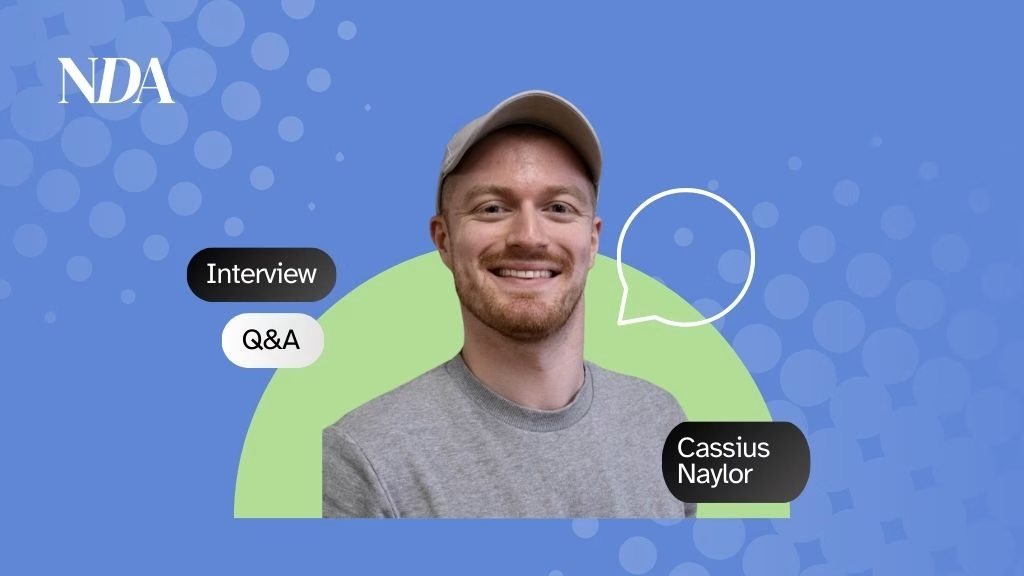
As Cassius Naylor steps down from the role of Advocacy Co Director at Outvertising, he reflects on seven years of change, and the development of the organisation’s Outvertising Playbook. In this conversation with New Digital Age Editor in Chief, Justin Pearse, Cassius looks back at the evolution of the role, the industry’s shifting approach to LGBTQIA+ inclusion, and what comes next.
Why did you join Outvertising, and how did your role there begin to take shape?
It is funny looking back now because it has been nearly seven years. When I joined in 2018, the organisation was still called Pride AM and felt far more like a social group than an operational body. It was an advisory board of about 30 people and we were much less formal than we are now.
At first I was part of the commercial team, then became involved in the early conversations about forming an advocacy function. It was really the pandemic that pushed us to get better at organising with little resource and limited bandwidth. Because I am not trans, I was able to operate in the space with the emotional distance needed to sustain the work.
How did the advocacy role evolve during your time in it, and what are you most proud of achieving?
We knew we wanted Outvertising to have a stronger outward presence, a more political voice. We were seeing clear links between the advertising industry, the money that moves through it, and the political environment. Hate crime was rising, and as an industry we could not ignore the connection between ad spend and societal impact.
When I took over, we were midway through a campaign called Hate Free Advertising. But I felt we were not clearly articulating what we actually wanted companies to do. We had a line about making UK advertising completely LGBTQIA+ inclusive. I took that and asked what it would mean in practice. If a CMO came to me and said they wanted to live that philosophy, I needed a detailed answer.
That is where the playbook began. It has become my magnum opus and I think it will remain my legacy at Outvertising. It set out a manifesto for what we want from the industry, giving everyone else in the organisation a strong platform to engage with companies about the how.
The other achievement I am proud of is establishing Outvertising as a more prominent voice. We were not doing anywhere near as much press before Marty and I got involved. Getting Lucy McKillop onto the BBC felt like a moment where the organisation really entered the broader conversation.
Tell me more about the playbook, the impact you have seen it have, and where you hope it goes next.
We went very wide with it. There is always tension between brevity and comprehensiveness, and I leaned toward the latter. I wanted it to be a bible people could draw from. When we first developed it, I brought together a large group of practitioners from across the industry.
We created a document that moved beyond representation in ads and looked at the symbiotic relationship between internal practices and external output.
Historically, Outvertising focused on representation in campaigns, but I wanted to centre what I call the inclusion infrastructure. Things like policies, staff networks, executive sponsorship, internal language, and processes.
You cannot have inclusive work without an inclusive workplace. That framing, the idea that internal change drives external change, has been widely adopted. People tell us the playbook helped them think about inclusion more holistically.
I hope the playbook continues to shape how organisations understand their responsibilities. Money talks, and if we can position inclusion as integral rather than ornamental, we will see real progress.
How optimistic do you feel about the future of this work?
I am cautiously optimistic. People who are still investing in this work genuinely believe in it because they are doing it despite political headwinds. A few years ago, during the end of the Biden administration, many people thought the argument for DEI had been won and it was just a technical challenge. The last year has shown that was not the case.
The big public gestures have become riskier, which has pushed companies inward. That is not necessarily a bad thing. This quieter period has created space for deeper internal work on policy, process, and people. When this period of backlash passes, organisations that invested internally will be much better positioned to act externally with integrity and impact.
How have you seen organisations apply the playbook differently?
It varies widely. We always said people should take the playbook as a template then create a bespoke version that suits their organisation. Some focus on staff networks, some on policy, some on internal communications. All are valid.
For some organisations it sits within comms, with employee communications acting as the DEI function. For others it remains within HR. Some have even made it a leadership priority. I often say that if you do not have space for a dedicated DEI lead, the CEO becomes the DEI lead. The principles are universal, no matter where they sit.
Finally, how broad should Outvertising’s remit be as the industry expands far beyond traditional advertising?
It is a challenge for a volunteer-run nonprofit with limited resources, but the industry is now a complex ecosystem of media, technology, and advertising. You cannot pursue change without considering all three. We are already bringing in more interdisciplinary voices, from strategists to technologists. Inclusion cannot stop at advertising. Every choice made across the ecosystem affects the society we all live in.
We hold enormous cultural power in this industry. Recognising that, and using it responsibly, is more important than revenue alone.