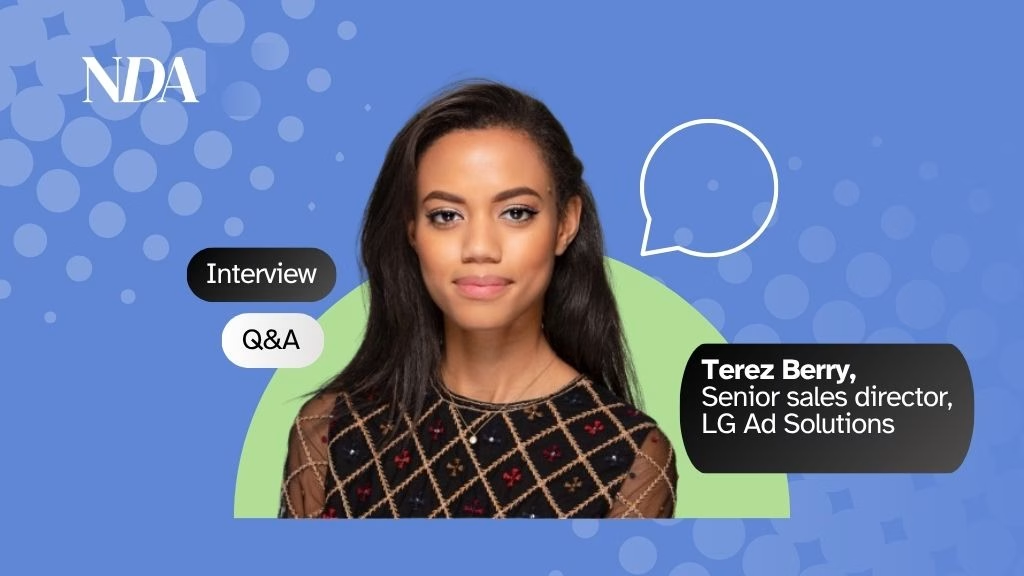
Following International Women’s Day earlier this month, New Digital Age spoke to Terez Berry, Senior Sales Director at LG Ad Solutions, to find out how we can all continue to support women in the digital media space throughout the year ahead…
What are the biggest current challenges to achieving equity in the digital industry?
There’s no doubt progress has been made in the digital industry, but true equity requires more than performative gestures; it demands intentional action. Achieving it means addressing structural issues in hiring, promotion, and leadership, rather than focusing solely on ‘people’ policies. Leadership diversity is especially important, as the perspectives shaping strategy influence whose voices are heard and valued.
Inequities persist in tangible ways. For women who choose to have children, unequal parental leave is still a problem. Career breaks such as maternity leave deepen gender pay disparity, meaning that women often end up with smaller pensions over the course of their working life, which impacts their long-term financial security. Even everyday costs, such as women’s personal care products, illustrate systemic barriers through the ‘pink tax’.
Closing these gaps requires a holistic approach: cultivating inclusive cultures, redesigning structures, and tackling economic barriers together. Only then can workplaces truly become equitable spaces where talent of all genders can thrive.
Are you worried that the growing use of AI might have a negative impact on diversity initiatives in our industry?
AI is a powerful tool but if it isn’t designed carefully, it can reinforce existing inequalities and biases. Many systems rely on historical data, which can inadvertently lead them to learn and amplify human prejudices.
The teams building AI are often not diverse, which increases the risk of bias being embedded into algorithms. AI is frequently presented as neutral, yet the logic behind decisions is too often opaque, making it harder to scrutinise than human choices.
With inclusive design, fairness testing, and ongoing accountability, AI has the potential to support equity rather than undermine it, but only if we remain intentional about addressing bias at every stage of its development. This is where the industry has a responsibility to set standards now, before these systems scale further.
What is the biggest opportunity for women in your sector of the digital industry today?
While Linear TV has traditionally been male-dominated, the rise of Connected TV (CTV) offers an exciting chance to shape a new space. We’re seeing more women step into leadership roles and influence how success is defined here. The upshot of this is that CTV products are being built with inclusivity in mind, and audiences are more fairly represented.
There’s a major opportunity in this space to design systems that support equity from the ground up, while creating a culture where diverse voices are heard and valued. Being part of an evolving sector means women can leave a real mark, not just on their own teams, but on the industry as a whole.
What support structures and organisations are most important and effective to you as a woman in the digital industry?
Those in positions of power who advocate for women are invaluable. Not just in public, but particularly behind closed doors, where the real decision-making takes place.
Networks such as Bloom and Women in Programmatic also provide safe spaces to share challenges and learn from others’ experiences, offering guidance and mentorship.
Equally important are everyday conversations with colleagues and friends who understand the realities of working in this industry. Together, these structures help women navigate challenges, build confidence, and feel supported as they grow their careers.
What is the biggest misconception about women and by women in the digital industry?
The biggest misconception about women is that assertive women are often labelled as ‘aggressive’, whereas men exhibiting the same behaviour are rewarded. In reality, emotional intelligence and diverse leadership styles are highly significant advantages in a fast-moving, collaborative industry like digital advertising. Teams benefit from leaders who bring empathy, insight, and varied perspectives, which ultimately drives better decision-making and innovation.
What is your advice to anyone in a junior position who wants to engender change within their own organisation?
I’d suggest starting with the areas where you know you can make an impact. If you see bias in the workplace, be inquisitive and ask questions: Are campaign strategies inclusive? Are audiences represented fairly? What could be done differently? In asking these questions, you’ll be able to build a case for what needs to change and how it can be actioned.
I would also stress the importance of building allies. There is real power in combining voices, especially if you are in a more junior position, where you may not have as much perceived power as senior colleagues. Getting a cohort of colleagues together to speak up on certain issues and challenge the way things are done can be a really powerful way of influencing change.
As a final point, I’d say it’s important to celebrate all wins, no matter how small, both internally and externally. Small, deliberate actions can spark meaningful change and over time, truly transform your organisation’s culture.