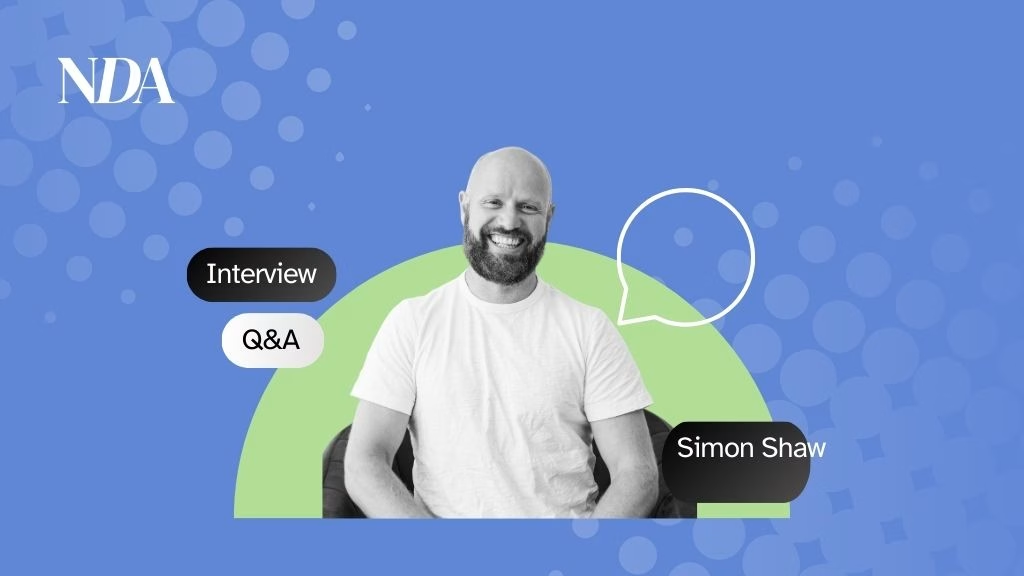
As AI reshapes the marketing landscape, new players are emerging that promise more than incremental improvement. NDA’s series AI Marketing Pioneers explores these companies. Next up we sit down with Simon Shaw, CEO of Fifty Technology.
What does Fifty Technology do, and how has its audience modelling evolved?
We’re fundamentally a data and technology company working in marketing, and our core capability has always been mapping and understanding audiences at a global scale. We combine publicly available social and web data with a network science approach, allowing audiences to effectively segment themselves rather than forcing them into predefined categories.
That enables us to go to a brand and quickly model its specific audience, compare it to competitors, or analyse how audiences around particular trends are evolving.
We’ve been building and refining those models for around a decade, but AI has accelerated what we can do enormously. Our point of difference has always been visualising audiences and connecting that understanding directly to media activation.
Over the past three years, AI has allowed us to become far more granular and customised in how we translate audience insight into actionable planning. It has reshaped how clients perceive the business, the kinds of clients we can work with, and the speed at which we can deliver meaningful outputs.
In many ways, we’ve been on that journey from the start, but the pace of progress now is significantly faster.
What do you mean when you say audiences segment themselves?
Traditional adtech signals tend to be quite singular, such as the content of a webpage or a basic identity signal. We’ve never approached audiences that way. Instead, we look at how multiple behaviours and signals connect across a network.
Using graph modelling, clusters emerge naturally based on how people behave and interact digitally. Humans rarely exist as a single homogeneous group, so you see multiple subclusters forming around interests, behaviours, or cultural signals.
For example, when brands come to us with persona-based segmentation, we can test how those audiences actually manifest in the real digital environment across the UK or globally. Often, the reality is more nuanced than internal personas suggest. Every client engagement is bespoke.
We don’t rely on predefined segments, although having conducted thousands of studies globally, we understand how certain audiences typically form. Even then, the shape of a sporting audience will differ depending on whether you’re analysing it for Nike, Decathlon, or another brand entirely.
Has AI become less of a talking point for clients and more of an everyday tool?
In many cases, yes. Clients don’t really care about AI as a concept. What they care about is fast, accurate, high-performing outcomes. AI is simply the mechanism enabling those results.
It has transformed what we can deliver, and our capabilities in areas like audience modelling and planning are effectively doubling year on year.
In that sense, AI is becoming commoditised. You don’t ask whether your accountant uses Excel, but Excel fundamentally changed the accounting profession. AI is similar. It’s deeply disruptive, but it becomes embedded so quickly that it stops being remarkable.
Marketing, in particular, has adapted relatively quickly because the industry was already heavily digitised. We’ve gone through multiple waves of technological disruption, from programmatic to automation, so there’s a cultural readiness to integrate new tools into workflows.
Where do you see the most significant disruption happening in the marketing ecosystem?
The biggest impact will be on structural silos within agencies and adtech businesses. Historically, planning, strategy, creative, buying, and reporting have existed as separate functions, sometimes even across separate organisations. That structure was built in a pre-AI world.
AI allows those processes to become connected and continuous. In our platform, technology acts as a kind of golden thread linking audience insight directly to planning and execution. That dramatically reduces friction. The traditional siloed model slows everything down, whereas AI enables speed, agility, and integration.
To give a practical example, we can go from having no defined audience to producing a fully built media plan, including targeting and channel allocation, in under a minute. For some global brands, that process historically took months or even a year. Now both realities exist simultaneously, and organisations must decide how to adapt.
Those that remain siloed will struggle to compete with more integrated, technology-driven models.
How quickly do you think AI’s broader economic impact is actually being felt?
If you zoom out, the technology is advancing extraordinarily quickly, arguably faster than many people realise. But the measurable economic impact at scale is sometimes slower than headlines suggest.
Large global businesses are still working out how to integrate AI deeply enough to transform their cost structures and operating models.
Marketing is slightly different because we’re already very technology-enabled. You can see real adoption happening, and real efficiencies emerging. That said, there is still a gap between the potential of the technology and its full operational implementation. We’re in a transitional period where the capability exists, but organisational change takes time.
What does this mean for jobs and talent within the industry?
I think AI makes the best people dramatically more effective. The most talented strategists, analysts, and planners can amplify their output significantly using these tools. That’s always been true with technology, but the multiplier effect is becoming more pronounced.
At the same time, it creates challenges, particularly for entry-level roles. Historically, junior positions existed partly to perform labour-intensive tasks that are now automated. That changes how people enter and learn within the industry. We’ve always believed strongly in bringing in young talent and developing it, and that remains essential, but the pathway is evolving.
More broadly, I think we’ll see roles shift rather than simply disappear. There will be greater emphasis on strategic thinking, interpretation, and creativity, areas where human judgement remains critical.
AI handles repetitive and analytical tasks extremely well, but the ability to define the right questions, interpret nuance, and connect insights to real-world business outcomes is still fundamentally human.
Ultimately, AI is both an efficiency engine and an augmentation tool. It raises the ceiling for what organisations and individuals can achieve, but it also forces structural change. The next few years will be defined by how effectively companies and talent adapt to that new reality.