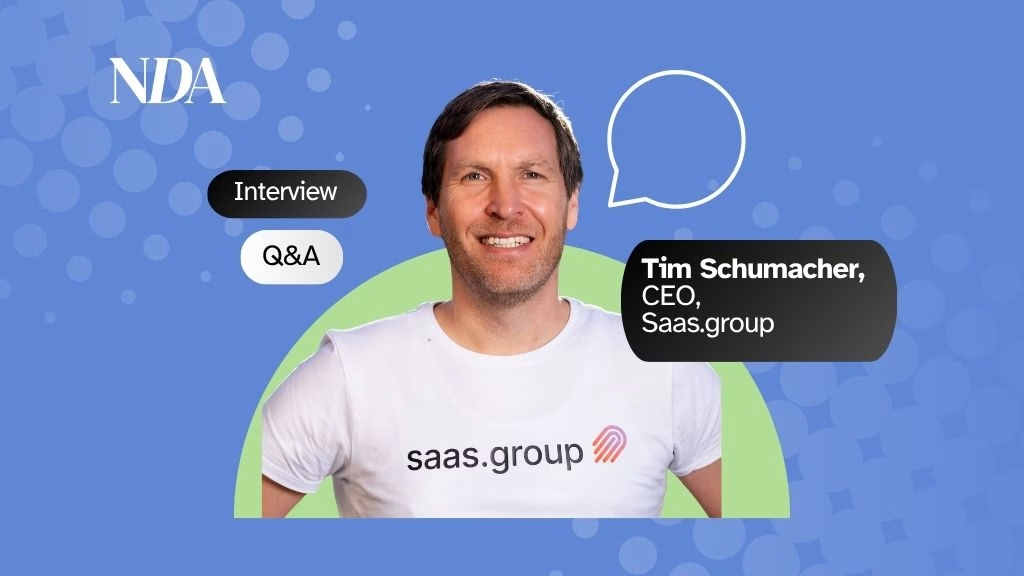
The traditional venture capital model is often characterised by a high-stakes race to find the next “unicorn.” However, TimSchumacher, co-founder and CEO of Saas.group, is proving that there is immense value and sustainability in a different path. By focusing on profitable, independent SaaS products that have already found their footing, Schumacher’s team is building a sprawling community of software businesses that prioritise longevity over hype.
We sat down with Tim to discuss his entrepreneurial journey, the criteria for a winning acquisition, and how AI is fundamentally shifting the software landscape from a “system of record” to a “system of action”.
Tell us about your background and how it led to co-founding saas.group.
I’ve been an entrepreneur my whole life, starting with coding software as a teenager. My first major venture was Sedo.com, which became the world’s largest secondhand platform for domain names. After running that for a decade and exiting, I spent time as an angel investor, but I discovered two crucial things about myself: I love the operational side of running a company, and I am much better at “1 to 10” than “0 to 1”.
I realized there are many brilliant developers who build a great product, reach a few million in revenue, and then get bored after five or six years. These businesses are “too big to die, but too small for private equity”. I saw an opportunity to buy these projects and run them independently with dedicated operators, building a community of independent SaaS products as an antithesis to monolithic “Big Tech”.
How does your acquisition strategy differ from those chasing tech “unicorns”?
While the traditional model chases massive scale at any cost, we identify businesses that have already proved they have a viable product and a loyal audience. Often, these originators are brilliant at the “idea” phase but lack the interest or skill set for the long-term building of a business back-office. We step in to provide that operational clout and marketing expertise to take them to the next level.
Digital marketing and ad tech is a cluttered space. How do you select the businesses you want to acquire?
It is cluttered because it is so easy to bootstrap a SaaS product, but you must solve a problem better than anyone else for a specific target group. We look for niche specialists, by which I mean businesses that “nail” one specific problem. For example, we have a business that exclusively handles pre-rendering for JavaScript-heavy sites so search engines can index them.
We’re also interested in companies that serve European markets with a focus on GDPR and data sovereignty, which can be a significant competitive advantage over large American generalists.
Finally, pricing efficiency is an important criteria for us. We’re looking for nimble developers who can undercut the heavy pricing of big enterprise tools.
How are you responding to the fast-evolving state of AI?
AI is shifting software from being a system of record (organizing info) to a system of action (executing tasks). Historically, software supported human decisions; now, AI-enabled products can execute tasks end-to-end.
This is both a threat and an opportunity. Some products become obsolete; others are in a tough position right now. However, for others, the ceiling for growth increases because we are no longer just competing for software budgets; we are competing for labor budgets. Our priority is loading our products with AI layers or connecting them into the new “vibe coding” builders like Cursor and Lovable where developers are working today.
From a marketing perspective, what support are brands looking for right now?
The core needs haven’t changed as much with AI as you might think. Founders often enjoy the tech and the customer service, but they want to get rid of the “boring” parts: HR, finance, and operations. On the marketing side, many are technologically strong but struggle with execution. They come to us for a marketing team that can employ standard, high-quality practices to take a good product to the next level.
What are Saas.group’s big priorities for the year ahead?
Beyond navigating the AI transition across our portfolio, our goal is aggressive growth. We are aiming to acquire 6 to 7 new businesses this year, specifically looking for those with a few million in revenue. Overall, we want to acquire between $30 to $40 million in SaaS revenue this year and are actively looking for entrepreneurs ready for their next chapter.