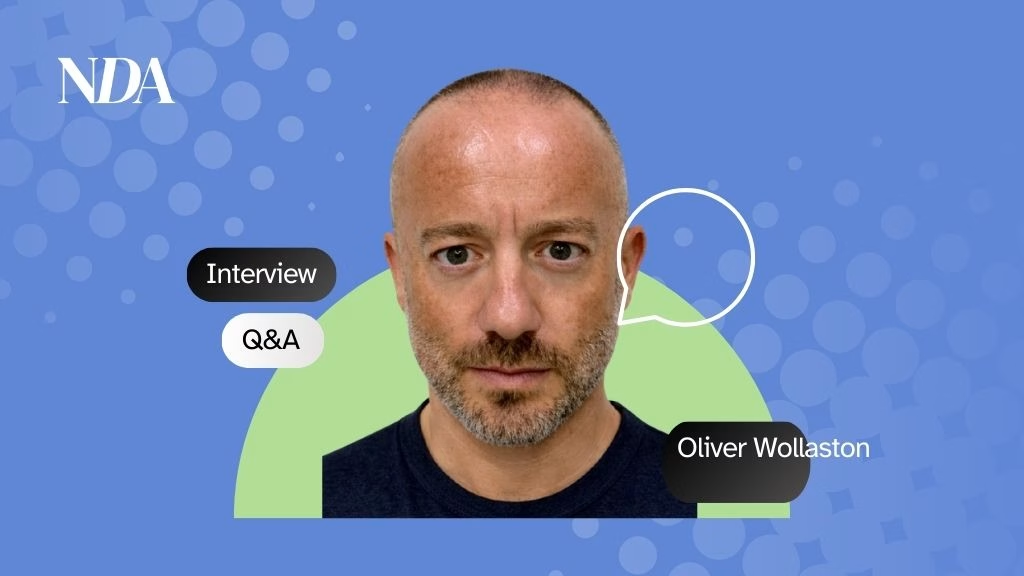
While the industry obsesses over GEO and the latest AI-driven search developments, some of the most commercially impactful innovation is happening elsewhere, in the space where art meets science. For Oliver Wollaston, Managing Partner at Alchemy Network, creative technology is not just another trend cycle, it is one of the most significant structural shifts he has seen in more than two decades in media.
Justin Pearse, Editor-in-Chief of New Digital Age, sat down with Wollaston to discuss the explosion of adtech solutions, the rise of GEO, and why creative tech is seeing such momentum.
You spent more than 20 years agency side. What led you to Alchemy Network?
My background is entirely agency side. I spent over two decades there, first at Mindshare and then 16 years at Dentsu. In my final five years at Dentsu, I was actually a client of Alchemy. We used its services to help drive innovation across a number of accounts.
Like most network agencies, we were constantly being measured on client satisfaction, often through a simple question, how likely are you to recommend us. One of the recurring themes in feedback was innovation. Clients would say the plan this year looks very similar to last year’s. They wanted to see new partners, new formats, new thinking.
Alchemy helped us discover solutions that sat in that 10 percent innovation bracket of the 70, 20, 10 model. It was about identifying emerging tech that could be tested and, if successful, scaled.
When the opportunity came up to join, it felt like a natural evolution. I had seen the value from the client side.
What exactly does Alchemy Network do?
The simplest way to describe it is that we are a curated matchmaking service between brands, agencies and tech partners.
There are now more than 20,000 adtech and martech solutions in the market. Whether that number is 18,000 or 23,000 almost does not matter. The point is it is overwhelming. Faced with that level of choice, most marketers default to the big, global platforms. They are excellent, but if everyone uses the same platforms in the same way, differentiation becomes difficult.
We run what we call discovery sessions. These are typically one-hour quarterly virtual sessions where we introduce a brand or agency to three tech solutions that are relevant to their brief. That brief can be very specific, for example, we are reviewing our CRM partner. Or it can be broad, such as, we do not know what we do not know, show us what is interesting in the market.
We curate both sides. Clients can effectively approve who they meet, and tech partners can also approve who they are introduced to. That way both parties are genuinely interested in the conversation.
How do you navigate such a crowded market and ensure quality?
It is a lot of work. We attend industry events, we network extensively, and we have a team dedicated to sourcing and vetting tech partners. Just because a company has funding does not mean it automatically gets onto our programme.
We ask tech partners to pitch to us. We need to be confident that the solution is genuinely differentiated and innovative. If it is simply another DSP with no meaningful point of difference, it is not going to add value for our clients.
Quality control is ongoing. We collect feedback after every session. If we see a consistent pattern of poor feedback, we will remove that partner from the programme. It protects the integrity of what we do and ensures value on both sides.
What are the biggest trends you are seeing in the market today?
There are two clear themes.
The first is GEO. Over the past six to nine months, interest has surged. When more advanced AI tools became mainstream, usage broadened dramatically. Now everyone is using generative AI in some capacity, whether for research, planning or decision making. Naturally, marketers are asking how they optimise for that environment.
Interestingly, demand is currently outstripping supply. There are fewer mature GEO solutions than there is interest from brands and agencies.
The second, and for me the more exciting long-term trend, is creative tech.
Why is creative tech so significant right now?
Marketing has always been described as a blend of art and science. Media has historically been seen as the science, highly optimised, data driven, constantly refined. Creative has often been positioned as the art.
What we are seeing now is the introduction of science and rigour into the creative process without undermining creativity itself.
There are practical efficiencies, such as automating creative reformatting across multiple channels. Brands spend significant budgets producing central assets, then spend more time and money adapting them for different platforms. Automation can dramatically reduce that burden.
More interestingly, there are solutions that bring predictive analytics into creative development. Tools that use historical eye-tracking data and synthetic data to predict attention and performance metrics before assets go live. That means brands can launch a single optimised version rather than producing multiple variants and testing them live at cost.
It shifts conversations from subjective opinion, I think this works, to evidence-based decision making.
Is there equal demand from both brands and tech providers in these areas?
With GEO, demand from brands and agencies is very high. Supply is still relatively tight, so we see fewer GEO partners actively seeking introductions because they are already busy.
Creative tech is slightly different. Many brands come to us with business challenges rather than asking specifically for a creative tech solution. They might say we are spending too much time adapting assets, or our creative debates are taking too long. From there, we can identify relevant solutions.
For me, that is where the real opportunity lies. Not just chasing the headline trend, but solving meaningful operational and performance challenges through smarter use of technology.
And if creative tech continues on its current trajectory, it could reshape how the industry balances art and science for years to come.