Prescriptive analytics gives marketers concrete and detailed recommendations on individual customers and how to engage them. Driven by AI, the technology is gaining new popularity among marketers looking for guidance and support.
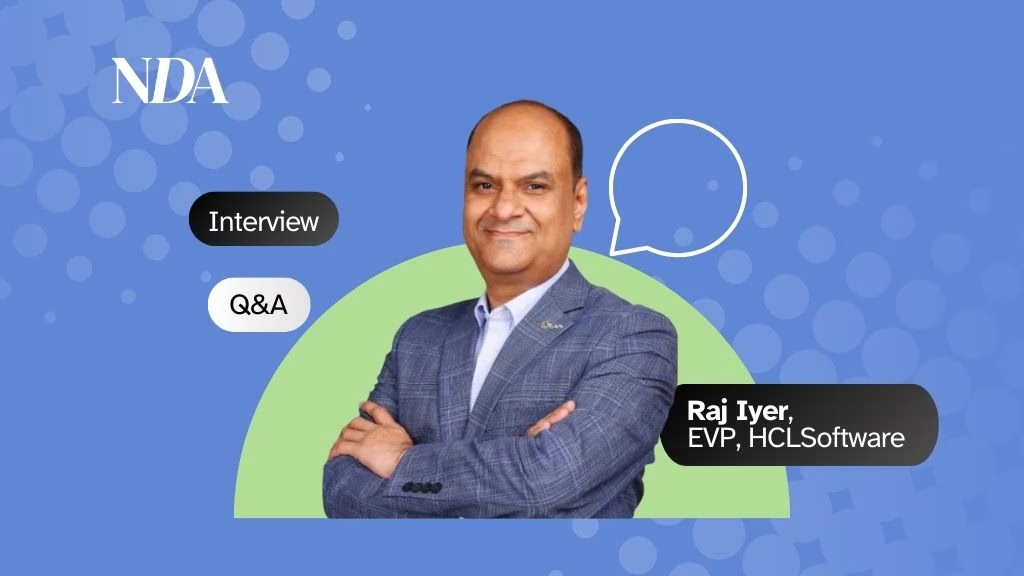
NDA spoke with Raj Iyer, Executive Vice President & Portfolio Manager at HCLSoftware to find out more…
What is Prescriptive Analytics and why is it a hot topic now?
Prescriptive analytics transcends mere predictions, empowering you to answer the most critical questions about the optimal course of action. Instead of simply forecasting, it guides you toward strategic decisions. For instance, it can determine the price point that maximizes revenue, identify the marketing channel yielding the best return, or pinpoint the offer that prevents customer churn.
Essentially, prescriptive analytics tells you precisely what to do next. It meticulously analyzes your data, anticipates future outcomes, and then recommends the most effective action to achieve your desired results. In essence, prescriptive analytics transforms your raw data into a clear, actionable plan for improved performance.
Where predictive analytics tells you the chance of rain, prescriptive analytics tells you to bring an umbrella.
To what extent will prescriptive analytics transform marketing?
A recent survey revealed that 83% of CMOs are pressured to enhance their ROI, while 75% of marketing organisations struggle to achieve more with fewer resources. Prescriptive analytics represents a significant transformative force in marketing, shifting the paradigm from reactive strategies to proactive engagement.
Organisations that have embraced it are reporting impressive first-year ROIs of up to 500%. Prescriptive analytics achieves these returns by accelerating marketing organisations’ ability to adapt to change and significantly improving their overall ROI. We’ve observed that integrating prescriptive analytics with conversational AI can effectively provide every marketer with a personalised advisor.
Why hasn’t it taken off before now?
While effective applications of prescriptive analytics, such as Next Best Offer (NBO) and Next Best Experience (NBX), have been in use for many years (a capability long present in HCL’s Interact product), the current surge in its adoption can be attributed to the convergence of several pivotal factors.
The first is data availability and infrastructure. Fundamentally, analytical challenges are rooted in data. The accelerated digital transformation during the COVID-19 pandemic, the widespread adoption of Customer Data Platform (CDP) technologies, and advancements in real-time data processing capabilities have collectively established a robust foundation for further progress in artificial intelligence, particularly within diagnostic, prescriptive, and agentic AI domains.
What’s more, computational power has consistently advanced, and the increasing accessibility of GPU farms has significantly facilitated the development and training of more extensive and complex models.
There’s a growing acceptance of AI among the public. Generative AI has elevated public expectations for artificial intelligence, and Agentic AI has further propelled these expectations toward proactive, AI-driven actions. Historically, the investment required to leverage prescriptive analytics was substantial, leading to very limited adoption. These recent changes are now enabling HCL to help many more customers truly harness the power of prescriptive analytics.
What are some examples of this technology already in action? What results has it delivered?
This technology is currently delivering demonstrable results across various applications. For instance, “next best offer” and “next best experience” (NBO/NBX) represent robust implementations.
Consider a scenario where a customer navigates to specific products; the system immediately proposes a personalized discount or relevant content. This has led to a remarkable 300% increase in conversion rates for some organizations by presenting the precise offer a customer is most inclined to accept at that particular moment. This also contributes to a reduction in the volume of irrelevant communications received by customers, thereby enhancing the impact of each interaction.
Beyond NBO/NBX, numerous email service providers utilize send time optimization, employing prescriptive analytics to determine the exact moment each individual subscriber is most likely to open and click an email. Companies such as OneRoof have observed substantial improvements, with a 218% increase in total clicks to property listings using this methodology.
Brands additionally leverage channel affinity to ascertain customers’ preferred interaction channels, ensuring messages are delivered via their favoured platforms. This entails sending an SMS to an individual who consistently responds to text messages and an in-app notification to another, thereby increasing overall engagement.
Finally, journey recommendations direct customers along personalised pathways informed by their real-time behaviour, seamlessly progressing them from initial interest to purchase and beyond. These are not theoretical concepts; rather, they represent tangible, measurable enhancements that businesses are currently achieving.