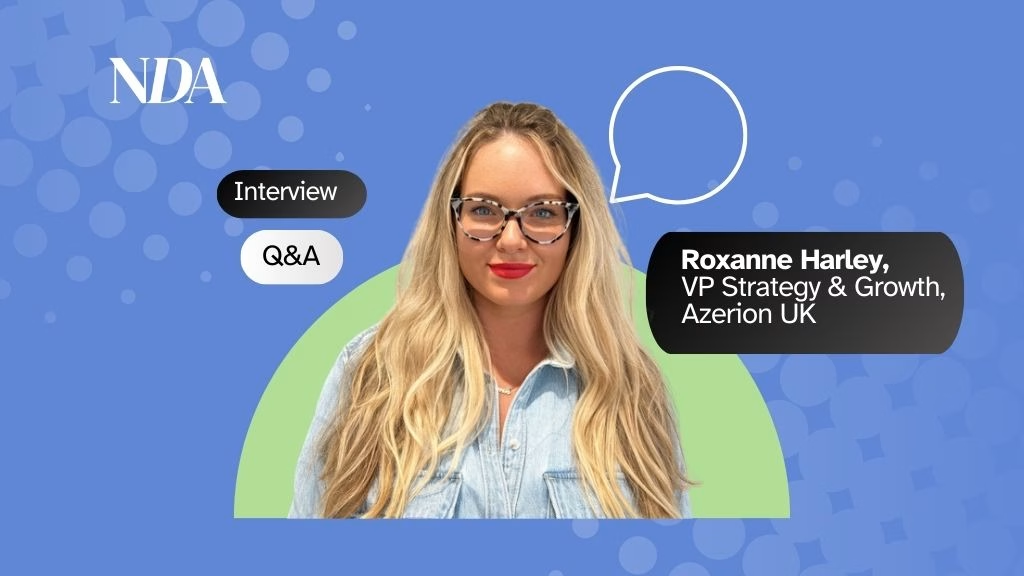
Omnichannel advertising platform Azerion recently promoted Roxanne Harley to the newly-created position of VP Strategy and Growth in the UK. Previously Azerion UK’s head of growth, Harley has been instrumental in bringing together the company’s marketing insight, research, and sales initiatives.
New Digital Age recently spoke with Harley about her new role and more…
What are the key priorities for you in this new role?
I’ve actually been with Azerion for around five years in total. I originally worked at Collective, which was later bought and brought into the UK by Azerion, so we merged and rebranded. Since then, it’s been quite a journey with lots of mergers and acquisitions along the way — it’s been a really fun ride.
My new role is to continue building out the planning and strategy capabilities that we offer to clients, to ensure teams are delivering excellent sales enablement and brand response to briefs. There’s also a focus on designing the best creatives, across every omnichannel outlet, and delivering top notch client success with measurement frameworks.
What that means in practice is ensuring our teams work together in a more cohesive way and that we’re using all the knowledge and expertise we have across the entire lifecycle of how we work with brands. From the first response to a brief and the initial idea, through to the creative build, optimisation and ultimately the outcomes. It’s about making sure everything we deliver is at the utmost level of excellence.
All these aspects will help to elevate the Azerion brand and make sure we are seen as thought leaders in the market.
From your perspective, what kind of support are clients most commonly looking for right now?
I’d say clients are asking for product innovation. They want strategic intent, but they also want clarity.
The industry and the media landscape are more complex than ever. We’ve got so many channels, platforms and measurement frameworks, and brands want partners that can simplify that complexity while still delivering the outcomes they care about. And when I talk about outcomes, I don’t mean just hygiene metrics — I mean tangible brand building or sales impact.
From the conversations I’ve been having with planners and strategists recently, there’s also a big appetite for better ways to understand audiences. It finally feels like we’re moving away from the old-school thinking of “I just want to target ABC1s” and instead focusing on more personalised experiences.
There’s a growing appreciation of things like category entry points, audience receptivity and consumer mindsets. Brands are asking for help understanding consumers at that level, but they also want that strategic thinking to carry through into activation.
What advice would you give brand marketers navigating the fragmented media landscape today?
For me, the most important thing is not to start with the channel. Start with the audience.
There are so many options available now and so much fragmentation. The strongest media strategies begin with understanding where audiences are, where they’re spending their time, what mindset they’re in and how those different audiences influence behaviour.
Media can’t really be separated anymore. The best campaigns look at the message, the environment and the audience together and they measure them together as well.
The brands that learn the fastest and adapt the quickest are the ones that will ultimately see the best outcomes. Even with all the uncertainty and consolidation happening in the market, we shouldn’t lose sight of what our industry is great at, which is innovation. Testing, experimenting, trying new strategies – that passion for research and evolution is really important.
Are there any noticeable trends in terms of the channels that brands are allocating budgets to?
We’re seeing strong momentum behind channels that combine premium environments with digital addressability. Audio is a major focus, some of the biggest campaigns we have run this year are in the audio space. As well as being the second most receptive (to advertising) channel, audio also gives brands access to broadcast-quality environments with more flexible targeting and measurement. Combine that with AI and personalised creative that we can now do at the press of a button and it becomes a really exciting space.
Azerion is launching a new product called the Azerion Mind Map. Can you tell us more about that?
Product innovation is a big priority for us, and the Azerion Mind Map is something I’m really excited about.
It’s essentially a tool that enables brands and agencies to deliver ads at the moments when audiences are most receptive to receiving brand messages. It brings together a lot of the ideas I’ve been talking about: designing the channel mix around receptivity, adapting creative, understanding the audience and supporting it all with data science.
At the heart of it is a receptivity index that helps identify when people are most open to engaging with a message. Our focus now is rolling this out, educating clients and speaking with strategy and planning teams more than ever to understand what they need and how they can use the tool.
We now have access to real-time signals and huge amounts of data. Matching those signals with planning is really interesting, because it allows us to test whether this approach drives stronger outcomes, whether that’s more sales or increased brand awareness compared to more static demographic targeting like “male, 15–34”.
That next evolution will be putting the testing and measurement frameworks in place to prove the effectiveness.
Following International Women’s Day, what’s your perspective on progress for women in the digital media industry?
I think things are changing for the better, but there’s still a long way to go.
When I first joined digital media, after starting my career in cinema advertising, I was actually the first female salesperson in a very loud group of salesmen. It was fantastic and I learned a lot from them, but it does show how much the industry has evolved since then.
At Azerion UK today, our senior leadership team is more than 50% female, which is great. There’s also far more flexibility in the industry now, particularly around things like working from home and being able to pick up your children without the guilt that people might have felt in the past.
That said, there’s still a lot of work to do, especially around the gender pay gap. Companies really need to reflect on what they pay, who they pay and how they pay it, to make sure women aren’t missing out on opportunities.
Maternity leave is another area that needs attention. What is it like for someone returning to work after time away? Do they have the support they need? It can be overwhelming coming back into a role in an industry that evolves so quickly. The job you left a year ago might not be the same when you return.
So there’s definitely progress, but we can still do better in terms of support, closing the pay gap and ensuring women have opportunities to build their profiles, speak on panels and take up leadership roles.