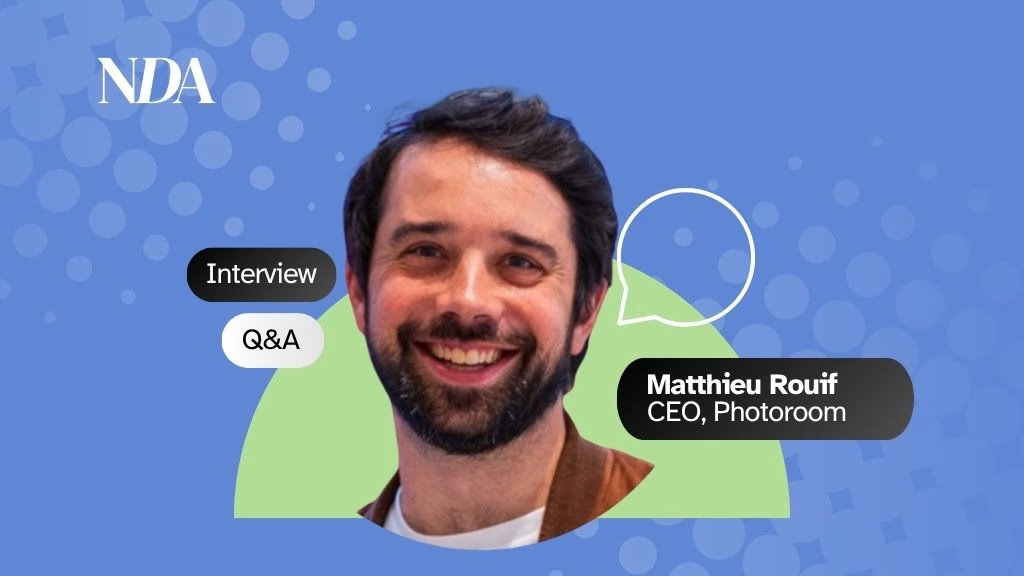
New Digital Age recently spoke with Matthieu Rouif, CEO of AI image-editing platform Photoroom to discuss the company’s evolution to date, how Britain can create a fertile landscape for AI infrastructure to grow and flourish, and the significance of Microsoft’s recent multibillion-pound AI investment in the UK.
Rouif argues that while the scale of Microsoft’s investment represents a major step forward, its long-term impact will depend on building the conditions that allow smaller firms to access, trust, and benefit from such infrastructure. Without an environment that nurtures skills, reduces adoption costs, and ensures accessibility, he says much of this investment risks remaining the preserve of larger corporations rather than catalysing nationwide growth…
What does your role involve day-to-day?
“We’ve become one of the world’s leading AI image editors, especially for ecommerce. Our goal is simple: help everyone (that’s everyone from side-hustlers selling on eBay or Depop in the UK to some of the world’s biggest marketplaces like Amazon and DoorDash) sell more by building trust through better visuals.
“Anyone selling physical goods online can be more successful with Photoroom. Whether you’re running a Shopify store, listing items on marketplaces, or selling cars or food, our AI lets you test different visuals instantly. What used to cost thousands for a photoshoot you can now A/B test in minutes. GenAI has completely changed how commerce works.
“The UK is our second-largest market after the US and one of the earliest adopters of AI. We work with major marketplaces like Depop, and even nonprofits like the Red Cross, where we help improve sell-through rates and train employees to list products online using AI.
“We’re now a team of just over 100 people and have passed 300 million downloads, so AI is growing fast for us. My time is split between constantly evolving the product and hiring great people across Europe, the UK, and the US.”
What’s your view on Microsoft’s recent AI infrastructure investment in the UK?
“These kinds of investments help an ecosystem reach escape velocity. For AI, you need four things: capital, GPUs, data, and talent. When a big player like Microsoft invests in infrastructure and GPUs in the UK, it’s a strong signal that builds trust. It encourages talent to stay and helps everyone who relies on that stack, from model-training companies like us to enterprise users.
“It’s still early days for visual AI. We’ve built one of the best background-removal tools around. The next step is generating a full product page – photos, videos, all variants and colours – directly in Photoroom. There’s still huge room to improve speed, quality, and resolution.”
Looking ahead, what does success look like for Photoroom?
“We want to become the Photoshop of the GenAI era for merchants. Our ambition is that ‘Photoroom’ becomes a verb – something you do to transform a listing. GenAI is making image editing far more accessible, which was the original reason we started the company.
“AI has incredible potential to make sophisticated tech more accessible to everyone. We have five-year-olds who love Photoroom because they can play and create, and we have Carol, a 93-year-old in Virginia who now makes content for her community. Before AI, she couldn’t create the images she wanted.
“Photoroom is now available on mobile and web, and for enterprises we provide an API that can slot straight into their workflows. It typically saves 90% of the time and cost of manual editing.”
What shifts are you seeing in enterprise adoption of visual AI?
“2024 was all about enterprises adopting LLMs. In 2025, we’re seeing a major shift in visual and media AI because the results are so much more accurate. We’ve signed a lot of enterprise deals this year, and the impact is clear – marketplaces are seeing higher GMV and more listings thanks to AI.”