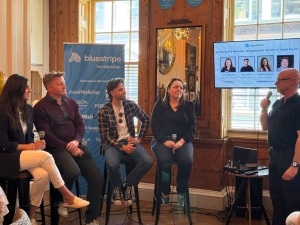
At the latest Marketing the Marketers event from Bluestripe Group, a senior panel examined how marketers at agencies, adtech companies and other players in our industry can effectively engage their target B2B audience in an environment defined by proliferating channels, compressed budgets and heightened internal accountability.
Joining NDA Editor-in-Chief Justin Pearse were Kelaine Blades, Global Managing Director, Converged GTM & Operations at Havas; Lydia Oakes, COO at Bluestripe Group; Seb Joseph, Executive News Editor at Digiday; Maria Shcheglakova, Director, Global Marketing CTV and Data Advertising at TiVo Ads; and Zoe Jones, Founder and Director of The Zoder Collective.
Across the discussion, one message surfaced repeatedly, marketing cannot operate in isolation. It must be commercially grounded, internally aligned and externally consistent.
Commercial strategy before channel strategy
Shcheglakova was clear that tactical decisions must be rooted in commercial reality.
“It starts with a commercial strategy,” she said. “We are looking at what the team is really planning to achieve, who their potential customers are, new customers, existing customers, what type of relationship we want with these customers and how we want to grow them.”
Marketing, she argued, is now scrutinised well beyond the CMO. “It’s not just the CMO. It’s the chief revenue officer, sometimes the person running the company, and the chief product officer. They also want to know what is happening and how the product is being developed.”
Only once that alignment exists should marketers determine where to invest. “Then we look at the marketing budget and see what tactics and channels we want to use to amplify our message,” she added.
Blades framed this as a systems challenge. “The different tools available to marketers are different levers of the same system,” she said. “PR delivers authority, awards build credibility and internal morale, owned content functions as the demand engine, and social media amplifies it all. They become most powerful when they work together in tandem.”
She emphasised that internal alignment is crucial. “Sometimes the biggest gap isn’t with the audience outside, it’s within your own organisation. Getting stakeholders on the same page makes your marketing more credible and impactful,” she said.
Perspective, trust and narrative
Joseph urged marketers to recalibrate expectations from a media perspective.
“A lot of it stems from them not wanting a quick return,” he said. Product launches and campaign announcements rarely hold sustained editorial interest. “We’re really interested in a marketer’s perspective on the industry based on the conversations that they’re having. When it gets to that point where there is trust, it’s really fruitful for both parties.”
Oakes added that this extends beyond media relations to client and team engagement. “We often see marketing teams too focused on immediate visibility rather than meaningful connections. Building long term relationships internally and externally gives far better results,” she said.
Jones highlighted the importance of storytelling in this context. “Even with limited budgets, a compelling story can cut through the noise,” she said. “It’s not just what you say but how you say it. Creating narratives that resonate with different audiences helps marketers stand out without overspending.”
Brand and demand must coexist
Budget pressure framed much of the discussion. Pearse asked how marketers should manage the balance between long term brand building and short term lead generation.
Blades cautioned against defaulting to performance at the expense of brand. “When budgets are cut, the gut reaction is to cut the brand build and just focus on getting leads,” she said. “But brand lowers the cost of acquisition. Combining brand activity with targeted thought leadership allows you to drive leads without undermining your long-term credibility.”
Shcheglakova offered a practical illustration. “Rather than defaulting to traditional sponsorship at IFA in Berlin, we invested in a distinctive DJ-led activation. It was memorable, cost-effective, and drove both awareness and engagement,” she said. “It showed that brand-led initiatives can have measurable commercial impact.”
Oakes emphasised that brand and demand must be treated as complementary. “Marketing should be seen as a single ecosystem. Brand builds the foundation of trust, and demand generation leverages it,” she said. “If you neglect either, you weaken the system.”
Jones added that authenticity is key. “Audiences are sophisticated. They can tell when a campaign is only chasing leads versus genuinely providing value. A strong brand voice combined with useful, engaging content will always outperform purely transactional messaging,” she said.
Joseph concluded that marketers must think holistically. “We value long term perspective and credibility. If marketers can combine brand building with commercial objectives and maintain trust with media, clients and internal stakeholders, they will get the most from their efforts,” he said.
Across the discussion, the consensus was clear: activity in this space requires balance, clarity, commercial insight and collaboration. Each channel, tactic, and message should reinforce the others, and long-term perspective and trust are essential to making campaigns impactful both inside and