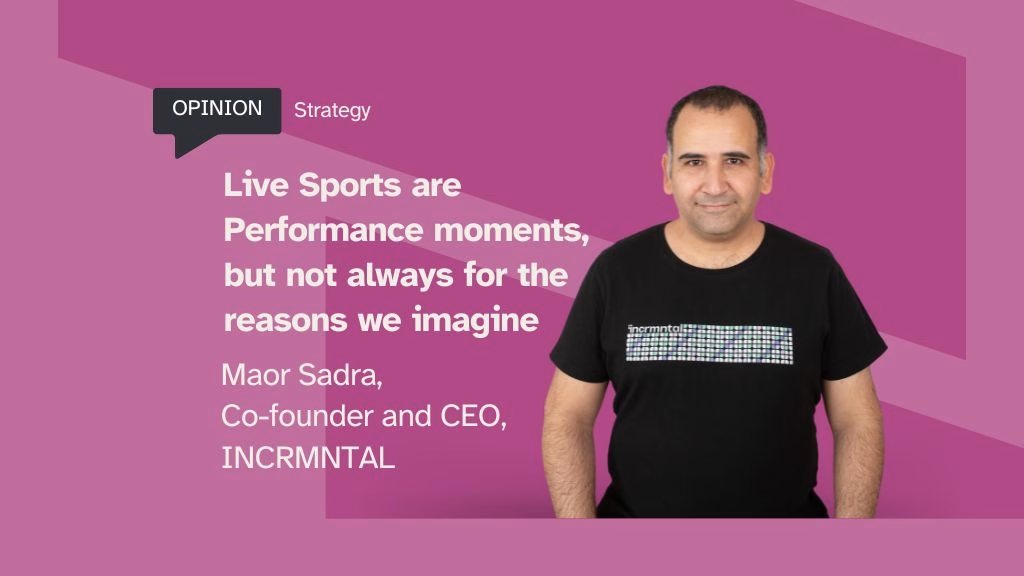
By Maor Sadra, co-founder and CEO at INCRMNTAL
Every year, the Super Bowl delivers the same post-game narrative in marketing circles. Record audiences. Escalating media prices. Conversion spikes. Falling CPAs. Another “proof point” that big moments still drive results.
And yet, a few weeks removed from this year’s event, the performance story looks more complicated than the headlines suggest.
The Super Bowl is not just an advertising opportunity. It is a concentrated cultural event that alters consumer behaviour in real-time. Search patterns shift, app usage rises, social engagement accelerates and purchase intent intensifies – often independently of any one advertiser’s activity.
When that happens, traditional performance metrics become harder to interpret.
When demand spikes, performance metrics get flattered
Recent analysis of advertiser spend and outcomes across multiple brands during the Super Bowl window highlighted just how varied the impact can be. In one case, a sports betting advertiser saw deposits roughly triple over the weekend. Blended CPA declined sharply. At face value, the campaign appeared highly efficient.
However, when examining what additional spend actually drove, the picture was more restrained. Only a very small share of those deposits – approximately 0.6% – could be attributed to incremental impact from paid activity. The effective marginal CPA was substantially higher than the blended figure suggested.
In other words, the event itself generated significant demand. Advertising absorbed the credit, but not necessarily the causality.
This doesn’t mean the Super Bowl “doesn’t work”. It means that demand shocks complicate attribution. When baseline consumer intent rises dramatically, paid media can appear more efficient simply because it sits close to the point of conversion.
Interestingly, the same analysis also produced the opposite result. Another advertiser during the same weekend increased spend significantly and saw incremental registrations rise at a disproportionate rate. In that instance, marginal efficiency improved relative to typical performance.
Same event, different outcome
The contrast is instructive. It suggests that major cultural moments do not guarantee incremental growth, nor do they inherently undermine it. Instead, they amplify existing conditions – the alignment between audience mindset, creative execution and commercial objective becomes more decisive.
For some brands, the Super Bowl creates an opportunity to capture genuinely new demand. For others, it accelerates activity that was already likely to occur.
This distinction is particularly relevant in an environment where performance marketing is expected to be accountable and measurable. Blended CPA and last-touch reporting often struggle to separate organic surges from media-driven lift, especially during periods of extreme attention concentration.
The Super Bowl is simply the most visible example of a broader phenomenon. Black Friday, major sporting tournaments, cultural releases and even viral social moments can all create similar distortions. When consumer behaviour shifts en masse, performance dashboards tend to flatter.
The cultural halo extends beyond game night
There is also a timing dynamic that is easy to overlook. In several instances, incremental impact appeared more meaningfully in the days following the event rather than during the broadcast itself. Cultural spillover – driven by half-time performances, celebrity appearances and extended social conversation – sustained elevated interest beyond game night.
Brands that evaluate performance strictly within the game window may miss that secondary wave of engagement. Equally, those that concentrate spend exclusively during peak pricing may not be optimising for the broader behavioural arc of the event.
The implication is not that brands should retreat from major moments. On the contrary, the Super Bowl remains one of the few media environments capable of delivering simultaneous national attention at scale. But it does suggest that performance interpretation needs to be more disciplined.
When conversion volume rises sharply during a high-profile event, the first question should not be “how well did the campaign perform?” but rather “what portion of this would have happened anyway?”
That question is not designed to diminish the value of advertising. It is intended to clarify it.
From Celebration to Causation: the accountability question
As marketing budgets face increased scrutiny, particularly in the context of economic uncertainty, the tolerance for conflating volume with impact is narrowing. Senior leadership is less interested in celebration and more interested in causation.
The Super Bowl will always produce extraordinary numbers. It is built to do so. The real challenge for marketers is to understand which of those numbers reflect genuine incremental contribution and which reflect the gravitational pull of the moment itself.
In an industry that prides itself on data-driven decision-making, separating hype from actual lift should not be controversial. Yet during cultural peaks, the temptation to accept flattering metrics at face value is strong.
The lesson from this year’s data is not that the Super Bowl underperforms. It is that performance during demand shocks requires context. Without that context, even the most impressive results can be misread.
And in a year where accountability remains high on every marketing agenda, that nuance matters.