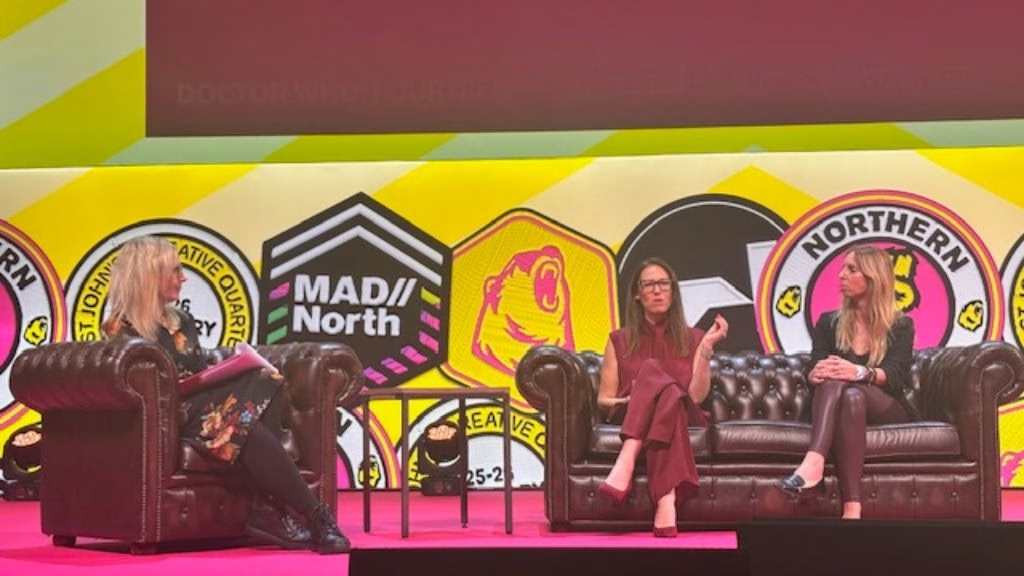
At Madfest North, Valerie Bounds, Co-Founder and Chief Strategy and Creative Officer of Aurora, led a session focused on a singular, powerful philosophy: people power helps brands scale faster.
The discussion, featuring Shelley Macintyre, Interim CEO of Brands and Licensing at BBC Studios, and Susan Finnegan, Head of International and Placemaking for Liverpool City Council, explored how locally born brands and cultural properties can transcend their origins to win hearts, minds, and markets globally.
The engine of people power
Valerie Bounds opened the session by explaining that Aurora’s work is built on the belief that mobilising communities creates a platform for challenger brands to take on the world. Bounds noted that “the brands who mobilise their people, that’s their employees, their fans, their communities, their partners, can win hearts and minds and reach in a way that no other marketing can achieve”.
She highlighted Aurora’s involvement in Eurovision 2023, where they saw an opportunity to leverage a massive media moment into an act of solidarity with Ukraine. By twinning with a Kyiv-based agency and working with partners like United24 and War Child, they created what Bounds described as “the world’s biggest global flash mob moment”.
The result was a global reach of 450 million people, driven by international coverage and community participation.
Beyond cultural events, Bounds demonstrated how this approach applies to corporate branding. When working with the Manchester-based gaming firm Team17 to launch their new global group brand, Everplay, Aurora focused on creating advocates from within the organisation. By launching the brand from the “inside out,” they saw an immediate 15% increase in share price on the day of the announcement, alongside a measurable cultural lift within the company.
Bounds described this as “authentic, people-powered commercial growth”.
BBC Studios: The “Glocal” formula for success
Shelley Macintyre discussed how BBC Studios takes intellectual property born in specific UK locations and prepares it for the international stage. Iconic programmes like Doctor Who, born in Cardiff, Strictly Come Dancing, which has its roots in Blackpool, and Bluey, created in Brisbane, Australia, all share a common thread.
Macintyre explained, “They’ve all been born very locally and they’ve all got a local grit and nuance to them, but they are all born from separate universally relevant insights that we’ve then been able to take through the global distribution vehicle”.
Macintyre argued that the path to global success requires a brand to have universal relevance that resonates across borders and cultures. For instance, Strictly Come Dancing has been adapted as Dancing with the Stars in over 60 markets, while Bluey is now “by far the number one preschool animation brand around the world”.
A key message from the BBC’s strategy is the importance of creative bravery.
Macintyre said that they “look for unique, brave stories that spark conversations on the sofa and start to change perspectives”. She stressed the need for “timelessness” and “timeliness,” citing Doctor Who’s 60-year history as a prime example of a brand that must “make sure that you’re reinventing all the time… the timelessness, but it needs to be timely too”.
Liverpool: Leveraging heritage for a modern economy
Susan Finnegan provided a masterclass in placemaking, detailing how Liverpool has transitioned into a modern cultural powerhouse with a £6 billion visitor economy.
She said that Liverpool’s global brand is built on a deep emotional connection, fueled by a history of major spectacles. Finnegan explained, “It’s all been about big, major spectacles, about creating an emotional connection between people and place”.
From the global legacy of The Beatles to the city’s two Premier League football clubs, Liverpool’s influence is pervasive. Finnegan recalled seeing a Liverpool FC shirt in a Thai rainforest, illustrating the reach of the city’s cultural exports: “Liverpool, wherever you go that emotion that resonates, that emotional connection, is really what does it for the destination”.
A significant part of Liverpool’s current strategy involves rebalancing its economy. While it remains a world-famous cultural destination, it is also a critical global trading port.
Finnegan highlighted that “we’re still a global trading port city, 45% of all US trade coming into the UK goes through Liverpool”. Projects like the Littlewoods Creative Campus are designed to grow the film and TV sector, further enhancing the city’s global profile.
Strategic partnership as a scaler
The session concluded with a focus on the “power of strategic partnership”. Finnegan pointed to the success of Eurovision 2023, which Liverpool hosted on behalf of Ukraine.
The city had only six months to organise the event, a feat made possible because local stakeholders were already aligned. Finnegan described this as “the power of strategic partnership, that you can just go, ‘Right, we’re ready, we can put on that show, and we can make that impact'”.
By combining local authenticity with a clear global path and mobilising the people who care about the brand, UK organisations can successfully navigate and own the international spotlight.