By Bashar Alaeddin, Board Member at MESMDA.com
When did we stop asking if an image is real and start asking if it simply looks native to the feed? During a recent regional escalation, a high-production [reels] video of a night-time missile strike went viral on Instagram, accumulating millions of views in mere hours. It looked authentic, it sounded raw, and it captured the visceral fear of a city under fire. By the time digital forensics teams identified the footage as a clip from a combat simulation game, the video had already been shared by thousands and cited by several commentators. The footage succeeded because it inherited the visual grammar of trust that we associate with raw, mobile-first documentation.
The collapse of friction represents the defining media problem of this moment. For decades, the distance between an event and an audience was buffered by the slow work of verification and the high cost of distribution. These were the structural guardrails of the public square. Today, those barriers have been deleted. We have more footage and more direct-source material available than at any point in history, yet the more content we receive, the less certain we are about what deserves to be treated as real.
In the current regional geopolitical landscape, the velocity of the algorithm has simply outpaced the speed of the editor. This is transforming the news from a record of facts into a real-time simulation of sentiment. Within the next few years, this lack and absence of friction will likely complete the transition from a search-based internet to an answer-based one. Users will no longer scroll to find the truth. They will inhabit personalised, AI-curated environments that filter out the very concept of doubt. In this future, the value of a media brand shifts away from its ability to reach an audience and toward its ability to remain the only human-verified anchor in a sea of synthetic certainty.
The Evolution of Proximity
A brief historical context clarifies how radically the concept of a source has evolved. The Vietnam War is remembered as the “first television war,” a conflict defined by the evening news bringing the front line into the living room for the first time. Reporters moved through the jungle alongside camera crews, delivering the raw footage that transformed the living room into a witness to active combat. By the 1990s and the early 2000s, the two Iraq Wars normalised the “embedded model.” CNN pioneered the 24-hour news cycle with live satellite feeds from Baghdad during the Gulf War, while the 2003 invasion placed hundreds of embedded journalists within advancing military divisions. Both offered a perspective that was immediate but fundamentally structured by official access.
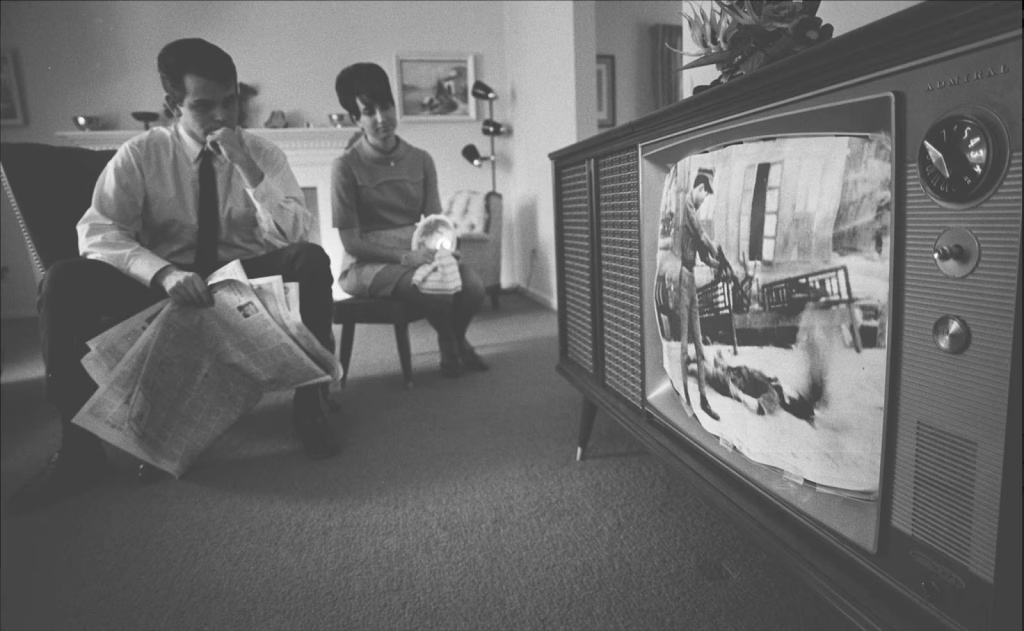
Photograph by Warren K. Leffler / Courtesy Library of Congress / 1968
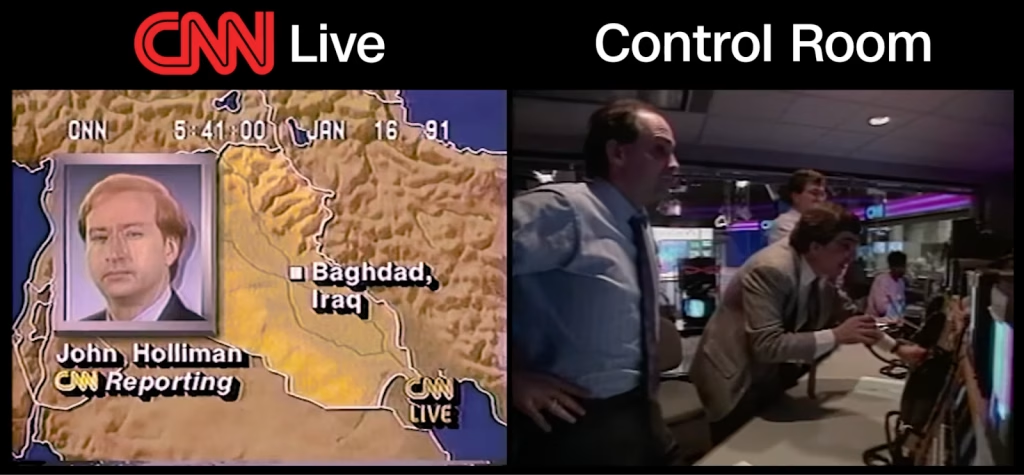
CNN archive / YouTube / 1991
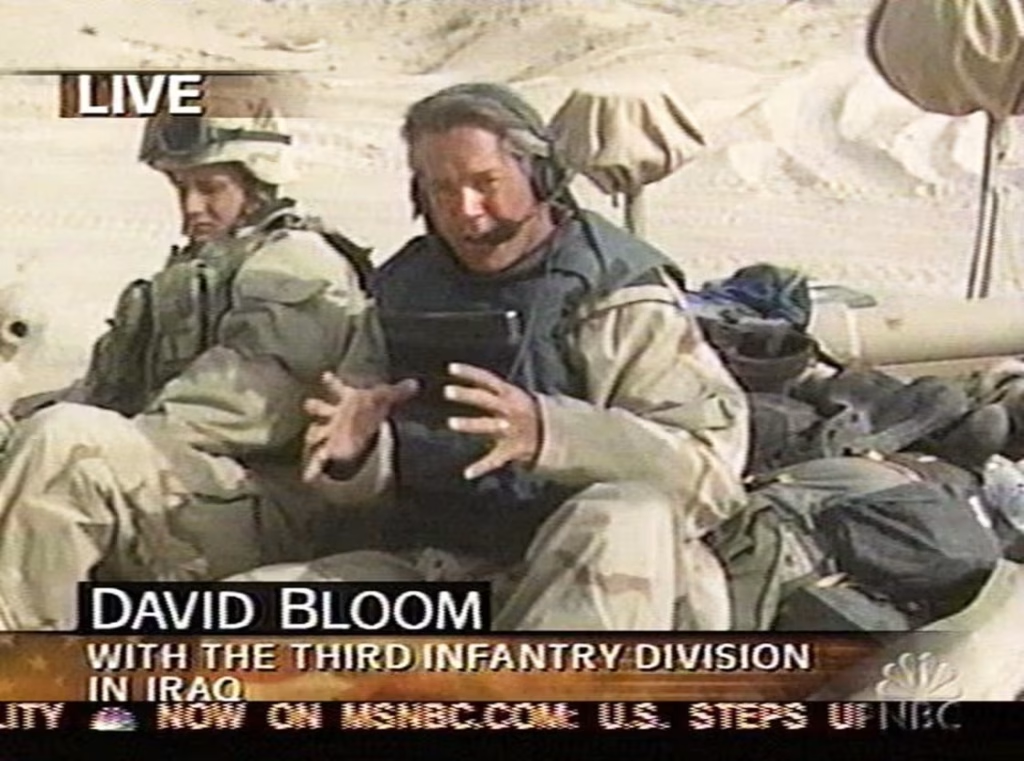
NBC News correspondent David Bloom reports from Iraq via live transmission from AP / 2003
The smartphone era arrived with the promise of a total democratisation of the news cycle where the audience could bypass the traditional news desk entirely. While the 2022 invasion of Ukraine was dubbed the ‘TikTok War’ due to the novelty of its algorithmic reach, the documentation of Gaza represented the total maturation of this transition. On Instagram, the distinction between the reporter and the resident vanished entirely. This was no longer a platform story; it was a crisis of witnessing where the raw stream of the individual became the primary record of the event. This provided a level of unfiltered access that had never existed before, at least until social media platforms began to introduce new barriers through shadow-bans and content blocks.
The 2026 Iran escalations mark an inflection point where AI content blurs the record of human witnesses. In the legacy model, we all looked at the same picture of the world provided by a few major broadcasters. Today, we inhabit a fragmented stream. The news has become a billion individual pieces of content scattered across different algorithms. Because there is no longer a central filter, everyone sees a different version of reality. In this environment, the truth has migrated away from a single coherent story and toward a collection of posts that we have to assemble ourselves. A single post functions as the news itself. By the time a newsroom responds, the narrative is already set. We are navigating a digital world where the event and the interpretation happen simultaneously.
The Official Feed and the Architecture of the Scroll
For better or worse, X has become the central nervous system of Middle Eastern crisis communications. It is where heads of state and government officials now bypass traditional media filters to issue direct, timestamped statements. In the GCC, this has become the gold standard for emergency alerts. When a crisis unfolds, audiences in Gulf cities no longer wait for a news cycle to catch up. They go straight to the official handle.
This direct link increases credibility for a mass audience. A post from a verified government account feels more immediate and authoritative than a packaged news segment. However, this pivot toward the direct feed creates a new kind of vulnerability. Because we are trained to trust the interface of an official account, we are uniquely susceptible to its manipulation through fake screenshots or fabricated alerts. We have traded the old editorial filter for a high-speed direct connection that carries its own set of risks.
Within the next few years, we will likely see these official channels evolve into “encrypted news hubs.” To combat the rise of synthetic screenshots, government entities may move toward platforms that offer cryptographic proof of a post’s origin. In this scenario, the audience will not just look for the official handle, but for a digital signature that proves the message was never altered by an algorithm.
All the while, the “Verified” blue badge has lost its status as a marker of credibility. In an era where verification can be purchased, the audience has learned to look past the blue check. Trust has migrated toward the Grey and Yellow badges on X that signify state or corporate organisation provenance. These institutional markers have become the only remaining anchors in a sea of paid personas.
In this environment, governments in the Gulf have provided a vital case study in digital sovereignty. By prioritising the speed of official alerts, they have proved that institutional announcements can compete with and ultimately overtake the spread of misinformation. This agility suggests that the only way to beat the algorithm is to match its velocity with verified authority.
The Instagram Stream and the Paradox of Rawness
While X handles the immediate news beat, Instagram has transformed conflict into a persistent, raw audiovisual stream. During recent regional tensions, Instagram Reels became a primary source of information for millions, but the nature of what we trust has fundamentally changed. We have moved past the era of the “polished” aesthetic. Today, the algorithm rewards content that feels spontaneous and unedited.
This creates a dangerous paradox. Because we have been trained to associate a shaky camera, a blurred frame, or a glitchy video with “raw truth,” we are uniquely susceptible to fakes that mimic this style. A high-production AI render can now be intentionally “downgraded” to look like a handheld mobile video. We are living through a total polarisation of media where a video succeeds not because it is verified, but because it matches our mental image of what an “authentic” witness should look like. The line between the physical event and the digital render has all but vanished.
The Future of Judgment
Looking ahead, the very way we interact with these feeds is set to transform. We are moving from an “Article Economy” to an “Answer Economy.” In a few years, audiences will likely stop scrolling for news entirely. Instead, they will use AI interfaces to query the world in real-time, asking for summaries tailored to their specific lives and locations.
In this world, the media organisation’s role is to provide the verified, structured data that these AI assistants can trust. If a brand cannot prove its provenance, it will be filtered out by the user’s own AI gatekeepers before it ever reaches their screen. The biggest disruption of the AI era is not the production of more media, but the reshaping of what we prioritise. We already know that optimising for algorithms over accuracy leads to a decay in institutional value.
The ultimate shift we are facing is one of human behaviour. We are moving toward an era where seeing is no longer believing. We are training ourselves to be sceptical of every frame, every blurred video, and every dramatic headline. In an infinite content world, the premium is no longer on being the first to post. It is on the ability to reconstruct the source chain and provide judgment. We are moving toward an era of provenance where the primary role of the media professional is to slow the feed down just enough to make sense of it. The winner is no longer the one with the most views, but the one who can prove the content is real.