The marketing industry has arrived at a historical junction that mirrors the mid-twentieth century revolution in music. Just as the synthesizer once promised to democratise sound only to initially flood the airwaves with generic noise, artificial intelligence is currently threatening to submerge the digital world in a sea of AI slop.
At the Braze City x City London event, the overarching narrative was clear, the era of focusing on sheer output is over. The new mandate for the modern marketer is to transition toward agentic intelligence, where AI is not merely a content generator but a reasoning partner capable of driving meaningful business outcomes.
From output to outcomes: Navigating the era of AI slop
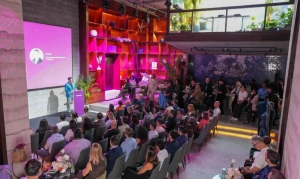
Bill Magnuson, CEO and co-founder of Braze, opened the day with a provocative comparison. He argued that the current state of AI mimics the early days of electronic music. Synthesizers and drum machines were easy-to-use tools that let anyone in a garage create new music, leading to an explosion of genres but also a mountain of low-quality noise. However, iconic artists like Kraftwerk and Daft Punk stood out because they wielded these tools with taste, creativity, and intentionality.
“AI is everywhere, and it’s relentless,” Magnuson said. “It’s relentlessly producing text, code, posts, images, video, but these things are not necessarily creating enduring value”. He warned that as consumers, our brains are rapidly sorting what we deem to be treasure from what we just put into the digital dump.
This is a repeat of history, he said. In 1994, the first banner ads saw a 78% click through rate. By 2011, that figure had dropped 1500 times to just 1/20th of 1%. As Magnuson pointed out, when marketing becomes impersonal or feels cheap, the human brain simply trains itself to tune it out.
The shift required now is away from volume and back toward relevance. While the industry moved from batch and blast to rules-based journeys over the last decade, Magnuson suggested those deterministic rules are no longer enough.
The next chapter belongs to AI agents that rise above simple rules and bring reasoning and intelligence to the table.
“The next chapter of AI can’t just be about more, more, more,” Magnuson said. “It needs to stay rooted in iconic marketers and iconic brands, making better decisions to drive better outcomes for their customers”.
This evolution is powered by context. Braze processed over 25 trillion data points in 2025, turning vast streams of first-party data into what Magnuson calls composable intelligence. By feeding this data into agentic units, brands can move toward rich, two-way interactions that deliver actual value. T
he danger, however, lies in over reliance on Large Language Models (LLMs) which can suffer from context rot or attention collapse when given too much information. The human edge, Magnuson argued, is in managing that context, setting the guardrails, and sharpening the tools to ensure the output feels like magic, not slop.
The anatomy of a winner: Man and machine in the agentic age
If the opening was about strategy, the second session was a masterclass in execution. Matt Katz, Senior Director of Product Management demonstrated that winning with AI requires a sophisticated blend of different technologies. They showcased the Braze AI Operator and Agent Console, tools designed to move beyond generative prompts into the realm of reasoning and autonomous execution.
Katz performed a live roleplay, acting as a marketer for a fictional concert app, Encore Access. He demonstrated how a marketer can now use the AI Operator as a creative “buddy” to build a complex VIP concierge program. Unlike standard bots, this operator reasons through a brand’s specific workspace, catalogues, and user profiles. It can build a Canvas Agent to recommend specific events to users and even write the underlying HTML code in seconds.
“It’s really important that man and machine work together to build an agent that’s as effective as possible,” Katz said. This was best illustrated by the introduction of the Campaign QA Agent.
As AI accelerates the production of content, the burden of quality control increases. Katz showed how an agent can be tasked with checking every piece of content against brand guidelines, legal requirements, and functional necessities like ensuring a working unsubscribe link. By automating the QA process, the marketer is freed from the technical grind and can focus on the higher level strategy.
Katz expanded on the technical philosophy behind these agents, introducing the concept of hybrid systems. He cautioned that LLMs, while creative, are fundamentally non-deterministic. For critical marketing tasks, like managing a subscriber funnel or hitting quarterly targets, brands need predictability. This is where reinforcement learning and the Braze AI Decisioning Studio come into play.
“You can think of it as a fit-for-purpose AI that’s built to make one-to-one decisions on your data to optimise some goal that you select,” Magnuson said. By stitching together the reasoning of LLMs with the mathematical optimisation of reinforcement learning, Braze enables marketers to create systems that autonomously experiment and learn. This hybrid approach ensures that the AI doesn’t just hallucinate a solution but actually finds the path to the highest conversion based on real world evidence.
The AutoSergei effect: A blueprint for brand transformation
The final mainstage session brought these theories to life through the lens of Compare the Market. Sol Lopez, Head of Customer Engagement, joined Braze’s Chief Business Officer, Astha Malik, to discuss the AutoSergei program. The goal was simple but massive, to turn their iconic meerkat mascot into a personalised AI assistant for 38 million customers.
Lopez was candid about the challenges. To move from static communication to a truly connected customer experience, the brand had to first fix its foundations. They moved away from fragmented data silos toward what Lopez described as an actionable customer view. By refining their data, they reduced 2,500 variables down to 350 high-value, actionable data points.
Once the data was unified, the speed of testing exploded. Using the Braze AI Decisioning Studio, Compare the Market was able to perform what Lopez described as “three years’ worth of testing in just six weeks.”
The AI agent tested 195 different variants and 300,000 different combinations of frequency, timing, channel, and message to find the optimal engagement for each individual.
The results were a validation of the agentic approach. Compare the Market saw a 33% increase in the share of revenue coming from owned channels and a 5% conversion uplift on their highest value campaigns.
“Data is no longer the differentiator,” Lopez said. “What makes the difference is how we are able to use that data. We apply intelligence and then we interact at the right moment on the right channel for the right user”.
The human factor: Why people remain the constant
Despite the focus on sophisticated agents and reinforcement learning, every speaker at the event returned to a single theme, the success of AI is ultimately a human endeavour.
Lopez highlighted that the AutoSergei program led to the creation of entirely new roles within his team, including AI content librarians and AI selection specialists. These roles focus on curating the action bank, ensuring the AI has high quality components to choose from, and auditing the machine’s decisions.
“It’s the people configuring the tech,” Lopez said. “It’s the people installing the tech, and it’s the people driving the business transformation”.
By automating the manual grind, Lopez’s team saw a 10x increase in productivity. This wasn’t about doing the same work with fewer people, it was about allowing those people to shift their focus from execution to the craft of marketing.
This mirrors Magnuson’s opening sentiment. The synthesizer didn’t replace the musician, it changed what it meant to be one. In the same way, the next era of marketing isn’t about the machine taking over the strategy. It is about the marketer becoming the conductor of a sophisticated ensemble of AI agents.
By wielding these tools with taste and intentionality, brands can move past the era of slop and back into an era where marketing feels like magic.
The tools for the agentic age are here, but it will be the iconic marketers who use them to push the frontier of their craft who will define the next decade of customer engagement.
As Magnuson put it: “Just like those musicians who use new tools to sharpen themselves and master their craft in a new way, the best marketers of the AI age will be the ones that sharpen themselves by grinding out an edge and creating new experiences for their customers with tools that don’t just end up feeling like slop, they’re going to feel like magic.”