Omnichannel advertising platform Azerion recently published new research that shows digital out-of-home (DOOH) advertising spend is growing, but further investment is limited by uncertainty around measurement and attribution.
Azerion carried out its study in February and March 2026; the 128 respondents include planners, buyers, strategies and media owners working across agency and brand environments in the UK.
The report, ‘The State of UK DOOH: Momentum, Measurement and the Road to Maturity,’ found that 68% of planners and buyers have increased their OOH usage in the past year, and 61% expect to spend more in the next 12 months. 93% report that the channel is important in their omnichannel strategy.
However, 58% say that measurement and attribution uncertainty is the biggest obstacle to investing more in OOH advertising. (In comparison, difficulty comparing OOH to digital, social and CTV were next on the list according to 47% of respondents, while 39% cited budget constraints.)
Looking at measurement tools in use, brand uplift (74%) and footfall (60%) are the metrics most widely used in determining OOH success; lower-funnel measures such as online conversions (16%) and incrementality (14%) are deployed less often.
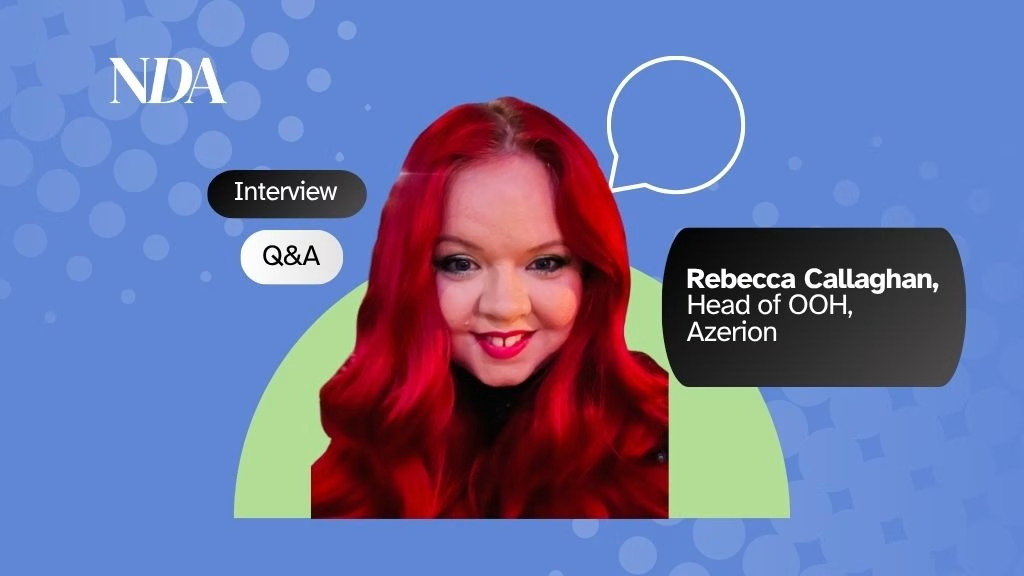
New Digital Age spoke with Rebecca Callaghan, head of out-of-home (OOH) at Azerion, to find out more…
Why did Azerion carry out the research?
This was actually our first piece of outdoor research, conducted for our inaugural outdoor event, which took place in April. We wanted new and current insights to share with the market.
Outdoor’s at a pivotal moment in its evolution, and with all the strong market momentum and growing advertiser demand, it felt like the right time to take the temperature from an omnichannel DSP perspective. We wanted to understand what we were hearing from the agency and client side, what we were seeing internally, and whether that all matched.
Specifically, we wanted to understand: if planners and buyers already recognise the value of outdoor programmatically, what’s still holding them back? What’s preventing greater spend? And ultimately, what do we need to do as an industry, and as a business, to help agencies build confidence and unlock the full capabilities of the channel moving forward?
What, for you, were the headline findings of the new research?
One of the biggest findings was around measurement and attribution. People cited measurement as the biggest barrier to greater investment, but at the same time very few said they were actively dissatisfied with the existing tools.
That tells me it isn’t necessarily a capability problem. It’s more about confidence and education. The appetite for the channel is clearly there. As the figures above show, outdoor plays a key role in omnichannel strategies, and spend is on the rise.
Historically, outdoor was sometimes treated as a bolt-on channel or a nice-to-have. Now we’re deliberately placing outdoor at the heart of omnichannel plans because of its priming impact, its amplification capabilities, its retargeting opportunities, and the positive impact it can have across all the other channels on the plan.
Did any of the findings surprise you?
I expected measurement to be a concern because that conversation has always existed in outdoor. But what surprised me was the scale of the disconnect between the concern itself and the actual dissatisfaction with what’s available.
If only 18% are dissatisfied and the capabilities already exist, then clearly they’re just not consistently understood or benchmarked across the industry.
People still see outdoor, even programmatically, as a way to raise awareness and drive consideration. But what we’re seeing is demand from advertisers for much more performance-orientated outcomes.
The reality is that outdoor now combines all the strengths of traditional outdoor — trust, scale, visibility and impact — with all the benefits of programmatic, including flexibility, optimisation, data and targeting.
We can do audience targeting, geo-targeting, day-parting, contextual triggers and dynamic creative. Campaigns can become far too reliant on thinking about outdoor only as a brand channel and not as a channel that drives performance.
Are clients more aware now of the full capabilities of digital OOH and its potential role within omnichannel campaigns?
Awareness has improved a lot and the pressure is definitely growing around outcomes-driven conversations. However, brands haven’t fully tapped into the opportunities of programmatic DOOH yet.
Most people in programmatic are learning programmatic outdoor from a programmatic point of view, whereas I came from an outdoor background and had to learn programmatic.
Outdoor requires a mentality shift. We’re not planning for a one-to-one channel. Understanding all the nuances, environments and media owners is a beast to get your head around if you’ve only ever worked in programmatic.
We’re audience planning now. How does the audience move? How do they feel? What does their day look like? We’re building campaigns around multiple touchpoints and across multiple channels.
Outdoor is brilliant at priming. You might see the ad outside during the day, then get retargeted later on mobile or CTV. Suddenly the same person has been reached across several channels, improving frequency and driving much stronger performance.
We’re seeing really exciting examples of this already. For one campaign, we linked outdoor exposure with mobile retargeting and achieved a click-through rate of 2.88% against a benchmark of around 0.5%, because audiences had already been primed by outdoor before seeing the ad on their phones.
What type of support are clients most commonly looking for right now?
A lot of what clients need right now is guidance, support and education.
We don’t own the screens, so our d ata partnerships and third-party relationships are hugely important, and clients often need help understanding how to structure campaigns and get the most out of the budget.
I’m there to make sure the right datasets are being used in the right way and that we’re getting the most out of the campaign. I’m often recommending how outdoor can work alongside another channel that maybe the client hadn’t considered.
We’re also doing a lot of creative sessions, lunch-and-learns and collaborative planning with clients, agencies and media owners all sitting around the same table.
One of the biggest barriers to entry for programmatic outdoor has always been the creative lift: different screen sizes, different ad lengths and all the production involved. So we removed that barrier by offering creative support through our in-house studio team.
All good advertising starts with creative. We don’t want people testing the channel for the first time and it not working as well as it possibly could.
Clients are also asking for much more support around attribution and measurement. Depending on the strategy and the data you use, that changes how you track performance and report back on campaign effectiveness.
Are there any other emerging trends in relation to DOOH that we should be aware of?
One of the biggest trends we’re seeing at the moment is FMCG. With all the changes in regulation around where and when certain products can be advertised, we’re seeing more spend move into outdoor as a solution.
Brands are also realising they need to reach people across multiple touchpoints: not just transport or roadside, but gyms, offices, residential screens and other environments where people work, rest and play.
We’ve also been doing a lot of work around behavioural targeting and understanding how factors like environment, timing and creative influence campaign effectiveness.
DOOH is no longer being planned in isolation. When you run it through an omnichannel DSP, you can measure the entire campaign performance, not just one siloed activation. That gives clients a much bigger picture of how everything is working together, and allows campaigns to become smarter and more accountable over time.
A copy of the white paper, ‘The State of UK DOOH: Momentum, Measurement and the Road to Maturity,’ is available to download here.