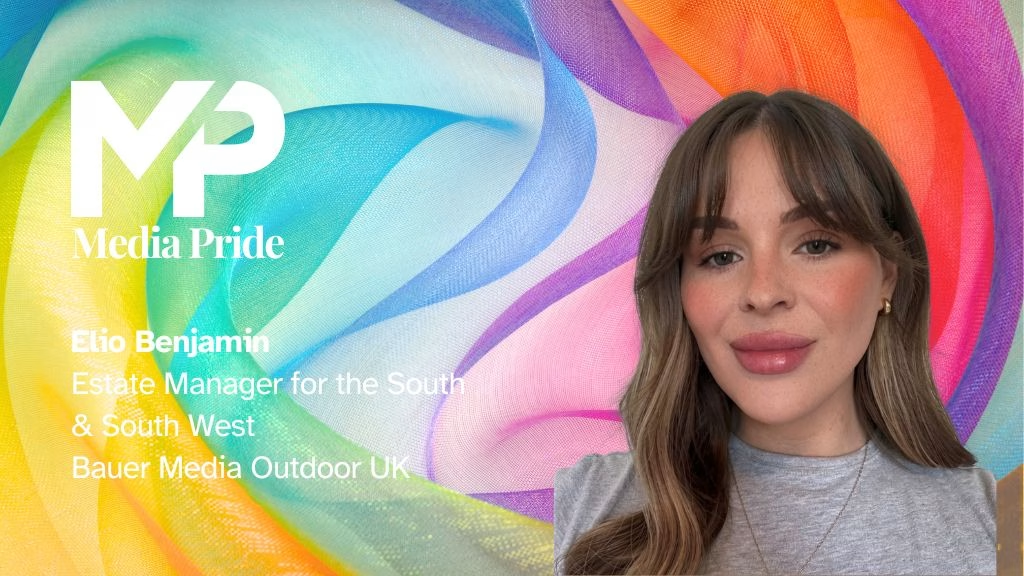
Elio Benjamin is Estate Manager for the South & South West at Bauer Media Outdoor UK. Elio focuses on building collaborative relationships with local authorities and partners to ensure that Out of Home environments work for both clients and the communities they serve.
What is the biggest challenge for members of the LGBTQIA+ community in our industry and how is it being overcome?
I think one of the biggest challenges as a transgender person working within media is the pressure to constantly assess whether you are “safe” to be fully visible in professional spaces. I am extremely fortunate that I have a supportive company behind me, that encourages me to be the best version of myself however this was not always the case.
Creative industries often present themselves as highly progressive externally, but there can still be a gap between public messaging and day-to-day lived experience. For trans people especially, visibility can sometimes feel complicated, I’ve often found myself balancing authenticity with concerns around perception, professionalism, or becoming “the trans person” in the room rather than simply being recognised for your work.
At the same time, I do think the industry is improving. I’ve seen far more openness, curiosity and willingness to learn as a reaction to recent events happening in the uk. More businesses are recognising that inclusion cannot just sit within marketing campaigns; it has to exist within workplace culture, leadership and decision-making too, that trans voices can often enrich a conversation.
Representation is also helping drive change. Seeing openly LGBTQIA+ people working across commercial, operational and leadership roles send’s a strong message that there is space for us throughout the industry, not just in traditionally “creative” areas.
What things could employers do to make the industry better for the LGBTQIA+ community?
For me, the biggest thing employers can do is create environments where people do not feel they have to edit themselves to succeed professionally.
That comes from culture more than statements. It is in the way leaders speak, how teams respond to mistakes, whether policies are actually practical, and whether LGBTQIA+ employees are included in meaningful conversations rather than tokenised during awareness moments.
As a trans person, small things can make a huge difference, people respecting names and pronouns, systems being inclusive, managers being educated enough that employees are not expected to teach them everything themselves.
I also think employers should recognise that LGBTQIA+ people exist across every area of business. I work within partnerships and infrastructure management, which perhaps challenges assumptions people sometimes have about where queer or trans professionals “fit” within media industries. Visibility across all functions matters because it normalises inclusion beyond stereotypes, however I don’t think visibility should be what we solely aim and settle for.
What impact can a more inclusive approach to LGBTQIA+ communities in our industry have on society as a whole?
Media has the power to influence culture in a very real way because we shape what people see as normal, accepted and valued.
Working in outdoor media has made me particularly aware of the importance of visibility in public spaces. Inclusive campaigns are not just seen by niche audiences, they exist in town centres far beyond London, transport networks and communities where millions of people engage with them every day.
For younger queer people especially, seeing authentic representation in mainstream environments can genuinely affect confidence, self-worth and understanding. I know that growing up in rural middle England in the early noughties like I did, there were very few examples of trans people represented positively or realistically in public life.
I genuinely believe that if I’d grown up seeing a wider spectrum of people represented across OOH and public spaces, my experience as a young person would have been very different.
Growing up, I often felt like the “oddity”, which naturally made me a target by what was considered the “norm”. At a stage in life where you should feel supported and safe figuring out who you are, I instead felt very visible in the wrong way.
That’s why representation in media matters so much to me. Seeing different identities reflected in everyday spaces can genuinely change how isolated people feel.
What support structures and organisations are most important and effective to the LGBTQIA+ community in the industry? What more is needed?
Internal employee networks can make a huge difference because they can create spaces where people feel understood and less isolated within their organisations. At BMO, being part of our group dubbed “Queer Crew” has allowed me to connect with likeminded colleagues across different areas of the business, which has been incredibly valuable both personally and professionally which is something I’ve never had access to before.
Sometimes just knowing there are other people around you who understand certain experiences without needing long explanations can make work feel far more comfortable and authentic.
That said, I also recognise this is often easier for larger businesses with established networks and resources. Smaller companies can find it much harder to create formal support structures or dedicated communities, which is why culture at leadership level becomes even more important. Even without large internal networks, businesses can still create inclusive environments by listening, being open to learning, and making people feel respected and safe day-to-day.
I think partnerships with grassroots organisations are incredibly important because they keep businesses connected to real lived experiences rather than corporate interpretations of inclusion regardless of the people who work within a company. Organisations such as Not A Phase are doing hugely important work around visibility, education and support for trans communities.
What is still needed most is consistency. Most organisations doing fantastic work, but inclusion should not depend on luck, geography or individual managers, it should feel embedded into workplace culture across the industry.
What can brands, agencies and tech companies do to ensure they aren’t merely rainbow washing?
I think people can usually tell when inclusion is genuine and when it is purely aesthetic.
For brands, allyship cannot begin and end with a logo change during Pride month. It has to be reflected internally through hiring, leadership, partnerships, workplace culture, and a willingness to support LGBTQIA+ communities even when it is not commercially easy or trendy to do so.
When I decided the time was right for me to publicly transition, I made the difficult decision to leave my employer at the time and start fresh somewhere new. I was extremely conscious of not wanting to be deadnamed, mocked, or viewed differently whilst going through such a significant period in my life.
What I did not fully expect was how much harder employment suddenly became. Pre-transition, I felt very employable. Post-transition, I consistently struggled to get beyond interview stages. At the exact moment I needed confidence and stability most, it felt like it was slowly being stripped away interview by interview.
That experience completely changed how I view performative inclusion. We are currently living through a period where trans identities in particular are heavily debated publicly and politically. If a brand choose to engage with LGBTQIA+ communities, they should do so with care, consistency and genuine accountability because for many people, these conversations are not theoretical, they directly affect our ability to feel safe, respected and able to build a future.
That does not mean companies need to be perfect, but it does mean inclusion should be something they actively practise year-round rather than temporarily perform.
How effective are trade bodies, industry awards, and the industry press at supporting and promoting LGBTQIA+ inclusivity?
I am still relatively new to the media industry, so I do not think I can speak extensively on how the wider industry has evolved over time. What I can speak on is my own experience within it so far.
Since joining Bauer Media Outdoor, I have genuinely felt listened to, supported and encouraged to do well in a way I honestly never have before. My experience has been that people see me for my work and value what I bring to the business, rather than reducing me down to my identity.
I think that balance is really important. Inclusion should not feel forced or tokenistic. For me, the best environments are the ones where LGBTQIA+ people are supported enough to flourish naturally rather than constantly feeling singled out as “different”.
Things like internal communities, open conversations and visible allyship absolutely matter, but ultimately the biggest impact on me personally has simply been feeling respected, trusted within my team, and the bonds I have built with people along the way with people I would not meet in my normal walk of life.
Seeing people recognised within professional spaces for what they bring to the workplace, rather than solely for who they are, has been significant in helping me understand and develop my own sense of worth professionally.
For me, the most meaningful progress happens in the quieter day-to-day moments, workplaces creating cultures where people feel safe, valued and able to succeed without feeling like they need to hide parts of themselves.
*Bauer Media Outdoor is a client of Bluestripe Communications, owned by Bluestripe Group, the publisher of NDA