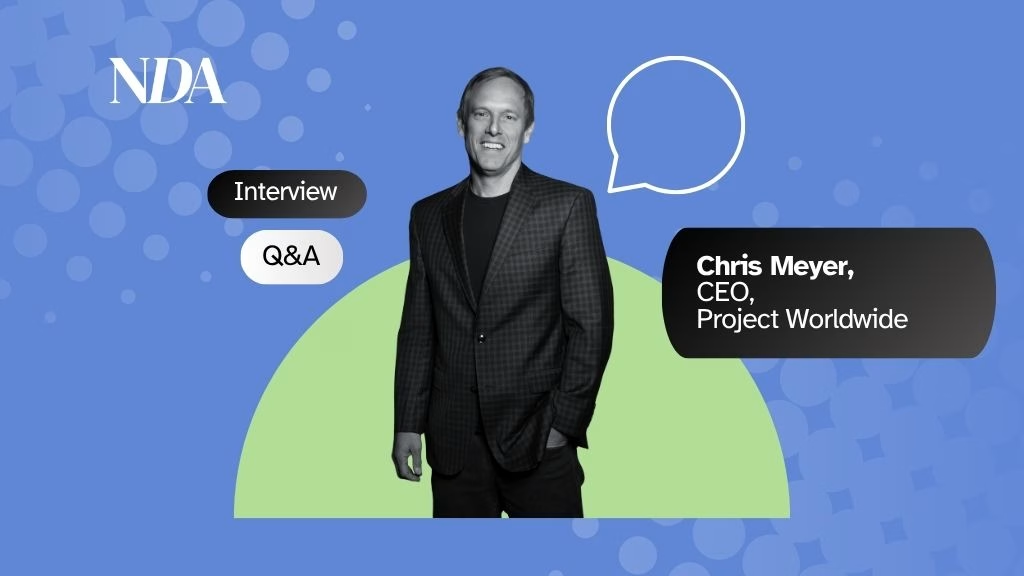
Project Worldwide, an employee-owned alliance of independent creative and experiential marketing agencies, recently announced a series of senior leadership changes designed to strengthen collaboration across its global network and position the business for its next phase of growth.
New Digital Age spoke with CEO Chris Meyer about the thinking behind the restructure, how AI is moving beyond the hype cycle, and why experiential marketing is becoming increasingly central to brands…
How does the restructuring reflect what you’re seeing in the market?
Everything we do starts with where our clients need us to be. Whether that’s geographically, through the services we provide or the industry expertise they need, those requirements ultimately dictate how we structure the business.
When I look at the support model Project provides across all of our agencies, it’s something that will continue to evolve alongside our clients’ needs.
We’ve made three leadership changes that all reinforce that direction. Ed Scott has moved into the role of President of Project Worldwide after spending the last year and a half split between GPJ and Project. He understands both our largest agency and how the wider network works together. His focus is on continuing to scale our global offering by removing friction and accelerating collaboration across our agencies. Despite the turbulence we’re seeing around the world, we still believe global coverage is critically important for both us and our enterprise clients.
Matt Statman has transitioned into the role of Global Chief Creative Officer while also returning to his roots at Motive. His role isn’t about directing the creative work of every agency. It’s about ensuring we’re consistently delivering the highest level of creativity across the network by partnering with the creative leaders within each agency. He’s also established a Creative Council with representatives from across the business to encourage greater trust, collaboration and shared thinking on our biggest client opportunities.
We’ve also created a new Chief Growth Officer role for John Higgins. As awareness of Project Worldwide grows, we’re increasingly seeing brands interested in working across our entire platform rather than engaging with individual agencies. That’s something that’s relatively new for us, and it’s why we felt the time was right to create a role dedicated to helping clients unlock the full capabilities of our network.
Has the hype surrounding AI already peaked?
I think the initial surge of hype has peaked. As an industry, we’re now entering a much more critical phase centred on implementation.
Many organisations are discovering that AI isn’t simply another piece of technology you bolt onto existing processes. It’s about reinventing workflows with AI as one of the tools that supports how you work.
We’ve lived through the emergence of the internet, then mobile, then apps, and now AI. AI is undoubtedly a more powerful tool for driving innovation, but for us the starting point has been to step back and ask which people truly understand our workflows and are prepared to rethink them. Simply applying AI to long-established processes isn’t enough.
At GPJ we’ve been around for 112 years, and sometimes it feels like some of our processes have been around for 112 years too. Reinventing those processes isn’t always easy, but that’s where the real opportunity lies.
Internally we’re also focused on what we call “hyperconnected intelligence”. The idea is to use AI to connect both human expertise and data across our global network so we can innovate faster and share knowledge more effectively. Because of our size, we can move much faster than some of the larger holding companies that are dealing with far more complex transformations.
How are you using AI with clients?
We’re already seeing some fantastic examples of AI enhancing creativity rather than replacing it.
One campaign I particularly like came from our Paris agency, Mnstr, working with the NGO Sidaction. They created an algorithm activism campaign designed to combat toxic masculinity on TikTok by building an army of 20 AI-generated influencers to tell the story.
AI helped create the campaign and the personas behind it. Without any paid media budget it generated more than a million organic views and around 90 million impressions. It shows how AI can enhance creativity and deliver remarkable results even with limited budgets.
At the same time, clients are understandably asking for greater efficiency and cost savings. Our response is always to bring everyone into the room and look collectively at how we work together. Rather than treating AI simply as a reason to reduce costs, we want to collaborate with clients on redesigning processes so AI delivers better outcomes for everyone.
What are clients asking for beyond AI?
Experiential marketing is having a real moment.
The conversation has moved well beyond thinking about experiential as simply face-to-face events. Today, everything is a brand experience, whether that’s advertising, digital, social, creator-led content or live events.
Because Project Worldwide was built from an experiential background, we naturally approach marketing through that lens. It’s become a genuine differentiator because our clients increasingly want partners who understand how every touchpoint contributes to a connected brand experience.
At the same time, trust in many traditional marketing tactics is declining. Brands are looking for experiences that genuinely connect people, build relationships and create trust. That’s why we’re seeing such strong demand for experiential thinking.
What trends are emerging across the wider industry?
After Cannes this year, I came away with the feeling that the industry is splitting into two very distinct camps.
One group seems driven by what someone described as “FOBO” — the fear of becoming obsolete. They’re focused on protecting the past rather than recognising how quickly the industry is changing.
The other group has accepted that the landscape has fundamentally shifted. They’re embracing AI, recognising the importance of the creator economy and understanding that marketing is no longer a straight funnel but an interconnected ecosystem of different tactics working together.
That contrast really stood out to me, and I think one of our biggest responsibilities is helping clients navigate that transition.
What are your priorities over the next 12 months?
Everything comes back to delivering value for clients.
The leadership changes we’ve made are designed to remove friction and ensure clients have access to the right people, the right processes and the right capabilities across our network.
Success isn’t simply about winning pitches anymore. It’s about consistently delivering value and making sure clients recognise that value in everything we do.
We’re also fortunate to be employee-owned. We’re not focused on quarterly market expectations or private equity targets. Our attention remains firmly on our people and our clients, and that naturally encourages collaboration across the business.
In fact, if collaboration itself were an agency inside Project Worldwide, it would already be our second-largest agency by revenue. That tells us we’re doing something right.
Finally, as we continue to grow, protecting our culture is absolutely essential. We’ve built Project around a founder-led culture supported by the scale and capabilities of a global platform. We never want to lose that entrepreneurial spirit because it’s a huge part of what makes us different.