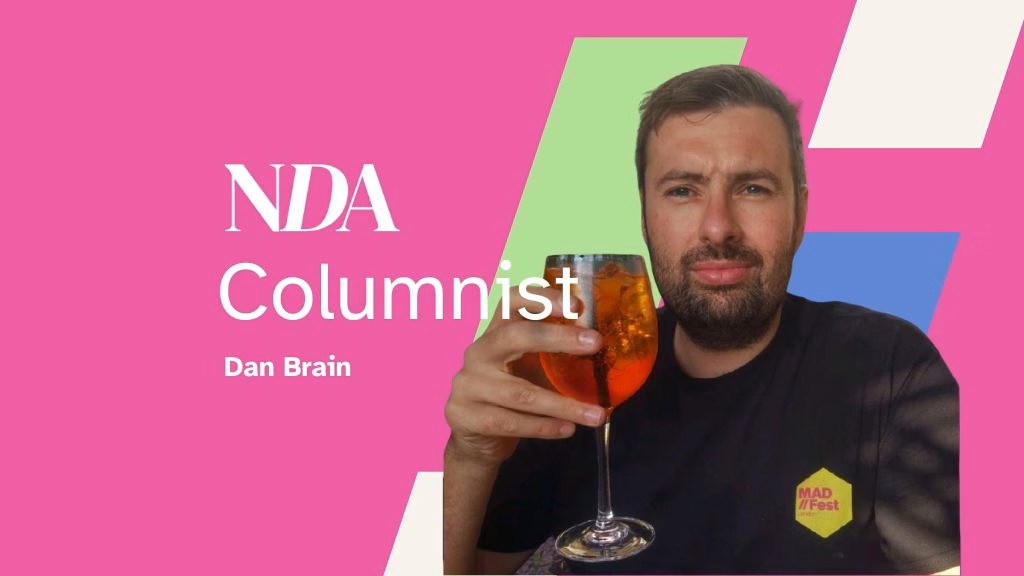
By Dan Brain, co-founder of MAD//Fest and MAD//Masters By Rory Sutherland.
Stop sending unedited AI-generated content and bring your critical abilities to work.
I recently learned a new term that sums up my frustrations in 2026: “meat proxy”. You may not have heard this phrase before, but I bet you’ve seen it in action.
A meat proxy has been defined (on X!) as: “A person who forwards AI-generated text, code or other output without reading, understanding or validating it. The person acts only as a relay between the AI system and the intended recipient.”
The human is the “meat”, with our role being limited to that of a proxy for the machine.
“Meat proxy” is a bit abstract for my untechnical brain, so I prefer the phrase “outsourcing critical thinking”. But the practice of blindly copying and pasting AI generated answers into emails is a symbol of a warped relationship with AI that clearly needs a reset.
Meat proxies add no value
I 100% agree with Niklas Guhn, the developer who coined the phrase after noticing that he was receiving verbatim answers from AI chatbots on Slack: “This is not adding value. I can talk to Claude myself. It’s going to be faster and I get to control the context. I don’t need a meat proxy in between.”
Whether it’s staff or an agency partner, we don’t pay or get paid to copy and paste AI-generated answers into emails or other work channels.
Here’s my real beef – this practice wastes time. Simple one line notes or, dare I say, over the desk conversations are turned into plausible but predictable mini essays with too many bullet points and AI’s unmistakable double hyphens.
Worse still, if you rigorously sense-check AI’s work, you probably won’t trust its judgement or accuracy. Maybe your prompts are hotter than mine, but in my experience, AI has a habit of getting completely the wrong end of the stick. It makes dumb assertions that are hidden among seemingly sensible words, inevitably leading to confusion and overcomplication when this information is shared.
When we have a known human bias against AI generated work (see ‘The Illusion of Effort’), why would we put our name to content that is obviously AI generated? Is this a good look in front of a client or colleague? Is it really going to do your career wonders or impress your client? Does it justify your salary and job? I’d say “no” to all of the above.
Losing critical ability? You need to edit more
Left to our own self destructive devices, both individuals and businesses risk losing critical ability and credibility at a rate of knots.
I cut my teeth working at emap in the noughties, an empire of glossy and glamorous magazines like FHM, Grazia and…errr…Heating & Ventilation News. Back then, the prospect of sending a magazine to print or breaking a big news story without the critical eye of an experienced editor and subbies would be unfathomable.
Publishing inaccurate information with reckless abandon could be career ending. It could end up in court. It could cost a tonne of money. That threat hasn’t gone away – in fact, it’s got worse.
I don’t understand why people don’t even pay lip service to these values in the era of AI. It’s all too easy for AI to spit something out that sounds plausible at first glance, but, on closer inspection, is in fact complete garbage. And this could land you in hot water, reputationally, legally, or both.
Sure, AI might make you an efficient writer of internal emails or marketing copy, but you need to add a distinctive human layer, and spend more time checking its work like a rigorous editor. And publishers should be hiring more subbies because of AI, rather than laying them off.
There is something strangely dystopian about a world where not only do we live in fear of becoming subservient to robots and the possible eradication of the human race, we have immediately become hooked on AI, which is like crack for a species of “cognitive misers” – a term popularised by the psychologist Daniel Kahneman to describe those who only exercise the grey matter if they absolutely have to.
AI is a support tool – not a replacement for critical judgement
I may be part Luddite, but I’m not totally against using AI to validate your assertions, check if you’ve missed any detail, or using it to analyse data or content in a time-efficient fashion (AI generated transcripts are a godsend!).
Theoretically, it can reduce the burden of boring tasks and free up time for more creative work, so the argument goes.
But we should be thinking about AI as a support tool, not a replacement for our own critical judgement.
Thankfully meat proxies have never been a problem at MAD//Fest and long may it continue. We have always wanted people to have the freedom to use their intelligence, act on gut feelings, or think on their feet to make creative ideas happen fast. ‘Going against the grain’ has served us exceptionally well. Our best ideas and decisions have been made with zero historical data, let alone an AI intervention.
Yes, we’ve got it wrong plenty of times thanks to human error, but we’ve always been distinctive, willing to break rules, and have held a healthy disdain for homogeneity. And when you’re trying to disrupt a market with a shoestring budget, this really is valuable.
I can’t help but worry for humanity if our contribution in the workplace is reduced to that of a meat proxy. I don’t want people on the payroll to default to AI because they live in fear of making a mistake or error of judgement.
I’m concerned for the businesses where outsourcing critical thinking becomes the norm.
But every cloud has a silver lining. I’m increasingly convinced that those who are brave enough to maintain and apply their human intelligence will have a chance of bucking the trend.
By all means use AI. Use it to inform, finesse or organise your thoughts.
But for fuck’s sake, make sure that they’re YOUR thoughts in the first place.