As AI moves from simply serving content to making decisions on our behalf, the fundamentals of advertising could be about to change.
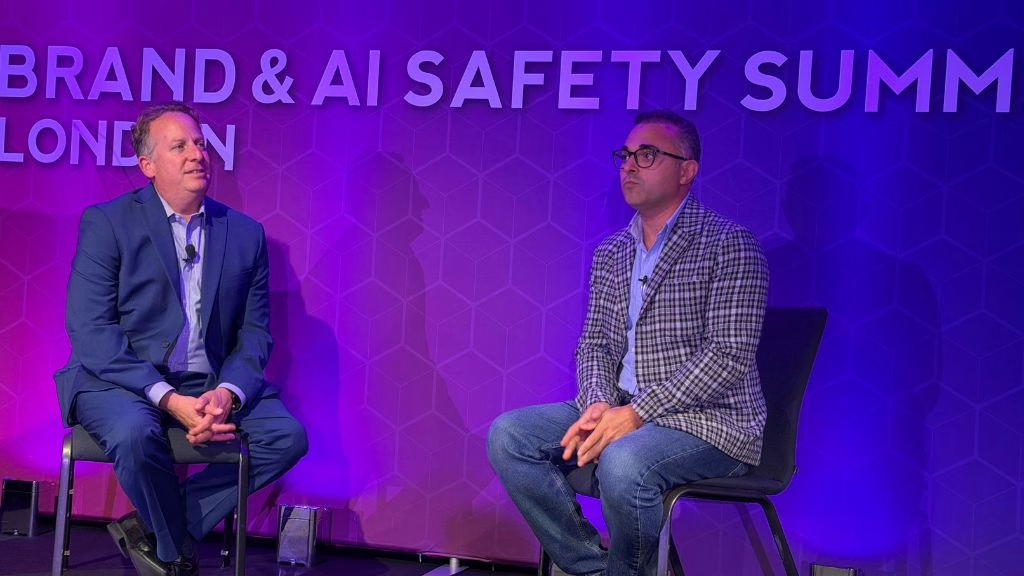
Hakim Charles, Founder of Vellum Intelligence and former public policy and regulatory affairs leader at Meta and X, joined Rob Rasko, President, Brand Safety Summit in an interview to close this year’s show to discuss advertising in the age of AI, the implications for brand safety and why brands may soon need to appeal to machines as well as humans.
How does AI change the traditional conversation around brand safety?
Historically, brand safety has largely been about adjacency. Brands ask where their advertising is appearing and whether it is sitting alongside content they are comfortable being associated with.
Conversational AI makes that much more complicated. It is no longer enough to think purely about adjacency. We also have to think about transparency and trust, and increasingly about whether an AI agent itself can trust a brand or its advertising.
That creates an entirely new set of questions for advertisers.
Are AI developers actually thinking about advertising when they build these systems?
Some are and some aren’t. There are companies that have built their AI products first and are now introducing advertising infrastructure into an existing conversational environment. Others are thinking about advertising as part of the architecture from the beginning.
Then you have companies such as Anthropic, which has taken the position that advertising could create a conflict of interest. If an AI agent is supposed to act on your behalf, does it serve you or does it serve the advertiser?
That becomes particularly important when these systems are involved in sensitive conversations, including those around mental health or emotional vulnerability.
But if an AI recommends a product, isn’t it already doing something very similar to advertising?
That’s where it becomes ambiguous. If you ask an LLM to recommend a pair of shoes, it will suggest particular products or brands. We don’t necessarily know why it chose those products.
There may be no commercial relationship involved, but the system is still influencing a decision. So we need to think carefully about what advertising actually means when AI increasingly mediates the relationship between consumers and brands.
Why is advertising inside conversational AI fundamentally different from traditional advertising?
Think about a billboard. Whether you’re happy, sad, recently divorced or have just received a promotion, you see the same billboard. It exists independently of your emotional state.
AI is completely different because advertising can become embedded within the conversation itself.
Previously, we created an ad, distributed it and measured the outcome. AI potentially collapses all those stages together. It can understand intent, create content, target an individual, persuade them, complete a transaction and potentially upsell them.
That creates enormous opportunities, but also risks we don’t yet fully understand.
Imagine somebody discussing a physical or mental health problem with an AI system and a particular brand is recommended. If something subsequently goes wrong, where does responsibility sit? These are scenarios brands need to start considering now.
What areas should the advertising industry be researching?
One of the most interesting is what happens when AI agents begin acting on our behalf.
Advertising has traditionally been designed for humans. Brands want to be memorable, creative and distinctive because they are competing for human attention.
But imagine an AI agent with permission to use your credit card. It can research products, compare alternatives, make recommendations and potentially purchase something for you.
At that point, the audience is no longer necessarily human.
What does that mean for brands?
It means brands can’t just be memorable. They also have to be machine-readable.
An AI agent isn’t necessarily going to care that you have a brilliant piece of creative. It may care much more about whether your product information is structured properly, whether your pricing is clear, what reviews exist and whether there are reliable signals that the product can be trusted.
We’re moving towards an environment where brands may need to persuade humans while simultaneously making themselves understandable and credible to machines.
Could we eventually be advertising to AI agents rather than consumers?
Potentially, and that’s why this area needs much more attention.
A consumer might eventually have several AI agents acting on their behalf, researching different things, comparing products and making decisions. That adds another layer between the advertiser and the individual.
The question becomes: how do you make your brand discoverable and attractive to those agents while protecting its integrity and safety?
We’ve spent decades learning how to influence human audiences. Now we may also have to learn how to communicate with machines making decisions for them.