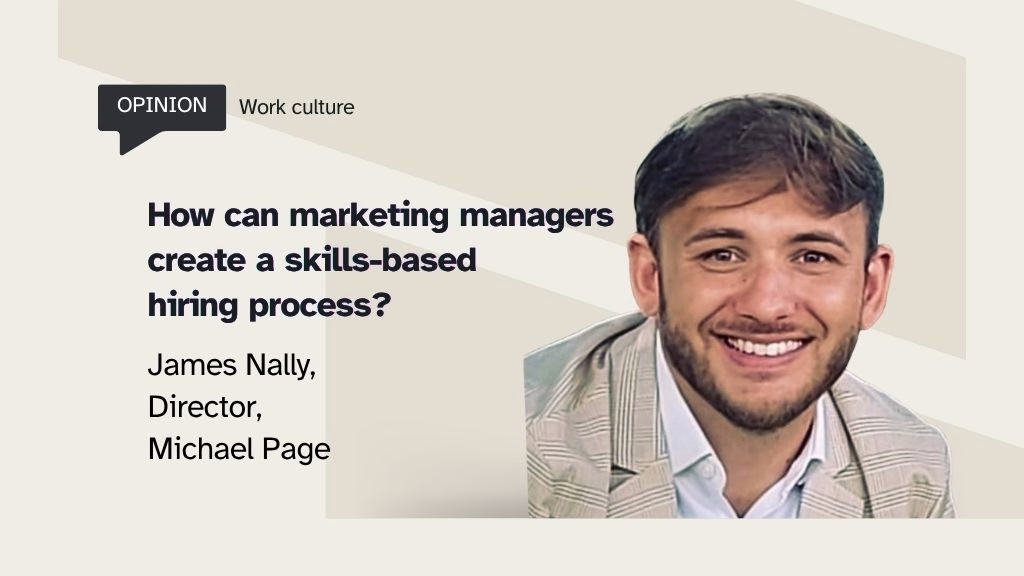
by James Nally, Director of Michael Page‘s Marketing and Digital Practice
In today’s job market, the volume and polish of applications has shifted quickly, largely thanks to AI. More job seekers are using it to apply for roles, meaning hiring managers are seeing more applications than ever, many polished to a similar standard. That’s making it both harder to tell candidates apart on paper and pushing organisations hiring marketing talent to rethink how they assess candidates in the first place. Michael Page’s latest Talent Trends research shows marketing leading that shift: more than half (51%) of marketing hiring managers value demonstrated skills over a candidate’s career history and education, well above the 33% national average.
Yet only 56% of marketing hiring managers say their organisation has actually formalised skills-based hiring into its processes – below the 66% national average. Marketing hiring managers, in other words, are ahead of the curve in belief and have a genuine opportunity to catch up in practice. The question isn’t whether skills-based hiring matters (that’s already clear) but how to turn that conviction into a hiring process that reflects it.
A landscape reshaped by AI
Marketing is experiencing this change more than almost any other sector. It has one of the highest rates of AI adoption among job seekers of any sector surveyed: 90% of marketing applicants now use AI tools when applying for roles, well ahead of the 67% national average.
With that many candidates using AI, a polished CV isn’t always a reliable signal of capability on its own. And for a sector that moves as fast as marketing, where the skills a role needs can shift within a single campaign cycle, hiring managers often need a fuller picture than a CV alone can offer.
The skills that matter most
Marketing hiring managers are clear on what they’re looking for. The Talent Trends report shows communication (32%), interpersonal skills (30%) and analytical thinking (28%) are valued more than any other capabilities. These are exactly the kind of skills a CV finds hard to demonstrate on its own.
Skills-based hiring closes that gap. Rather than relying on job titles or qualifications, it assesses what a candidate can actually do and what they’re capable of learning next, through structured interviews, work-based exercises and real evidence.
It’s an approach with strong support on both sides of the hiring table: all of the marketing hiring managers surveyed (100%) report tangible benefits, most commonly clearer criteria for comparing candidates (49%) and an easier match to current and future skill needs (38%). Candidates are just as convinced – 65% say they’re more likely to apply to an employer that hires on skills rather than education or career history, above the 58% national average.
With that level of appetite on both sides, the real opportunity now is putting it into practice.
Turning intent into action
Knowing skills matter is the easy part. Building a hiring process that reliably surfaces them takes a bit more work – but it rests on three things coming together.
Structured assessment brings consistency. Rather than trying to read communication or analytical thinking off a CV, hiring teams can test for them directly – a short campaign brief or creative problem-solving exercise shows how a candidate actually thinks and communicates under real conditions. Asking every candidate the same set of core interview questions makes it possible to compare like with like, and scoring against agreed criteria, rather than gut feel, helps those decisions hold up under scrutiny.
Sector expertise adds the context a scorecard can’t – and it’s where a specialist recruiter earns their keep. Someone who spends their time deep in a single market knows what “strong” actually looks like for a specific marketing discipline, channel or business stage, and can spot the difference between two CVs that look similar on paper but represent very different candidates.
Recruiters also bring relationships that a single application can’t replicate. A specialist who’s placed a candidate before – or watched them move across several roles – understands how they’ve grown, what motivates them, and where they do their best work. That’s context no interview process builds on its own.
None of this needs to be built from scratch. It’s exactly the kind of process a specialist recruitment partner is already set up to support, bringing structure, sector knowledge and candidate relationships that many in-house teams don’t have the time or reach to build alone.
Looking ahead
Marketing hiring managers have already done the hard part: recognising, more clearly than almost any other sector, that assessing skills tells them more about a candidate than a CV can. What’s left is building a hiring process to match – and with more applications arriving polished to a similar standard, there’s a real advantage for the employers that move first.
To explore more insights from Michael Page’s 2026 Talent Trends report, click here.