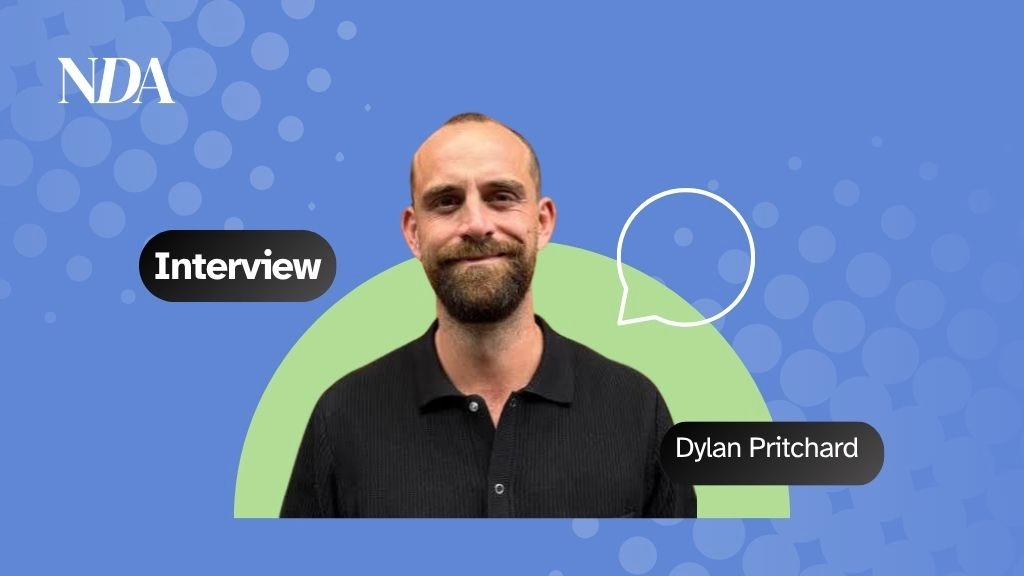
As Head of Audiovisual (AV) at Bicycle London, Dylan Pritchard occupies a unique vantage point in the UK media ecosystem. Responsible for navigating the rapid shift between traditional broadcast TV and streaming platforms, Pritchard has championed a video-first mindset across client portfolios. NDA sat down with him to talk about the death of the traditional Insertional IO, why linear TV is no longer untouchable, and how agencies must evolve to survive.
The UK AV landscape is shifting rapidly. What is the single biggest change you’ve seen in how advertisers approach video budget allocation over the past couple of years?
For decades, linear TV was treated as virtually untouchable. It was the automatic foundation of every serious media plan because of historical ROI and broad audience reach. Today, sophisticated measurement tools like Market Mix Modelling (MMM) and multi-touch attribution are proving that digital video and Connected TV (CTV) frequently outpace traditional broadcast on pure ROI.
We’ve seen a clear movement away from linear-first strategies toward video-first approaches.
Even when planning for older demographics, where people assume broadcast is still king, we’re routinely shifting 60 to 70% of AV investment into digital video spaces. The consumer habit transitioned long ago; modern media planning is simply catching up to where attention actually lives.
How has the role of the modern AV buyer changed since you first entered the agency world?
There was a phase during the early growth of VOD where I genuinely felt my job was becoming obsolete. I had gone from meticulously planning and buying individual broadcast spots to simply signing off static IOs worth hundreds of thousands of pounds without much active management.
It felt passive, and frankly, if an agency’s sole role is approving IOs, clients will eventually bring that capability in-house.
The rise of DSPs like The Trade Desk and Amazon DSP has completely reignited the sector. Today, AV specialists have to be hands-on programmatic operators.
We aren’t just buying bulk reach; we are managing audience data, optimising supply paths, and actively adjusting campaigns mid-flight to drive tangible business outcomes.
Speaking of programmatic trading, how do you handle internal alignment between programmatic and AV teams at Bicycle?
Historically, media agencies built rigid silos between the traditional AV team and the digital programmatic desk. That separation makes zero sense in today’s ecosystem.
At Bicycle, we actively work to integrate those disciplines. Naturally, my team handles the bulk of high-volume video and CTV agreements, but we don’t block the programmatic performance team from buying video inventory if it helps them hit a specific acquisition target.
Democratising access to inventory across the agency ensures the client gets the best outcome rather than an outcome dictated by agency structure.
Measurement remains a controversial topic in the UK. How do you view recent industry updates, such as Barb incorporating YouTube TV viewing data?
It is a major, welcome step toward standardised, cross-platform measurement. Being able to evaluate YouTube on the living room screen alongside traditional broadcast gives advertisers a far better foundation for apples-to-apples comparisons.
However, we have to acknowledge the context.
Measuring YouTube on TV screens captures a distinct viewing behavior, but YouTube consumption across mobile and desktop remains vast and fragmented. Broadcasters still deliver unmatched mass reach in a single hit, whereas CTV and YouTube offer exceptional incremental reach, particularly among younger audiences.
The goal isn’t to crown a single winner; it’s about using independent data to find the optimal, most efficient mix.
What’s the biggest challenge in the AV and CTV market right now?
The fragmentation of supply paths and the lack of backend transparency.
Programmatic activation has brought incredible agility, but it has also allowed complex intermediary chains to emerge. It can make trading unnecessarily murky.
As an agency, our job is to strip away that complexity, clean up supply chains, and guarantee that client budget goes directly toward high-quality, viewable content rather than unnecessary tech markups.
Finally, what advice would you give to independent brands trying to navigate the AV market today?
Don’t let traditional broadcast barriers hold you back. Historically, smaller brands were priced out of TV due to creative costs and high minimum spends.
On-demand video and programmatic CTV have lowered the barrier to entry significantly. You can now target precise audiences on the biggest screen in the room with full geographic and behavioral control. Focus on high-impact video, measure the response rigorously, and scale from there.