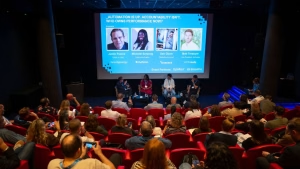
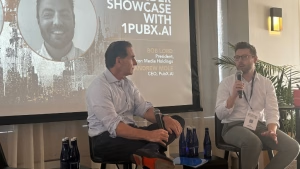
Nicola Webb was an attendee at the recent Bluestripe “Selling The Sellers” breakfast, where one of the key topics to emerge was that adtech sales will always need a human touch. In her first column for NDA, Nicola expands on this theme
Trust, the ability to listen and confidence feel like they’re in shorter supply than ever.
Everyone says people buy from people. In a world where every product, every pitch and every AI-generated email increasingly sound the same, perhaps what people are really buying is confidence.
Confidence in a decision, a supplier and that someone will still answer the phone when something goes wrong. Yet we seem determined to remove as much humanity from the buying process as possible. We spend millions automating conversations instead of having them. We build nurture sequences, automate outreach and personalise at scale. We create ever more sophisticated ways of contacting prospects. Then we wonder why they don’t reply.
Perhaps because they’ve received the same “personalised” email from twenty-five other companies before lunch.
After more than twenty years in media, adtech and sponsorship sales, I’ve watched our industry become immeasurably smarter. We have more data than ever. Better attribution. Better targeting. Better technology.
Yet the hardest part hasn’t changed one bit. Getting another human being to trust you.
I remember when salespeople were almost expected to be larger-than-life characters. Always the last one standing at an awards do at Grosvenor House. Lunches regularly turning into all-day and night affairs and the expectation that an Insertion Order would come through on the fax machine soon after (gosh I’m old!)
Thankfully, most of that expectation has disappeared; however, I fear we have replaced it with something almost as bad. Companies and often people sound the same.
Every LinkedIn message starts with “I noticed your recent post…” An email begins with “Hope you’re well.” Each pitch deck promises “AI-powered solutions that drive measurable business outcomes.” AI has undoubtedly made us more productive, but it has also made it easier than ever to sound exactly like everyone else.
By slide seven of a presentation, you’re wondering whether you’ve accidentally opened the same presentation three times….
Here’s the irony. As products become increasingly similar. people matter more. Most technology today is brilliant. Most companies can solve broadly the same problems. Margins of difference exist, of course, but rarely enough for a buyer to confidently say:
“This platform is objectively 37% better than that one.”
So, what happens? People become the differentiator. Would I trust this person with my budget? Would I enjoy working with them when something inevitably goes wrong?
So, perhaps that’s what trust really gives us. Confidence. Confidence to sign the contract. Confidence to back an idea internally. Confidence to recommend a supplier to your boss. Because without confidence, something else creeps in : Inertia. We ask for another meeting, and we request one more tweaked proposal. A decision is made to revisit it next quarter, and not because the buyer doesn’t understand the solution but because there isn’t the confidence to move and buy.
Here’s my controversial opinion: pick up the phone. Not everything needs another Teams call or a follow up email – it requires a human touch. It still amazes me how many difficult conversations people try to have over email.
One of the best salespeople I ever worked with wasn’t the loudest. He wasn’t the slickest presenter either. In fact, his PowerPoint was pretty average. What he did brilliantly was ask questions. Then he listened properly. People left meetings feeling understood rather than sold to. Unsurprisingly, he was also the highest bonussed sales individual in the business.
I’ve always believed there’s a difference between being persuasive and being useful. The first helps you close deals. The second builds a career.
When clients call you before they’ve even written the brief…When recruiters phone because someone has recommended your name…When ex-colleagues become customers…
That’s not because your discovery framework was exceptional. It’s because people trust your judgement.
Trust is strangely old-fashioned. It isn’t scalable. It doesn’t fit neatly into a CRM field. There’s no dashboard measuring “keeps their word.”
But in our industry, it’s probably still the most valuable commercial asset you can build, especially now.
Of course, this isn’t just about sales. It’s about leadership too. The best leaders I’ve worked for didn’t have every answer. However, they listened, admitted when they made a mistake and my favourite – celebrated other people’s success. They created environments where people wanted to do good work rather than simply avoiding bad outcomes.
The same principles apply whether you’re leading a team or trying to win a client. People remember how you make them feel.
So perhaps that’s the challenge for all of us. In an industry obsessed with technology, efficiency and automation…How do we ensure we remain unequivocally HUMAN
Because when products look increasingly similar, and AI can write almost every email we’ll ever send…technology will continue to evolve and AI will naturally get smarter.
Products will become increasingly difficult to differentiate so trust may well become the last real competitive advantage.
People rarely buy when they’ve been convinced. They buy when they feel confident enough to say yes.