Global B2B marketing agency tmp recently published major new research, revealing a sector under unprecedented strain.
Drawing on insights from 1,000 marketers and tech buyers across the UK and US, the research shows a marketing industry at breaking point. More than half (53%) of marketers describe their working environment as chaotic, while burnout, fatigue (34%) and heightened stress (34%) are widespread for over a third. Nearly three quarters (72%) say they are not sleeping properly, with many working extra hours, skipping breaks and deprioritising long-term planning.
But the chaos is not limited to people. It is embedded in processes, with product (40%), partner (29%) and demand (28%) identified as the most disconnected areas of the marketing function. Fragmentation is creating stalled deals (29%), inconsistent quality of work (33%) and missed opportunities (32%), all reported as key challenges for marketers.
The findings paint a clear picture: marketing, sales and partners are not aligned, and buyers feel the effects. Deals now involve 11 or more stakeholders, while too much content (34%), unclear vendor messaging (31%) and lack of trust (33%) are major obstacles in the buying journey.
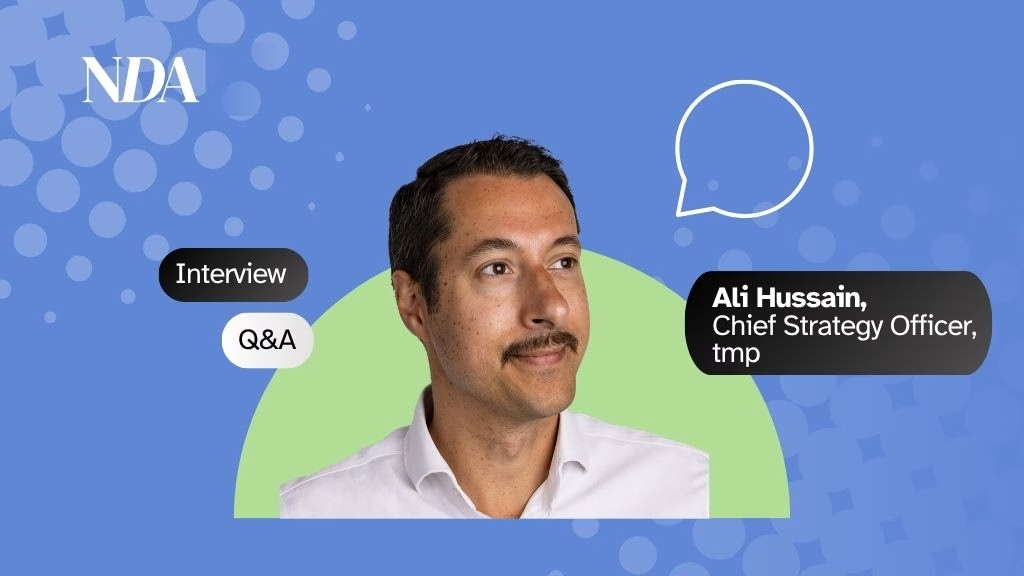
Ali Hussain, Chief Strategy Officer at tmp, said: “In 2026, marketing teams are being asked to do more with less, to use AI, to move faster. That’s exacerbating the problem – they’re scaling fragmentation. Instead, marketers need to focus on creating coherence across data, strategy, creative, media and sales, from reputation-building to revenue and on through retention.
New Digital Age spoke to Hussain to find out more about the research findings…
What stood out most to you in the research?
The biggest challenge for marketers and buyers right now isn’t AI, growth, or budgets. It’s chaos. Geopolitical instability, economic uncertainty, and incredibly fast technological progress are cascading through markets and organisations, and that’s having a real impact on B2B marketing and buying.
How is that showing up in practice?
Teams are dealing with constantly changing objectives, restructuring, too many tools, too many systems, siloed teams, and fragmented media. All of that is pulling apart both the marketing function and the buyer journey. The answer isn’t more tools or more speed. It’s coherence.
Was there anything in the findings that surprised you?
One thing was the extent to which buyers themselves are feeling the chaos and fragmentation throughout the journey. It’s not just a marketing problem; buyers notice it too. Another was how many marketers are still struggling to tell a coherent story about the value marketing creates for the organisation.
You used the phrase “fragmentation is being scaled.” What do you mean by that?
If everyone in an organisation is already moving in slightly different directions, with different incentives and different views of success, then giving them all more speed through AI or other tools can make the problem worse. You don’t just get more efficiency; you can get more chaos. That’s what I mean by fragmentation being scaled.
What should marketing teams do about it?
They need to focus on bringing things together. That means building a strategy that works across marketing and the wider revenue function, creating brand identities and creative ideas that work across multiple channels, and making sure media and creative are developed in a joined-up way. It’s about moving from random acts of marketing to a coherent approach that compounds over time.
Are client expectations changing?
Yes. Clients are looking for deep expertise to help them navigate change. Domain expertise matters more than ever. They also want help managing the fact that there is now too much content in the market, which can make the buyer journey harder rather than easier.
How is AI affecting that conversation?
Clients want help using AI in a coherent way. There’s huge opportunity in AI around efficiency, effectiveness, and innovation, but there’s also risk. Many clients have a lower appetite for that risk than agencies do, so part of the agency’s role is to move faster and help them capture value while managing that risk.