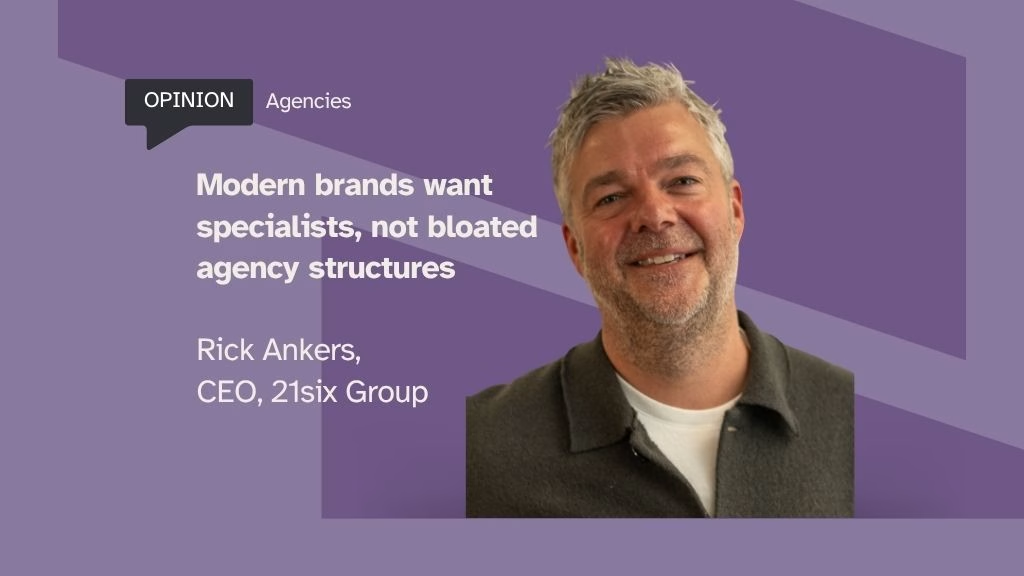
By Rick Ankers, CEO of 21six Group
The way creative businesses create value is changing.
For most of the last two decades, growth in the creative and media industries followed a fairly predictable formula. Scale was the ambition. More services, more departments, more offices, more capability. The bigger the network became, the more valuable it appeared, both commercially and strategically. Clients bought into that logic too, as the media landscape has increasingly fragmented across platforms, formats and channels, the amount of work involved in reaching audiences has increased significantly.
Brands suddenly needed more content, more campaign assets, more reporting, more specialisation and more measurement than ever before. Large agency groups offered breadth, international reach and the convenience of accessing multiple specialisms under one banner. Integration became the promise, one agency group coordinating increasingly complex marketing ecosystems on behalf of clients.
But suddenly, over the last few years, expectations around what clients value have started to shift. The market has changed. Technology has changed. And that means the economics of modern creative work look very different to the economics the industry was originally built around.
What will clients pay for?
Today, clients are under pressure to move even faster, produce even more content and yet justify spend more clearly, all whilst demonstrating measurable commercial impact almost immediately.
At the same time, AI and automation are fundamentally changing how agency work gets done behind the scenes. Tasks that once took days now take hours, even minutes. Production cycles are shorter. Administrative and operational workflows are becoming leaner. Entire layers of delivery are being compressed.
Which means the conversation is increasingly moving away from scale for the sake of scale and towards a much simpler question: what are clients actually wanting to pay for now?
And how can you differentiate amongst the noise and slop?
Increasingly, the answer is not infrastructure. It is expertise.
For years, a significant proportion of agency fees inevitably went towards the machinery surrounding the work. Offices, layers of management, operational complexity, internal process and coordination. That made sense when delivery itself was more labour intensive and complexity required larger operational structures to manage it.
Now, technology is changing the equation. AI is accelerating production, streamlining administration and removing many of the repetitive or time-consuming parts of the process. The middle of delivery is becoming faster, leaner and more efficient.
But interestingly, that does not make human expertise less important. If anything, it does the opposite. As technology makes execution faster and more efficient, the quality of the thinking behind the work becomes far more visible. AI can streamline processes, but it cannot replace judgement, creativity or genuinely original ideas.
The value of specialists
That is why many clients are placing greater value on specialists and senior expertise; people with deep understanding of a category, discipline or audience, and trusted partners who genuinely understand a client’s business and commercial objectives.
In increasingly competitive markets, businesses are looking for trusted partners who can contribute real commercial thinking and deliver meaningful output quickly, not simply manage processes around it. That is where independent agencies and smaller specialist groups are increasingly finding their advantage. Clients want closer access to senior expertise, faster decision making and teams who are deeply embedded in a particular category, discipline or audience, rather than layers of management sitting between strategy and execution.
In many ways, the industry is moving back towards valuing craftsmanship and experience, just with the modern tools now available to support the sheer scale of modern content that modern media demands. Brands today are creating significantly more assets across more platforms, formats and audiences than ever before, and AI is helping businesses manage that complexity far more efficiently – they don’t need bloated agency structures to do that.
What they do need is the initial strategic thinking, the right data and insights to back up their strategies and the creative direction. This still comes from people.
The ideas, instinct and understanding of what will resonate culturally or commercially cannot be automated. Increasingly, that is where brands want white-glove support and genuine senior expertise, at the front end of the process, where the thinking happens.
Preserving autonomy
That shift is also changing how newer groups are being structured.
Rather than building vast organisations where specialist businesses are absorbed into a central machine, there is growing interest in models that preserve expertise and autonomy, while still allowing companies to collaborate when needed.
That is something we have thought about carefully with the 21six Group, and I’m delighted by the quality of thinking, and the humans we have involved! They can all pull on vast experience to deliver brilliant work – from leadership roles at globally respected companies like Red Bull, to building and exiting their own previous companies. As well as being people I love spending time with in both a professional and personal capacity – something increasingly important in my view to build trust and confidence.
The goal was never to create another traditional holding company structure. It was to build a group of genuinely specialist businesses that are strong enough to operate independently but aligned enough to come together seamlessly when clients need integrated support.
Clients today are far less interested in complexity for the sake of it. They do not want to feel like they are paying for layers, overhead and operational weight before seeing meaningful output. They want confidence that investment translates into real commercial value.
Equally, specialist businesses are often successful precisely because of their focus, agility and expertise. Folding them into overly rigid structures can dilute the very thing that made them valuable in the first place.
The challenge now is creating models that allow specialists to remain specialists, while still giving clients access to broader integrated capabilities when required. And ultimately, that is where the industry appears to be heading.
AI will continue to reshape how creative businesses deliver work. But in doing so, the value of strong human judgement, creativity and specialist expertise will only become more visible, and more valuable.