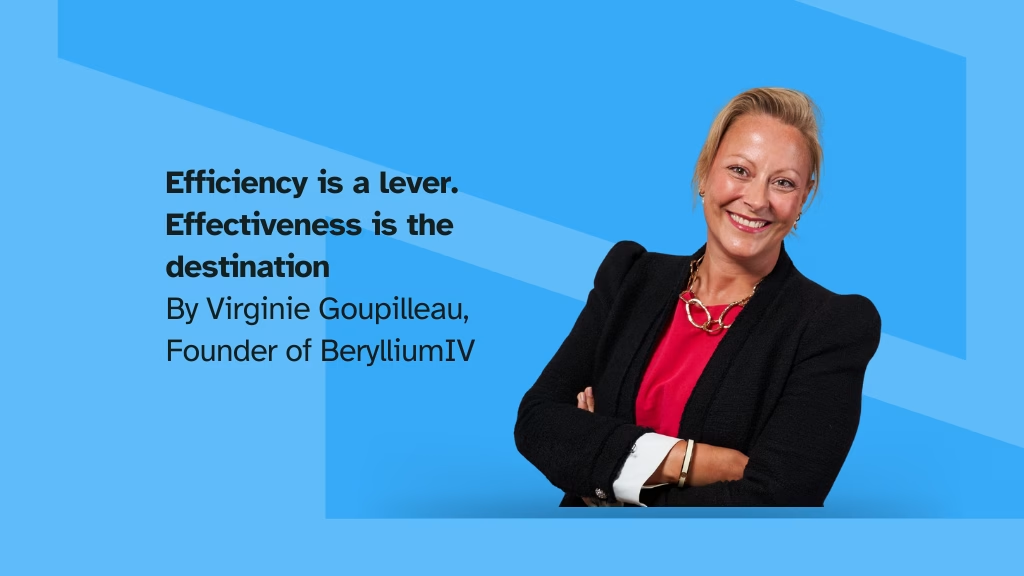
By Virginie Goupilleau, Founder of BerylliumIV
The AI race in our industry has been framed almost entirely around efficiency. More output. Less headcount. Faster delivery. The holding and big tech companies are investing billions in AI platforms whilst laying off thousands. The trade press is full of stories about reduced turnaround times, automated content production, agentic buying and selling, and campaign optimisation that runs itself.
Read the articles and case studies. They are impressive. Now look at the margin reports.
When everything is optimised for volume, output becomes a commodity. And commodities race to the bottom on price, on quality, and on differentiation. And clients start to notice. The service doesn’t improve or decline. Innovation is absent. The churn game is ON!
Efficiency is not a strategy. It is a starting condition. The playing field is currently being levelled up at pace, whilst the margins are put under unprecedented pressure.
That is the wrong race to win. The wrong place to be as a business.
The Evidence Is Already Here
A landmark field experiment published by INSEAD and Harvard Business School in March 2026 tracked 515 high-growth startups through an AI adoption programme. The firms that were simply given AI tools saw marginal gains. The ones that were coached to rethink where AI creates value across their production process saw something significantly different: 12% more tasks completed, 1.9 times higher revenue, and 18% more likely to acquire paying customers.
What moved the needle here came down to the cognitive shift required, not the tools that you used. The researchers called it “the mapping problem”: discovering where and how AI creates value within a firm’s production process. The firms that cracked it used AI to do fundamentally different things.
McKinsey’s 2025 State of AI report found that two-thirds of organisations are stuck in what is called “pilot purgatory”. They are running AI experiments that never graduate to production because they bolted AI onto unreformed processes. If your AI pilots are not moving EBIT, the problem is almost certainly an operating model and measurement issue.
Put simply, it is a strategy problem. And it is a problem our industry has been largely unwilling to tackle properly.
Advertising’s Efficiency Trap
The advertising and media industry has a specific version of this challenge.
For decades, agencies have sold time. Hours of strategic thinking, hours of creative development, hours of media planning and activation. The business model was built on the billable unit. The good old FTE model served the industry well for a long time. AI threatens it because it collapses the time that used to justify the invoice: planning, buying, running campaigns, reporting. As a consequence, these jobs are now unfairly devalued to the eyes of the brands and their procurement teams who were served a standardised lever for negotiation on a platter.
The instinctive response has been to use that collapsed time to produce more of the same thing. More creative variants. More reporting. More content at scale. More plans. More campaigns. More. More. More. According to IAB’s 2026 Outlook Study, buyers are moving toward performance-led strategies, and the pressure to demonstrate measurable outcomes is intensifying, even for brand led activities. Yet a Gartner study found that 38% of US digital agencies have moved at least one service line to outcome-based pricing in 2026, meaning the majority are still operating on models that reward input rather than impact.
There is a paradox sitting at the centre of this. The platforms are eating the executional layer. Google, Meta, and Amazon have spent years building AI systems that can plan, create assets at scale, buy, and optimise without human intervention within a closed loop measurement environment. eMarketer projects that autonomous AI will manage 78% of all programmatic advertising spend by 2026. If agencies respond by becoming faster executors, they are competing with the very infrastructure their clients pay for directly. That is not a position. It is a slow exit.
The Intelligence Layer: AI as Glue, Not Just Accelerant
Here is what efficiency-first thinking misses. AI is not just faster. At its best, it is connective.
The traditional agency model is structured around silos. Creative. Media. Data. Technology. Strategy. Each discipline has its own incentives, its own leadership, its own language. Briefs move between them like parcels being handed over a fence. Information decays at each handoff. The intelligence one team builds is rarely visible to the next.
AI changes this, but only if you redesign for it rather than bolt it on. McKinsey’s research on agentic organisations describes a future where organisation charts built on hierarchical delegation pivot toward what it calls “work charts” built on exchanging tasks and outcomes. The agencies of the future will be using AI to collapse the siloes that make the model inefficient in the first place.
Imagine a media planning process where the creative brief, the audience insight, the channel data, and the performance feedback are connected in real time rather than shared sequentially in a deck. Imagine a client relationship where the strategic recommendation is not delivered quarterly but is updated continuously as the market shifts. This is not a technology vision. It is an operating model vision and a true value proposition based on judgment, strategic thinking, creative approach and execution at pace. The technology makes it possible. The leadership decision makes it real.
Moving Up the Value Chain
The agencies that are genuinely ahead have made a deliberate decision to reposition, to stop selling executional hours and start selling outcomes, human judgment, and strategic thinking.
It requires a different commercial model, an upskilled talent mix still anchored in the same expertise fundamentals, a different relationship with clients, and a different definition of what the agency is here for. It requires leaders who are willing to have uncomfortable conversations: we are going to produce less volume, and here is why that is worth more to you.
The INSEAD and Harvard research gives that conversation its backbone. Firms that shifted their AI use toward product development and strategy, rather than just automating existing tasks, generated 1.9 times more revenue. They grew faster. And their demand for external capital fell by 39.5% relative to the control group, because they were building businesses with genuine structural advantage rather than marginal efficiency gains that just level the playing field.
The same dynamic is available to agencies. Not by copying what startups do, but by understanding what the research reveals about where AI actually creates value: not in task completion, but in production redesign.
The New Commercial Logic
When an agency uses AI to produce 10 times more content for the same fee, it has made itself cheaper. When it uses AI to provide strategic orchestration across creative, media, data, and technology in real time, it has made itself indispensable. These are not the same thing. And that is exactly the platform play that most holding companies are playing right now. Once a client’s workflows are anchored to a proprietary SaaS layer, switching becomes structurally difficult. That is not a service model. That is a lock-in model, and it is working.
The shift from production to orchestration is not just philosophical. It changes the revenue model. It changes which talent matters and how much they are worth. It changes what the client conversation is about. Agencies that sell outcomes measurable in real time can command a different kind of commercial relationship than those who sell hours. Retainer-plus-performance, outcome-based pricing, shared risk and reward structures, transparency of measurement: these are the models that align agency incentives with client growth rather than with volume of activity.
McKinsey’s research on AI maturity is instructive here. Only 1% of business leaders describe their companies as genuinely AI-mature, meaning AI is fully integrated into workflows and driving measurable business outcomes. The gap between adoption and maturity is vast. Agencies that close that gap for their clients, not just for themselves, are creating a category of value that no platform can replicate.
THAT is the business to build.
This Demands a New Kind of Leadership
None of this is automatic. It requires a specific kind of leadership, one that can hold operational rigour and strategic imagination at the same time.
The organisations moving forward now are the ones that made three decisions in 2024 rather than waiting for certainty. They treated AI as a foundational shift, not a phase. They invested in governance before a public incident forced the issue. And they restructured the shape of the organisation rather than assuming retraining alone would suffice.
In advertising, that means being honest about what the agency model is currently optimised for. It is optimised for output. It needs to be optimised for outcomes. That is a different workforce shape, a different incentive structure, and a different conversation with the people who run the business and with clients.
The leaders who can navigate that transition understand the business well enough to know where AI creates genuine leverage, and who have the credibility to take the organisation with them through the discomfort of change. They combine operational fluency with strategic clarity. They are the next generation of leaders who still know what it means to run the business, where the rubber meets the road. And they can translate that into a vision people will follow.
There is a reason transformation programmes fail. It lies in the gap between the vision on the slide and the operating model on the ground.
The Destination
The winners of the AI era in our industry will be the agencies moving the conversation upward. From production to strategy. From delivery to design. From selling hours to selling results.
This is available to any agency that is willing to make the decision. Not the technology decision. The strategic one. The ones that require work, not the quick fix.
Efficiency has always been a means, not an end. Pursued for its own sake, it cheapens the conversations and pushes the prices down. AI just amplifies that. That is precisely why it is no longer a source of advantage. The advantage lies in what that efficiency creates.
Effectiveness is not harder to achieve with AI. It is now harder to settle for anything less.