AI advertising platform StackAdapt has released The AI Delegation Gap, a global report examining how marketers are redefining decision-making in advertising as artificial intelligence becomes more deeply embedded across campaign workflows.
Based on a survey of 500 marketing and advertising professionals across North America, EMEA and APAC, the findings reveal marketers are increasingly comfortable allowing AI to recommend actions, prepare work for approval and operate within clearly defined guardrails. Confidence drops significantly, however, as AI moves toward autonomous decision-making.
The research found that nearly eight in ten marketers (79%) feel pressure to increase AI usage, while 59% believe leadership expectations are ahead of their organization’s readiness. Only 19% say their AI tools are fully integrated into marketing and advertising workflows, highlighting the gap between AI ambition and operational readiness.
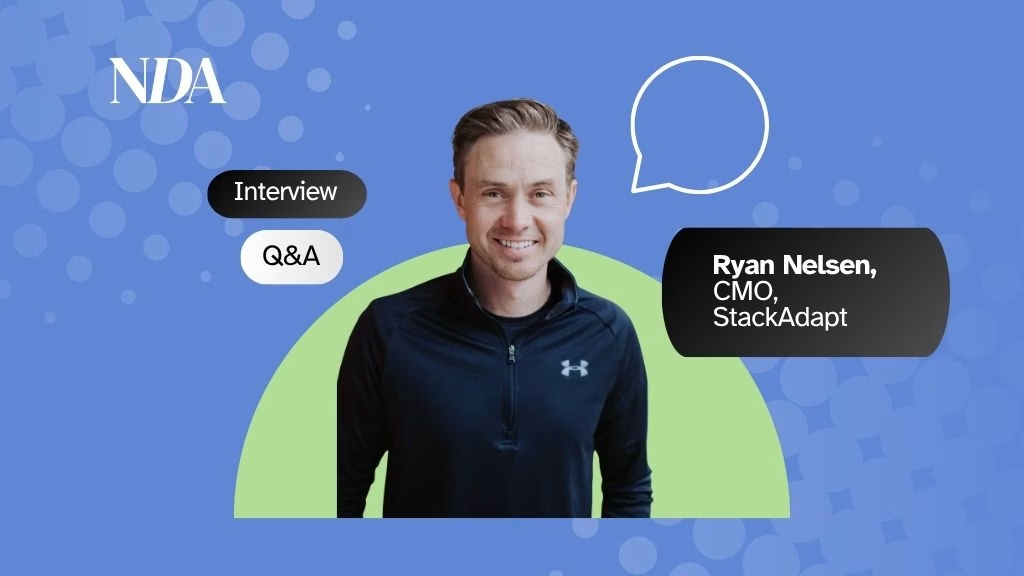
New Digital Age spoke with Ryan Nelsen, Chief Marketing Officer at StackAdapt, to find out more…
What motivated StackAdapt to commission the research?
StackAdapt has a large number of customers and a large amount of data, and we also have a point of view that we want to share with the world. We want to capture our own proprietary research and share it with our clients.
The research was really commissioned to identify the gap between AI usage and the trust that advertisers and marketers have in AI. We identified several trends and findings within that, and we call that the “AI delegation gap”.
What were the headline findings for you?
I think the biggest one is that 91% of advertisers use AI, but only 50% would let it decide alone. That drops all the way down to about 6% who would act straight away on the things it recommends.
There’s this gap from 91% to 6%, and I think over the next year or two, or the next couple of years, we’re going to be closing that gap with the confidence that advertisers and marketers have in the recommendations that AI makes. It’s interesting to set the benchmark today and see where that goes.
Another interesting finding was that 60% almost always act on platform recommendations, but 42% ignore them when they feel generic or irrelevant. People don’t want to take action unless they have the right context, the right explanation and the right KPI relevance.
Was there anything else that particularly stood out?
Another interesting one was that 58% of decision-makers are comfortable with autonomous AI, versus only 34% of the practitioners using the AI. So the leaders have more confidence that the AI is going to do the right thing versus those that are in the details.
I thought that was interesting – that leaders and practitioners are using AI differently.
And then maybe one other finding was around ‘brand risk’ as a barrier to more autonomous AI. Sixty-three per cent cite brand risk, and 56% cite data quality as barriers to greater delegation.
Advertisers are wanting to test and predict impact, and ultimately create an environment where you understand when AI can act versus when a human needs to intervene.
What emerging trends do you think could become more important over the next couple of years?
I think AI ambition is really outpacing our operational readiness as businesses. Seventy-nine per cent feel pressure to increase AI usage, 58% say leadership expectations may be ahead of their readiness, and only 19% say AI is fully integrated into their workflows.
Leadership has very high expectations. The teams and the practitioners that are putting it together are moving quickly, but maybe not as quickly as leadership would like. There’s probably a little bit of an empathy gap within leadership in many companies.
They see something on LinkedIn or online and say, “Well, they just did that and launched that thing in 20 minutes.” But there’s actually all the data and the infrastructure and the foundational layer required to do that effectively and correctly at scale.
Is part of the problem that management may not recognise the data silos and other barriers that exist within their own organisations?
Absolutely. A lot of companies over this last year have been trying to move so fast that they’ve kind of just given their employees access to AI tools, and everybody is starting from zero in many ways.
They’re asking a question, they don’t like the answer, and the beginners in AI are going back and saying, “Okay, let me reword that,” and asking it again.
Those that are moving up the AI adoption curve, and becoming more advanced and expert in AI, are using skills and agents and foundational frameworks and guardrails. They’re able to use a source of truth or a hub, where there’s an underlying layer that the company is using, so they’re not starting from scratch every single time.
What advice would you offer CMOs who find themselves under pressure to do more with AI than their organisations currently feel ready for?
It comes down to trust. For me, it comes down to hiring and developing really strong talent and giving them the environment to thrive. That means connecting data, systems and processes, and building the foundation for them to build on.
What we’ve done is create an AI centre of excellence. We have a large marketing team, but there are several people within that marketing team who focus on this more closely to make sure we’re building the right systems, data, processes and frameworks.
We also dedicate some time every single week to make sure the team is building and changing the way they operate, and doing that with AI versus maybe the traditional way that they’ve done that. And we’re making it safe to do so.
I think the best CMOs are creating that environment for AI curiosity – to test, to try, to learn, to fail maybe a little bit. Then, as they put more coats of paint on it and get better and gain confidence, that amplification starts to happen externally, where the stakes are a little bit higher.
What safeguards can be put in place to increase marketer confidence in autonomous AI?
I think everybody’s on a different journey within this. We all need a bit of licence to test, to try, to learn.
We launched Ivy Studio at StackAdapt, and we’re seeing rapid adoption of this platform. It’s basically an AI-first advertising hub. It gives all of our customers the ability to go in and, instead of starting a campaign from scratch and saying, “Okay, here’s what I want to do,” you effectively wake up and it says, “Hi Ryan, what can I help you with today?”
You start to think through the prompts and the guardrails and the guidance of what it can do. It’s this copilot that sits alongside you, helping you plan a campaign, develop a campaign, build the creatives, and then prompt you on what actions you can take to create more effectiveness and ROI in your campaigns.