As most people will be well aware, podcasting has seen tremendous growth over the past few years, but what isn’t always considered is how technological advancements and people’s digital audio consumption habits have fuelled this growth.
Edison Research teamed up with AdsWizz and SiriusXM to conduct a UK national survey of 1,313 people aged 16 and older to dive into digital audio consumption habits as part of the first UK Infinite Dial study since 2021. Some of the key findings were shared at The Podcast Show 2025.
Consuming audio smartly
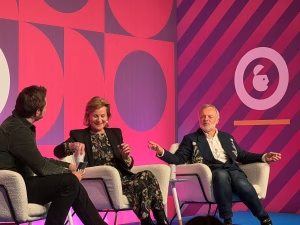
“[The smartphone] has changed the way we communicate. It’s changed the way we date. It’s changed the way we consume digital media,” said Gabriel Soto, Senior Director of Research at Edison Research, speaking at The Podcast Show.
It was revealed that 97% of the UK population now owns a smartphone, compared to 83% in 2021, reflecting “some of the advancements in technology we’ve seen in this intervening period of time,” according to Ollie Chadwick, Regional Director, UK & Ireland at AdsWizz.
“It also means there’s a far greater consumption of digital audio on the go – whether that’s radio, music streaming, podcasts – and the increased prevalence of automated digital audio advertising,” Chadwick continued. “The ability for these advertisers to target these listeners wherever and whenever they are consuming audio content on the go… Targeting capabilities have evolved immeasurably. So, even if listeners cannot be targeted with ads due to GDPR constraints, for example, technology has evolved so much now that contextually relevant ads can be served to listeners based upon the podcast content they’re listening to.”
Between 2021 and 2025, the UK has also seen smart TV ownership increase from 50% to 72%, and smart speaker ownership leap from 25% to 45%.
“As people upgrade their TV, so does the technology capability of all these devices. This can only really increase the opportunity for listeners to consume that audio content and digital audio through other devices, in this instance, smart TVs – whether they are consuming video or not,” said Chadwick.
“The radio – whether AM/FM, DAB, more linear devices – is being gradually replaced by the smart speaker… Again, that brings the multiple benefits of digital advertising with it.”
Into the mainstream
How these advances have impacted podcast adoption is highlighted by the fact that 68% of the UK has listened to a podcast before, with 46% having watched at least one.
As a result, it’s estimated that 71% of the population has listened to and/or watched a podcast before.
“Thanks to all the great content that you’re putting out there, advances in technology, and advances in advertising solutions, we’ve all capitalised on this opportunity, and podcast consumption has increased in the UK in the last four years,” said Soto.
“We estimate that 25 million people are listening to podcasts monthly in the UK. So, accounting for both video and audio podcast consumers, that’s 51%,” Soto continued. “It’s a milestone for the world of podcasting. So today, more people listen to podcasts every month than those that don’t.”
Chadwick added: “I think it’s undeniable – podcasting is in the mainstream now. There’s no fly by night or temporary blip… That’s actually reflected too in what’s happening with advertising revenue. Up until this year, podcast advertising revenue was the single highest growth medium in the intervening four years. So, bigger than search, bigger than display, bigger than CTV, bigger than video.”
Breaking down where people are consuming podcasts, Spotify has the largest market share at 33%. Perhaps surprisingly, showing just how much interest there is in video podcasts, YouTube comes in second at 20%. The top four is rounded off by BBC Sounds (16%) and Apple Podcasts (10%).
Furthermore, 56% of UK men are now consuming podcasts, compared to 42% in 2021. Interestingly, podcast listening has seen a far slower rate of adoption amongst women in UK – only growing from 40% to 46%.
“May well be down to the dominance of male hosts of podcast content,” said Chadwick. “Many top-ranking podcasts are hosted by men, or have more male hosts than they do female hosts. That can, in turn, influence listener demographics, as audience often gravitate toward hosts with whom they have an affinity.”
Other Edison research has found that women podcast listeners point to the host being “one of the most important reasons” for choosing the podcasts they listen to, according to Soto.
Going beyond the studio
With podcasts now firmly part of mainstream media consumption, it will be interesting to see how adoption changes over the years between not just men and women, but within every demographic.
Podcasts – and the consumption of digital audio as a whole – look set to only continue growing for the foreseeable.
“They’re a trusted source of information, they’re personalised, they’re flexible, they’re intimate, it’s immersive. There’s huge amounts of discoverability now available to listeners who are consuming podcast content and it’s been inserted into other areas of people’s lives,” said Chadwick.
“Podcasters now are not just recording podcast shows either – they’re doing events, they’re launching merch as well. So, it’s a bigger and bigger part of people’s lives as a medium. And I think that’s only going to increase, as will all consumption of digital audio.”