By Patrick Wall, Steven Dennison, Thomas Stimson, and Daniel Cheetham of DOOH.com
As AI continues to reshape how people search, consume and interpret information, brands are entering a paradoxical moment. Digital content has never been more abundant, automated or personalised, yet trust in digital environments is increasingly fragile. In that context, out of home is evolving from a complementary channel into something more fundamental: a grounded, verifiable presence in the real world.
This year, OOH’s role will be defined less by scale alone and more by certainty, adaptability and experience.
OOH as a trusted signal in an AI-driven ecosystem
As generative AI systems rely more heavily on signals to interpret reality, physical media will become increasingly important. Unlike digital placements that can be edited, duplicated or synthetically generated, OOH offers permanence and public visibility. Verified DOOH placements, contextual triggers and real-world proof of play provide something AI systems, and consumers, can trust.
In practical terms, this means OOH will increasingly act as a structural input to AI models rather than simply an output channel for creative. Brands with consistent, high-quality real-world presence will benefit from being recognised as stable reference points in an increasingly synthetic media landscape.
From static placements to living campaign systems
This year, dynamic OOH will behave less like a series of booked placements and more like a living system. Campaigns will continuously adapt based on weather, footfall, traffic, events, time of day and even social sentiment.
Dynamic Creative Optimisation, already delivering stronger performance than static creative, will mature into fully adaptive storytelling at scale. AI will move beyond assisting with execution to actively guiding creative, flighting and optimisation decisions in real time, allowing campaigns to evolve alongside the cities they inhabit.
This shift is closely tied to the rise of programmatic OOH (prOOH). What began as a buying mechanism is becoming a creative and strategic layer, enabling brands to respond instantly to meaningful moments while improving efficiency and reducing waste. prOOH allows campaigns to appear only when conditions are right, turning relevance, not repetition, into the primary driver of impact.
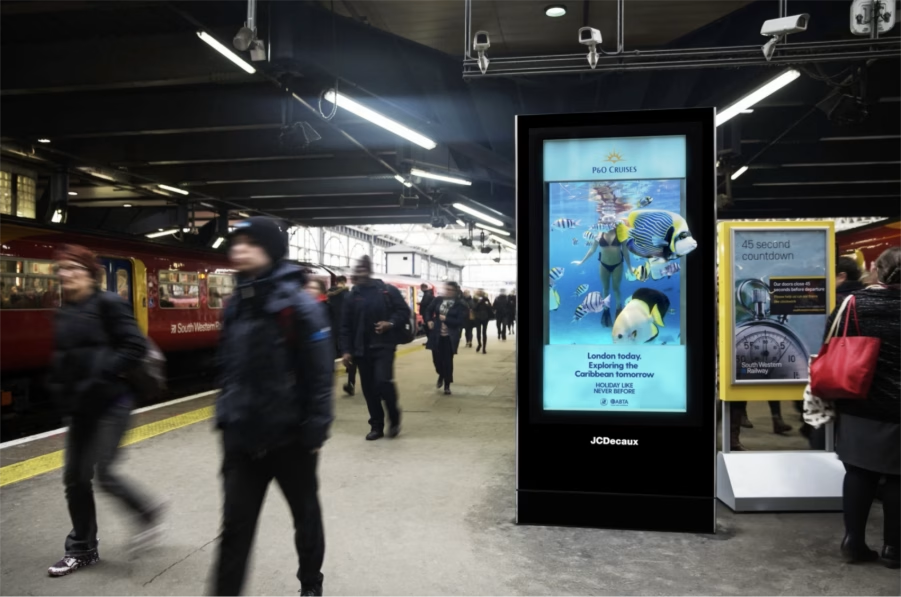
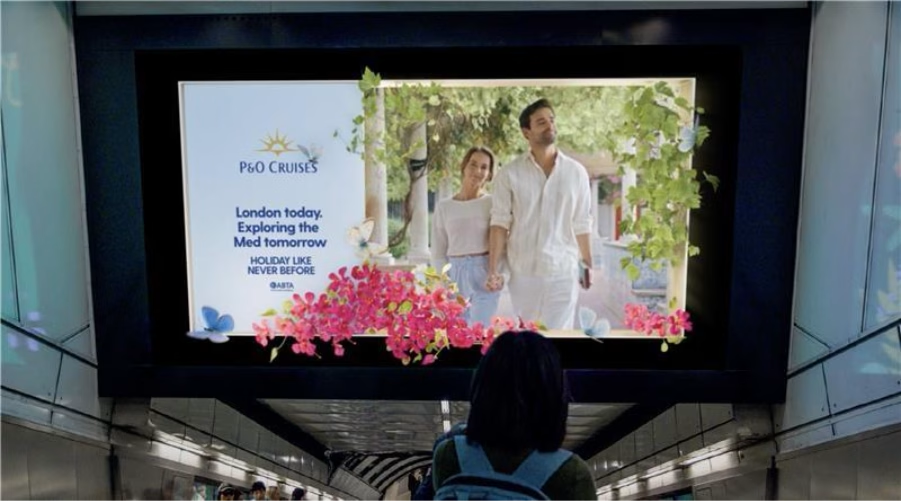
We are already seeing this in action. For P&O Cruises, dynamic prOOH activations were triggered by live weather and location data, ensuring messaging appeared only when audiences were most receptive to travel inspiration. Similarly, automotive and retail brands are increasingly using prOOH to align creative with traffic conditions, commuter flows and store proximity, delivering contextually relevant messaging at the exact moment it can influence behaviour.
Predictive planning replaces reactive buying
Another major shift to be seen this year will be the move from reactive activation to predictive planning. Forecasting models incorporating future weather patterns, movement data and major cultural moments will play a bigger role in how OOH campaigns are designed.
Global events such as the FIFA 2026 World Cup and the Winter Olympics will see brands planning further in advance, ensuring they are present not just in the moment, but at the moments that matter most. OOH will increasingly be used to anticipate attention rather than chase it.
Data-led activation, without compromising privacy
Data will sit at the centre of OOH’s next phase, but with a growing emphasis on privacy-safe infrastructure. Clean rooms will enable CRM, loyalty and store-level data to inform DOOH delivery without exposing personally identifiable information.
This will allow brands to re-engage known audiences near key locations, tailor messaging dynamically, and measure impact with greater confidence, bringing OOH closer to the accountability historically associated with digital channels.

Experience over exposure
Perhaps the most important shift that we’ll see this year will be cultural rather than technical. Audiences are increasingly saturated with screen-based content and are actively seeking experiences that feel physical, emotional and human.
OOH is uniquely positioned to meet that demand. Emerging technologies such as AR, XR, spatial audio and smart glasses will layer digital storytelling onto physical environments, transforming outdoor media from something that is merely seen into something that is experienced and interacted with.
At the same time, the rise of AI-generated content is reinforcing the value of craft. Brands that prioritise authenticity, creativity and sensory richness will stand out in a world where content is easy to generate but hard to believe.
What comes next
With 2026 upon us, this year OOH will build on that with work that is smarter, more dynamic and more creatively ambitious. The partners at DOOH.com are heading into the year energised by what is possible and ready for what comes next.