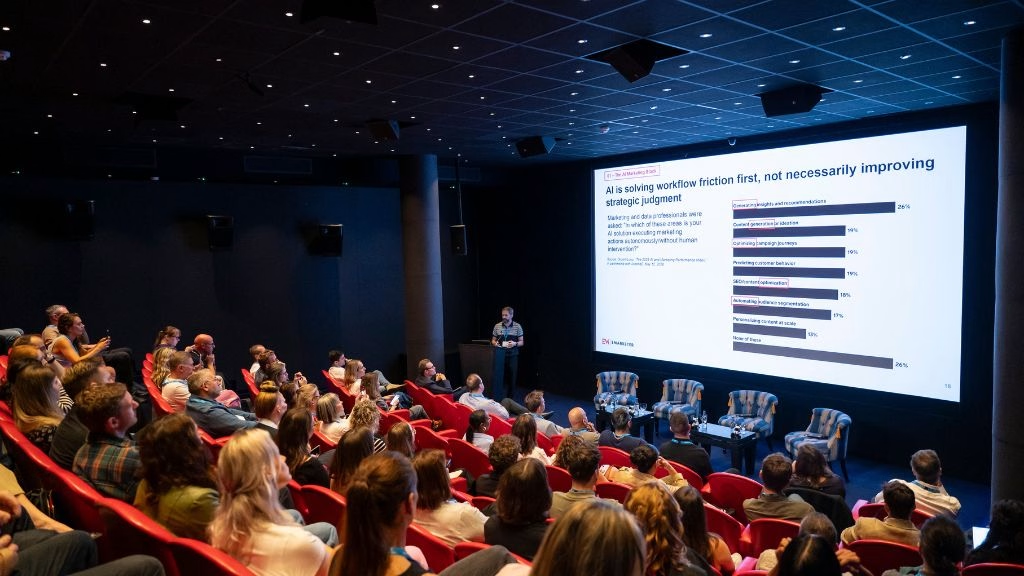
At New Digital Age’s latest Foresight event, Bill Fisher, Principal Analyst at Emarketer, set the tone for the day with a compelling opening keynote. Addressing an audience of industry leaders, Fisher tackled the core structural shifts transforming modern marketing and posed a question that sits at the heart of the industry’s current existential crisis: as advertising technology grows vastly more intelligent, is it actually becoming any more effective?
“It does feel like we’ve been here before,” Fisher said, drawing on his 30 years in tech and 15 years in advertising. Over the past decade and a half, the industry has seen successive waves of innovation, from cookies and social platforms to the rise of generative AI.
Yet, every major leap forward brings a familiar paradox. “Every time there’s a progression made, and advertising becomes more sophisticated, it also becomes more complicated,” he said.
Despite sophisticated tools, marketers find themselves returning to the same fundamental questions: How do we measure true effectiveness? Are we putting the right ad in front of the right person on the right platform?
To explore where the industry is heading, Fisher discussed three structural pillars reshaping the landscape.
1. The AI Marketing Stack: Are We Doing the Right Things?
The first pillar centres on how marketing operations are changing under the weight of AI integration. Citing data on the challenges of implementing agentic AI, Fisher highlighted three persistent hurdles: capability, trust, and governance.
There is also a stark internal disconnect within organisations regarding AI readiness. According to data from Optimizely, 70% of C-suite executives believe their organisation’s AI strategy is fully aligned. Among company analysts on the operational front line, that figure drops to just 27%, a gap of 42 percentage points.
While AI excels at task automation, generating, optimising, and automating across large datasets, Fisher cautioned against overextending its role into high-level strategy. “AI is super at recognising patterns and automating workflows, but we should not be moving it into making strategic decisions or creative judgment,” he emphasised, arguing that human oversight remains essential.
Without human strategy, brands risk falling into what Fisher described as the “black hole of mediocrity”. Pointing to the trade-off between frictionless efficiency (like Amazon or McDonald’s) and high-touch human interaction, he warned that over-reliance on AI can erode distinctiveness.
“This is what AI largely is: it’s average. And so you’re not differentiating yourself anymore,” he said.
Ultimately, Fisher urged the industry to reframe its approach: “We need to shift the narrative from where can we use AI? to where should we use AI? Just using it is not a measure of success. The value that AI creates should be the measure of success.”
2. The Outcome Economy: Are We Measuring the Right Values?
The second pillar addresses how value is measured as the industry enters the “outcome era”. In Emarketer research conducted with Cadent across the CTV space, outcome-related KPIs, such as conversions and direct sales impact, ranked as the top priority for advertisers.
However, measuring outcomes in an AI-driven environment has become significantly more complex. In a study with Partnerize, 54% of US marketers reported that AI-driven discovery platforms reduced confidence in their attribution models, citing AI channels as the single most difficult area for accurate attribution.
When measurement gets tough, the temptation is to fall back on metrics that are easy to capture rather than those that reflect true value.
Fisher pointed to changes in viewability metrics, such as YouTube’s evolved definitions, where raw view counts may skyrocket without necessarily delivering incremental business value. Similarly, serving an ad to a loyal brand enthusiast who was already intent on buying provides minimal incremental return.
“Rather than asking, can I measure what happened after somebody saw an ad?, we should be asking, did something valuable happen because they saw it?” Fisher argued.
True measurement requires connecting multiple touchpoints, combining brand lift, incremental engagement, and eventual conversion into a cohesive view of business value.
3. The Algorithmic Consumer: Who Really Influences Choice?
The final pillar examines how consumers navigate an environment where algorithms increasingly mediate discovery. As AI search tools and recommendation engines gain traction, brands face a drastically shrinking “digital shelf”.
A traditional retail search might display 40 organic results on page one, whereas an AI assistant might recommend only five.
While brands are eager to optimise for these new recommendation engines, Fisher offered a reality check on current consumer behavior. Emarketer forecasts show that while generative AI adoption is growing, it has not yet reached the ubiquity of social media or general ecommerce.
Crucially, when it comes to purchasing, consumers still demand personal control. In survey data on how internet users leverage AI, shopping ranked near the bottom at just 16.6%.
Studies from Profitero further indicate that social media algorithms and AI assistants currently rank lowest among trusted sources for product recommendations. Consumers rely on AI for early-stage exploration and research, but prefer human agency when completing a transaction.
“Algorithms don’t yet decide what we buy,” Fisher said. “They do increasingly influence our consideration, which means brands must consider two audiences: the commerce agents filtering information, and the end consumers who still want agency over their final decision.”
Making Intelligence Work
Closing his keynote, Fisher returned to his opening question. Is advertising becoming more effective as it grows more intelligent?
“Effectiveness depends on our ability to make that intelligence work,” Fisher concluded. “There is a lot of complexity and intelligence built into modern advertising systems, but we have to build our strategies around making it deliver real, meaningful value.”