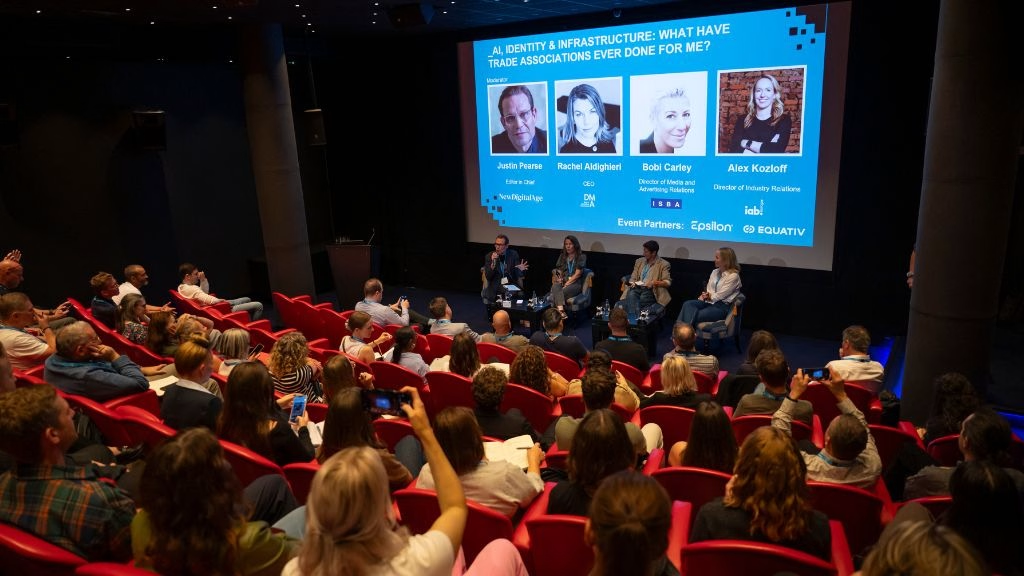
At New Digital Age’s Foresight event, NDA Editor-in-Chief Justin Pearse moderated a discussion with leaders from three of the UK’s prominent trade associations: Rachel Aldighieri, CEO of the Data & Marketing Association (DMA); Bobi Carley, Director of Media and Advertising Relations at ISBA; and Alex Kozloff, Director of Industry Relations at IAB UK.
The session examined the evolving role of industry bodies in an ecosystem undergoing rapid change, driven by AI, complex supply chains, and shifting regulatory demands.
The conversation began with the challenge of setting common standards and ensuring interoperability for AI across the advertising and marketing sector.
Alex Kozloff warned that fragmented AI standards are creating complexity. Furthermore, this fragmentation risks letting commercial players set their own agenda rather than growing AI responsibly. “That core role of the true impartiality of a trade body is key in making sure that AI, which is changing so fast, opens up and grows, but in a responsible way,” she said.
Rachel Aldighieri emphasised the regulatory and data-focused implications, particularly regarding agent-to-agent interactions. “We work really closely with government to try and ensure we’ve got the right regulatory framework, and at the moment, there’s big challenges with the data regulatory framework in the context of AI,” Aldighieri said.
She explained that a major part of the DMA’s role is holding regulators to account to ensure existing rules are enforced effectively before creating new ones. “We have a job to educate government,” she added, explaining that trade bodies help bridge the gap between policymakers and business realities.
Bobi Carley drew a parallel between current AI challenges and the early growth of retail media. When retail media expanded rapidly a few years ago, FMCG clients faced a chaotic landscape without clear definitions or consistency.
“They asked to get together with all the retailers in the room, and the message they delivered was simple: ‘We want to spend more money with you, but it’s too difficult,'” Carley said.
She explained that ISBA is seeing a similar demand for clarity around AI visibility, leading to the creation of a dedicated taskforce aimed at building consistency across agencies, tech providers, and brands.
Educating government and navigating regulation
Addressing how policymakers are handling AI, the panellists agreed that while ministers and civil servants are still racing to catch up with technical advancements, their willingness to engage with industry experts has improved significantly.
Aldighieri said that government departments are increasingly looking toward overarching, principle-based frameworks rather than trying to draft new rules for every iteration of technology. “What’s comforting to hear from them is how they can embrace existing regulation in the context of AI and what they might need to change,” she said.
Kozloff highlighted a shift in how government bodies approach technical detail.
“They are increasingly really keen to get under the technical hood, which is a change I’ve seen more recently,” Kozloff said. “They proactively want us to talk with them and bring people from IAB Tech Lab into the room to understand what the technical options are for regulation going forward.” She added that the UK remains well-positioned internationally to lead on safeguarding AI standards.
From the brand perspective, Carley pointed out that advertisers are establishing their own internal guidelines while waiting for formal legislation.
“Global advertisers are looking at the EU AI Act, but for local advertisers, it’s much more their own company principle-based judgements at the moment,” Carley said. Ultimately, she stressed, consumer trust remains the ultimate test: “If the consumer loses trust in their brand, that’s it. At the moment, it’s the consumer who is the referee.”
Driving member value and overcoming “blame culture”
When asked how trade bodies can deliver maximum value and what they require from their members in return, the panellists called for deeper engagement and greater accountability across the supply chain.
Aldighieri pointed to the concept of “return on involvement”, explaining that active participation in committees and working groups yields the greatest results for businesses. “The more people get involved, tell their stories, and talk to us about their challenges, the more that we can do,” she said.
Carley urged the industry to move away from pointing fingers when challenges arise in emerging channels.
“There’s such a history of everybody blaming everybody else,” Carley said. “That blame culture has got to go and everyone has got to take their rightful role in the supply chain. Everybody needs to take responsibility for governance and transparency in order for this to actually progress.”
Kozloff urged members to focus on foundational issues like standards and regulation, even if they seem less exciting than industry events.
“I would love for us to all ‘eat our vegetables’ a bit more,” Kozloff said. “Getting engaged in the stuff that truly is foundational to protecting our industry would really shift the needle in us working together and collaborating to enable more growth.”
Aldighieri stressed that while DMA members must adhere to a strict code of conduct, brands also need to push those expectations down through their vendor relationships.
“Brands don’t necessarily specify that when they’re appointing different suppliers,” Aldighieri said. “They need to make sure they don’t just live and breathe that code internally, but spread that down the food chain to build responsibility.”
Neutrality and protecting the broader industry
The panel addressed the common misconception that the largest or highest-paying members dictate the agenda of trade associations.
Aldighieri explained that compliance mechanisms ensure neutrality. “Some of those nefarious companies can’t be members of the DMA, and that helps us massively,” she said, adding that operating around a customer-first code prevents favouring individual corporate interests.
Carley added that influence is driven by active involvement rather than financial spend. “What does influence us is brands that lean in,” Carley said. “Despite scale, the brands that actually have an opinion and ask the most questions are the ones that actually drive and lead things.”
Kozloff demystified the financial structure of membership fees. “Our fees are capped so that any one particular member can’t pay disproportionately that much more than another,” Kozloff said.
“We don’t get a disproportionately large amount from one or two particular companies relative to what we get from other members. We are a non-profit with a board of 25 companies; those companies would not be there paying their membership dues every year if that was the case.”
In an ever-evolving digital landscape, compounded by the growth of AI, it’s clear that the role of independent trade bodies has never been more important.