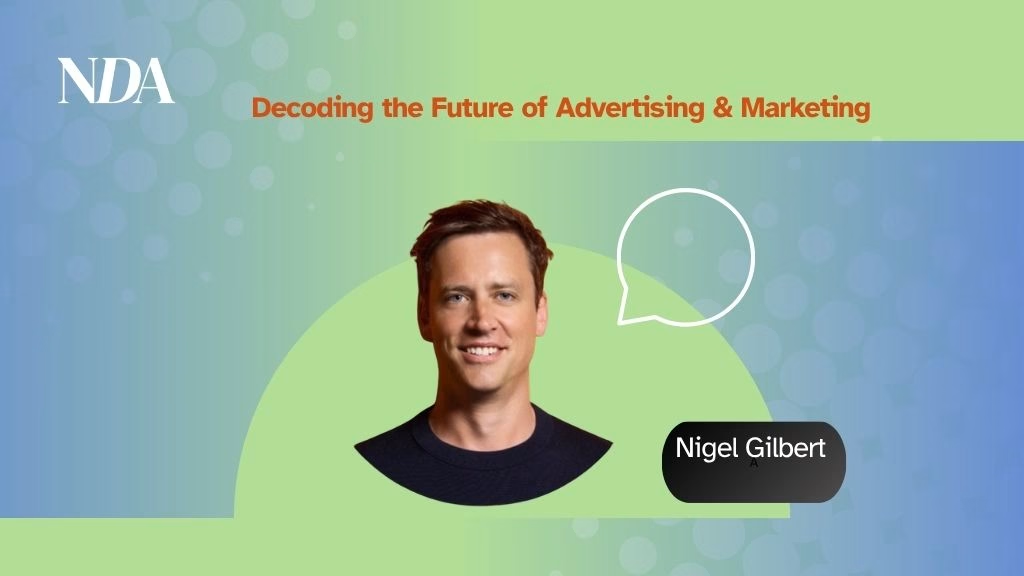
Nigel Gilbert has spent more than two decades at the forefront of digital advertising, holding senior leadership roles at AppNexus, Orange Advertising, Unanimis and most recently Accenture Song. Having worked across publishers, adtech and consulting, he has seen every major shift in digital marketing.
In the first of New Digital Age’s new interview series, Decoding the Future of Advertising and Marketing, he explains why AI is accelerating the convergence of advertising technology and marketing technology, and why brands need to rethink how they organise themselves for growth.
You’ve worked across publishers, adtech and consulting. Looking back, what has been the biggest change?
The biggest shift came around 2010 when buying and selling advertising became data driven. Before that, everything was manual, managing inventory, reporting performance and trying to optimise campaigns by hand. Then programmatic arrived with DSPs, SSPs and exchanges, transforming the way advertising worked.
The next major shift was martech.
Brands started connecting customer profiles, commerce, content and customer journeys. Marketing became much more sophisticated, but also much more complex because businesses suddenly needed to connect multiple technology platforms rather than simply running campaigns through an agency.
That was one of the reasons I joined Accenture. I wanted to understand how all those systems could work together to create real business growth.
What did consulting teach you that you hadn’t experienced before?
The biggest lesson was the importance of strategy.
Instead of talking about media costs or campaign performance, the conversation starts with the client’s business objectives. Are they struggling with fragmented technology? Do they have enough first party data? Is their customer experience disconnected? Are they achieving the growth they’re looking for?
Once you understand the business problem, technology becomes the enabler rather than the destination.
The other thing that stood out was the importance of technology partnerships. CRM, customer data platforms, content management, analytics, orchestration and cloud infrastructure all need to work together. That’s become just as important as media itself.
Adtech and martech still feel like separate industries. Why has convergence taken so long?
Because they’re fundamentally different businesses.
Adtech is relatively flexible. You can test platforms, change media partners and move budgets quickly.
Martech is a strategic investment. Once you’ve implemented a customer data platform or a cloud infrastructure, you’re changing workflows, governance, operating models and customer data across the organisation. Those decisions take years, not months.
Then you have privacy regulations. Martech owns first party customer data, while adtech has traditionally operated separately because of GDPR and other regulations. Connecting those environments in a secure and compliant way is incredibly difficult.
That’s why progress has been much slower than people expected.
What does better integration actually look like for consumers?
It comes down to relevance.
Brands already know who their customers are. They know what they’ve bought and how they engage. If someone is already receiving relevant communications through owned channels, they shouldn’t also receive advertising telling them exactly the same thing.
It’s not just inefficient, it damages trust.
The opportunity is to create joined-up customer experiences where owned media and paid media work together, rather than competing with each other. Trust and relevance become genuine drivers of growth.
Everyone talks about AI. How does it change this picture?
AI is probably the biggest catalyst for bringing these worlds together.
The mistake is thinking AI will simply automate individual tasks. The real value comes when AI has access to connected customer data, advertising data, workflows and business intelligence.
If those systems remain siloed, AI will only deliver incremental improvements.
If they’re connected, AI can recommend audiences, improve segmentation, optimise content production, automate workflows and continuously learn from every customer interaction.
Instead of thinking about a traditional marketing funnel, organisations begin creating what I call a marketing loop, where every interaction improves the next one.
So what’s preventing that from happening faster?
The biggest barrier is incentives.
Different partners are rewarded for different things. Content agencies are often paid to create more content. Media agencies are rewarded for buying media. Those commercial models don’t naturally encourage efficiency or automation.
That’s why we’re seeing organisations like Accenture Song, Publicis and WPP bringing strategy, martech, content and media much closer together.
Increasingly, the enterprise consulting side of those businesses is where the overall growth strategy sits.
Where do you see the industry heading next?
It feels like we’re reaching an inflection point.
AI is obviously driving change, but so are changing consumer behaviours, connected TV, cloud technology and the growing importance of first party data. Brands are increasingly recognising that their data may be their most valuable asset, while agencies are placing much greater emphasis on planning and strategy rather than simply media buying.
Every conversation I’m having suggests the industry is resetting itself.
The companies that successfully connect strategy, technology, customer data and advertising into a single operating model will be the ones that define the next era of marketing.
The next in this series will be published next month.