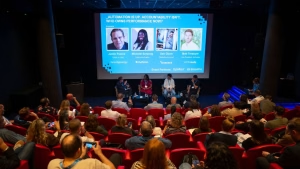
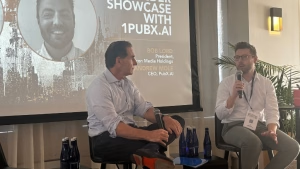
A recent roundtable hosted by New Digital Age in partnership with LiveRamp brought together leaders from publishing, media, advertising and technology to discuss the state of data collaboration and the growing role of AI in shaping its future. What emerged was a picture of an industry moving fast, but not always in the same direction, grappling with the gap between the promise of AI and the practical realities of data quality, governance and organisational readiness.
Attendees at the roundtable included Travis Clinger, Chief Connectivity and Ecosystem Officer and GM International at LiveRamp; Mario Lamaa, CRO at Immediate Media; Luke Fenney, SVP International Media and Platforms at LiveRamp; Lena Arbery, Director of Destinations, Travel and Growth EMEA at TripAdvisor; Paul Wright, board advisor and strategic consultant; Alex Kirby, Revenue Operations Director at Hello Magazine; Dominic Noble, Senior Director of Advanced Audiences at Omnicom; Tony Miller, CMO at Direct Line Group; and Camilla Child, Director of Commercial Data Strategy at the Telegraph
From chatbots to agentic workflows
The conversation quickly moved beyond AI as a novelty. The consensus around the table was that the industry has shifted from experimentation to operational reality, with agentic workflows emerging as the single most significant development of the past twelve months.
Travis Clinger, Chief Connectivity and Ecosystem Officer and GM International at LiveRamp, described how agents are already removing the need for specialist data scientists in clean room environments, citing the example of a company that has built an agent specifically for calculating return on ad spend:
“You’ve now eliminated for a marketer the need for that data scientist, allowed them to move to a higher level task and reduced the barrier to entry,” he said. Clinger added that his own organisation is rolling out agentic tools across its entire workforce, and that he personally saves at least two hours a day as a result.
Mario Lamaa, CRO at Immediate Media, echoed this, saying that the most important shift in recent months has been “away from AI simply being a chatbot, to more deeply embedded agentic workflows,” with the potential to compress operational setup times from months to minutes.
He recalled how, only three or four years ago, testing a data collaboration campaign could take three months just to establish a basic match and agree on what to do with it. The direction of travel, he argued, is clear: “In theory, post integration you could be up and running in minutes, as opposed to those long times we’ve had in the past.”
Luke Fenney, SVP International Media and Platforms at LiveRamp, added that the industry is now moving beyond hypothetical conversations to real execution: “There are actual agents being used to execute on different workflows,” he said, pointing to planning, activation and post-campaign measurement as areas already being transformed.
He also looked further ahead, arguing that the most interesting applications will come when agentic technology moves beyond marketing workflows entirely, into supply chains and other parts of the commercial process, allowing brands to connect inventory data directly to marketing strategy in ways that are currently impossible.
Lena Arbery, Director of Destinations, Travel and Growth EMEA at TripAdvisor, brought the consumer perspective to the discussion, saying that changing search and discovery behaviour is one of the most immediate practical challenges for brands. TripAdvisor is already auditing how travel partners show up in large language model responses, tracking what she described as “share of answer” as a new metric alongside more traditional measures of brand visibility.
“There’s a completely different way of looking at how brands show up for queries that are growing exponentially,” she said.
Data integrity as a foundation
Several participants stressed that AI is only as good as the data it draws on, and that the excitement around new capabilities can obscure some very unglamorous foundational work that still needs to be done.
Paul Wright, board advisor and strategic consultant with extensive experience in retail media, argued that poor data quality undermines everything: “If that data set is wrong, it’s going to create the wrong outcome.”
He added that AI may ultimately force organisations to address long-standing data hygiene issues, because flawed inputs will produce visibly flawed outputs, and unlike previous technologies, AI makes those failures highly visible.
Alex Kirby, Revenue Operations Director at Hello Magazine, said that the shift is already visible at an individual level, with people using AI tools to interrogate correlations across datasets that would previously have required hours in a spreadsheet. She was candid about both the opportunity and the risk:
“I’ve definitely learned to be constantly checking and reinforcing and making sure that it is not necessarily correct,” she said, adding that she is also conscious of not outsourcing her own thinking entirely to AI tools, particularly when she is trying to understand something new herself.
Kirby also said that a broader commercial shift, with her team now building capabilities in-house that they would previously have licensed from third-party technology providers, making the build-versus-buy calculation look very different from how it did even two years ago.
Dominic Noble, Senior Director of Advanced Audiences at Omnicom, added an interesting counterpoint on data quality, saying that while clean, structured data remains essential for operational uses such as inventory management, large language models have a useful ability to draw insights from messier, less formalised datasets:
“The LLM allows for interpretation, it allows for data sets to be interrogated in a way that wouldn’t have been able to be done before,” he said, pointing to the use of doctors’ notes in medical research as an illustration of how unstructured text can now be analysed at a scale that was previously impractical.
Part two of this writeup will be published on Monday.