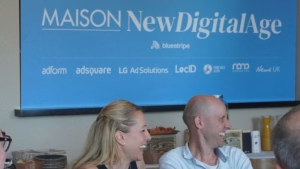
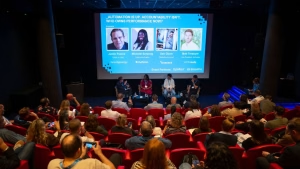
A recent roundtable hosted by New Digital Age in partnership with LiveRamp brought together leaders from publishing, media, advertising and technology to discuss the state of data collaboration and the growing role of AI in shaping its future. In part two of the resulting writeup, we exploredhow data collaboration is uncovering new commercial opportunities, the governance challenges that still slow progress, practical strategies for getting started, and how AI is shaping the future of data partnerships.
Attendees at the roundtable included Travis Clinger, Chief Connectivity and Ecosystem Officer and GM International at LiveRamp; Mario Lamaa, CRO at Immediate Media; Luke Fenney, SVP International Media and Platforms at LiveRamp; Lena Arbery, Director of Destinations, Travel and Growth EMEA at TripAdvisor; Paul Wright, board advisor and strategic consultant; Alex Kirby, Revenue Operations Director at Hello Magazine; Dominic Noble, Senior Director of Advanced Audiences at Omnicom; Tony Miller, CMO at Direct Line Group; and Camilla Child, Director of Commercial Data Strategy at the Telegraph
Discussing the value of data partnerships, Arbery spoke enthusiastically about the unexpected discoveries that emerge from data partnerships, describing collaboration as “a voyage of discovery.”
Her example of a two-year partnership with Mars Pet Care illustrated the point well. Built around the observation that pet ownership surged during the pandemic and that pet parents increasingly want to travel with their animals, the collaboration led TripAdvisor to develop new pet-friendly features and opened up a range of communication strategies that neither party had anticipated at the outset.
“Some of the really surprising data points that came out of it changed our direction and changed our strategy,” she said.
Noble made a related point about the value of testing assumptions through third-party data matching: “Very occasionally we find out that actually we had an assumption about this group of people we were trying to target, but actually there’s this other signifier that we didn’t know about,” he said, describing how this kind of work is surfacing increasingly niche audience signals that would have been invisible without collaboration.
Lamaa argued that publishers in particular should think more ambitiously about what their data assets can unlock beyond standard display advertising. He described Immediate Media’s investment in experiential as a case in point, suggesting that data collaboration could enable brands to identify and reach highly valuable niche audiences for live events and partnerships. Resulting in potentially monetising those audiences at a significantly higher rate than through conventional digital formats:
“Collaboration allows you to supercharge the value of a smaller audience, with commercial gains from this significantly higher than mass reach audiences” he said.
Governance, trust and the cautious DPO
Progress is not without friction. Tony Miller, CMO at Direct Line Group, described the constant “push and pull” between the desire to move quickly and the compliance requirements of operating in regulated sectors such as finance and insurance.
He was clear that consumer trust has to remain the anchor point: “Everything has to be done based on what your consumers think, feel and believe about your brand,” he said, adding that the explosion of poor-quality AI-generated content over the past year has made that challenge more acute, creating a climate of scepticism that responsible brands now have to work harder to overcome.
Camilla Child, Director of Commercial Data Strategy at the Telegraph, said that the definition of valuable data is itself shifting, and that organisations need to broaden their thinking about what constitutes a useful input for AI systems.
“It’s not just data for campaign activation or data for internal processes, it’s changing how people perceive the value of their work to feed AI,” she said, pointing to email exchanges with clients, sales collateral, editorial decks and even journalists’ voices as data assets with real commercial applications.
The Telegraph has developed a translation tool for one of its Ukraine podcasts that renders the journalist’s voice in Russian and Ukrainian, preserving the character and tone of the original, which Child described as an example of how far the concept of data has expanded beyond rows and columns.
Noble said that much of the hesitancy around first-party data predates AI entirely, and that post-GDPR nervousness in European markets remains a significant barrier:
“People are still very, very scared to do anything with their first-party data,” he said, adding that the DPO’s incentive structure, where the cost of a compliance failure is visible and the benefit of data activation is not their responsibility, makes this a structural problem as much as a cultural one.
Crawl, walk, run
Clinger offered a clear framework for organisations struggling to get data collaboration off the ground: start with a single, executive-sponsored use case with a defined outcome and a deadline, something digestible enough to pass through legal and finance without losing momentum.
“Everyone who tries to run, we spend two years with them and they struggle,” he said. “The people who crawl, they’re up and running faster.”
Lamaa agreed, arguing that organisations need to resist the temptation to pursue every possible use case simultaneously. The priority, he said, is identifying the most important and unique data assets the business holds, understanding what makes them genuinely distinctive in the broader ecosystem, and building from there.
Kirby added that the fail-fast principle applies directly here, and that businesses need to create the cultural conditions in which an experiment that does not work is treated as useful information rather than a waste of resource: “No one can have an ego about it,” she said. “Recognise what’s working, what’s not working, and move on.”
The year ahead
Asked for a single prediction, participants pointed in similar directions. Arbery highlighted the urgency for brands to understand how they show up in AI-powered search and discovery, describing the large language model as “a bouncer at the gate” of the purchase funnel.
She said that the share of answers will become a metric that marketing teams cannot afford to ignore. Clinger argued that team confidence in AI tools will be the real unlock for the industry as a whole: “Your job is going to be replaced by someone who knows AI better than you,” he said, adding that as people move from fear to familiarity, the pace of innovation will accelerate significantly.
Fenney pointed to the importance of underlying industry protocols in enabling scale, drawing a parallel with the role that Open RTB played in the growth of programmatic advertising, and noting that LiveRamp has been working with IAB Tech Lab on a unified collaboration protocol that could provide similar infrastructure for data partnerships.
Noble suggested that as familiarity with AI grows, the industry will develop clearer and more useful distinctions between different forms of it, arguing that currently lumping everything together under a single label is limiting how people understand and apply its capabilities.
Miller expressed hope that the consumer experience will be the ultimate beneficiary, with AI finally delivering on the long-promised frictionless connection between in-store, online and app touchpoints, across both owned and partner brands.
Wright kept it straightforward, predicting that broader, more effective data collaboration, backed by proven case studies and clearer commercial frameworks, will be the defining theme of the year ahead.
The overarching message from the table was consistent: the foundations are being laid now, and those who invest in data quality, governance and cultural readiness will be best placed to benefit when the next wave arrives.