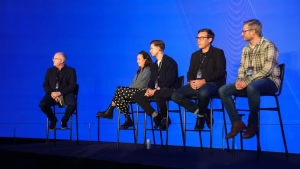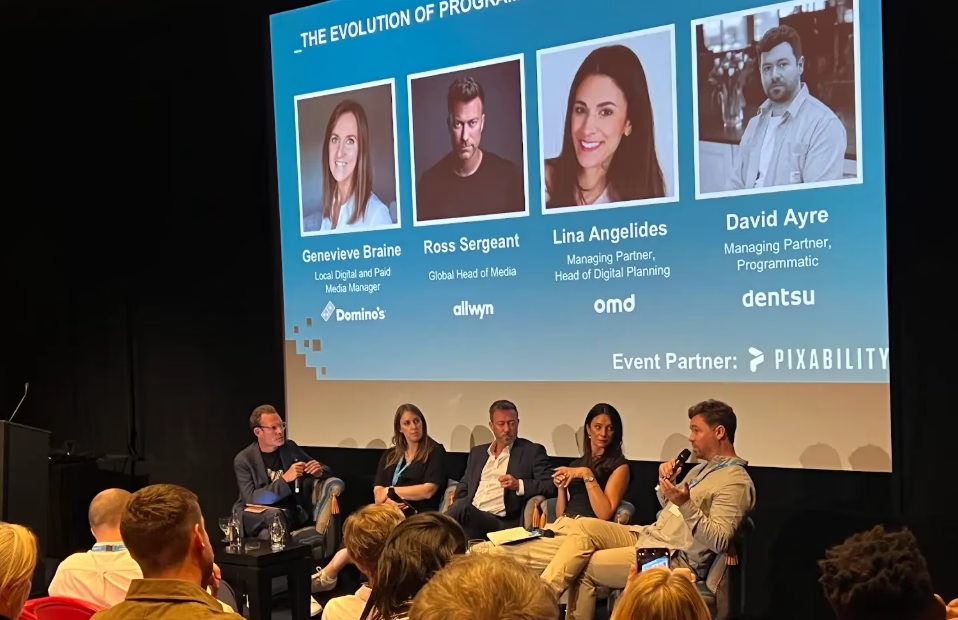
A panel, “The Evolution of Programmatic Advertising,” at New Digital Age’s recent Foresight event discussed the future of programmatic and featured Gen Braine, Digital Media Lead at Domino’s, Ross Sergeant, Global Media Director at Allwyn, Lina Angelides, Managing Partner, Head of Digital Planning at OMD, and David Ayre, Head of Programmatic at Dentsu, moderated by Justin Pearse.
From performance roots to brand building
For much of its early life, programmatic advertising was seen as a tool for driving short-term sales. Built on cookies and retargeting, it was pigeonholed as a performance workhorse rather than a channel for brand building. That perception is now changing.
Gen Braine, Digital Media Lead at Domino’s, described how the channel is expanding up the funnel. “It’s moved from the performance channel that we heavily used with first-party data retargeting, into flowing more into the top of the funnel,” she said. “We’re really starting to bring all of those buys together.”
This expansion has organisational consequences. “We’re still very siloed between performance and brand teams, but we’re starting to see that shift,” Braine added. “It’s about bringing those teams together so we’re integrated.”
Ross Sergeant, Global Media Director at Allwyn, argued that the industry has been guilty of overcorrection. “We had a period of about 10 years where the adtech crowd persuaded boards that brand building, especially TV, was the wrong bet,” he said. “Then there was a violent reaction from advertising agencies, and we swung the other way. We’re now starting to see programmatic being adopted through the planning process.”
For agencies, the value lies in programmatic’s ability to connect dots across channels. Lina Angelides, Managing Partner at OMD, said: “The beauty of programmatic is the ability to get real-time insights. We’re bringing digital planners and traditional planners much closer together and educating more on the insights you can get from programmatic, which might tell you where your AV ad delivered on Netflix or YouTube, and who responded to it well.”
David Ayre, Head of Programmatic at Dentsu, sees this shift as both channel-led and evidence-led. “Clients are questioning more of what’s in the programmatic ecosystem, and what is the true value,” he said. “We’re doing a lot of incrementality testing, and looking at the effect on other channels like search and social.”
Transparency and control remain central
Despite this maturity, transparency remains a live issue. Braine noted that standards vary significantly. “It still really depends on the partners we work with,” she explained. “Some of them are still very black box. Transparency is a big, big, big focus for us, because we need to make sure we’re being as efficient as we can.”
Ownership of data and contracts is now a strategic priority. “We nearly always contract with the tech partners so that we do own the data, and own the seats on platforms,” Braine said.
Sergeant was unequivocal about Allwyn’s stance. “We definitely own our own seats, we definitely own our own data,” he said. “One of the major reasons why Omnicom Media Group was appointed across the UK, Czech Republic,a and Greece was that they convinced me very clearly they would apply government-level transparency.”
Ayre believes agencies must drive that accountability. “We think we are the ones responsible for driving transparency in our tech partners,” he said. “We’re trying to work with more partners that plug within the major DSPs, so we can understand the data sets that are going in. It’s down to us to qualify everything in the ecosystem more.”
Angelides agreed, but pointed out that disclosure and accessibility are not the same thing. “Every DSP has come out with their new AI-driven algorithm,” she said. “A lot of this stuff is transparent when you ask for it, but it’s not necessarily accessible. Clients should always ask to get closer to the data.”
The role of creativity
While programmatic has become more sophisticated in targeting and measurement, its creative potential often lags behind.
Ayre highlighted process as the key barrier. “Programmatic is usually a later part of the plan,” he said. “By the time we get there, it’s too late to build the creative variations. Working with partners to use AI within creative really helps, lowering the cost and speeding turnaround.”
Braine admitted that translating brand craft into programmatic executions is an ongoing project for Domino’s. Our above-the-line is so great, it can be challenging to link into the basic performance driving creative, she said. “A huge part is educating our amazing in-house creative team on programmatic potential.”
Angelides said data itself can become the creative driver. “We’re using engineer availability data to direct how we target for British Gas,” she explained. “TV pause ads are another example. It’s about using technology and data in a creative way.”
The panel agreed that experimentation must be built into every plan, not treated as an optional add-on. Braine said Domino’s has worked to embed a culture of trial and error. “Fail fast and learn quicker,” she said.
Sergeant outlined how Allwyn systematises testing. “Once a month we run a media forum featuring case studies from across our different territories,” he said. “If something is presented as amazing, none of the rest of us will need to test it again, and that gives everybody justification to invest.”
Ayre insisted that testing should be visible at every stage of the process. “All campaigns should have some form of experimentation, even at a micro level,” he said.
Angelides warned that tests only matter if they shape live plans. “It’s very easy to do a test, but if it hasn’t made it through to the media plan, with the right measurement and teams, you don’t really understand the value,” she said. “Innovation has to be built from the bottom.”
The road to 2026
Looking ahead, the panel agreed that programmatic’s next stage will be defined by screens and simplification.
Braine pointed to Connected TV. “CTV is becoming a bigger focus for us,” she said. “More partners are accessible in DSPs, and consolidation lets us manage frequency and efficiency.”
Sergeant sees huge potential in addressable outdoor. “Digital out of home is definitely key for us,” he said. “Programmatic OOH lets us talk locally everywhere, and we can do that in smart, safe ways.”
Ayre believes simplification across fragmented video buying will dominate the next phase. “Clients want to simplify how they buy across YouTube, pre-roll and CTV in a simpler way, and make it more actionable,” he said.
Angelides concluded with a reminder that culture, not just technology, will decide programmatic’s future. “Bring planners together, make data accessible, and connect channels,” she said. “That is how programmatic earns its place at the brand table.”