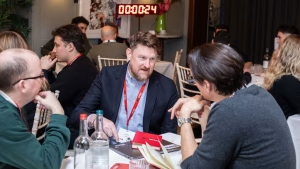
At New Digital Age’s latest Marketing the Marketers event, the focus turned to publishing. Against a backdrop of economic pressures, platform dominance and blurred lines around what even defines a publisher today, three leading voices from the industry discussed how publishing brands can thrive, not just survive.
Hosted by NDA Editor Justin Pearse, the panel featured Beth Gordon, Director of Brand Marketing and Communications at The Independent; Seb Joseph, Executive Editor of News at Digiday; and Andy Oakes, CEO, Bluestripe Group and Publisher of NDA.
How can publishers survive and thrive in today’s environment?
Beth Gordon kicked off with a call for courage and clarity. “It’s about going back to basics,” she said, “Simplicity, uniqueness, memorability and relevance still matter. But now, more than ever, we have to be brave.”
Gordon urged publishers not to shy away from ‘change moments’ like Pride or International Women’s Day, even if brands feel nervous about getting it wrong. “If you step away from these moments, people will think you never believed in them in the first place.”
She also made a passionate case for continued focus on DEI, calling it “not a nice-to-have, but essential.” Citing McKinsey research that links diverse leadership to stronger business performance, Gordon argued, “Even if you don’t believe in it morally – which you should – it makes economic sense.” She also warned against regressive policies on hybrid working, calling it damaging to equity and a sign of management panic.
Seb Joseph focused on the commercial realities. “News has become so commoditised that it’s difficult to build a business on one or two revenue streams,” he said.
The current economic climate has made diversified models not just desirable, but necessary.
“Publishers are exploring ecommerce, licensing deals, creator-led models and subscription packages,” he said, highlighting the trend of treating journalists as creators whose IP can extend beyond the article.
Andy Oakes added that quality publishers are needed now more than ever. “A quick trawl through X shows that truth isn’t valued by everyone,” he said, “but in this room, there are publishers doing great work and they deserve prioritisation by the media-buying community.”
He echoed Joseph’s sentiment on niche focus. “There’s bravery in staying small,” he said, referencing Brian Morrissey’s newsletter. “Find your niche, do it well, and stick to it.”
What does the word ‘publisher’ mean today?
As retail media, platform content and social media influencers grow in importance, the definition of a publisher has undeniably blurred.
Joseph acknowledged that while attention is now currency and many new entrants create quality content, traditional publishers offer something distinct.
“It’s not just about content,” he said. “It’s about perspective. Legacy publishers have honed their worldview over years, and that’s hard to replicate.” He was sceptical that newer, brand-led content businesses pose a long-term threat.
“Building a media brand is expensive, stressful and complex, many of these new players aren’t built for that.”
Gordon agreed, having made the leap from entertainment and tech brands like Spotify and Twitter to The Independent.
“There’s no comparison,” she said. “News brands carry an obligation to truth, trust and accountability. It’s a completely different world.” While she acknowledged the entertainment value of platform content, she insisted that what the world needs isn’t more content, but “more quality content.”
How are publishers marketing themselves effectively?
Joseph cited Puck, the US-based media brand covering politics and entertainment, as a compelling example. “They’ve built a model where access to journalists and their insights is tiered by subscription level. It’s a clever way to deepen reader engagement and revenue.” He said that Digiday itself is exploring similar models to capitalise on the expertise of its reporters.
For The Independent, Gordon emphasised impact-led marketing. “We align with change moments like Earth Day or Black History Month and do it authentically,” she said. “It’s never about telling people who we are, it’s about showing it.”
She shared the example of a recent Christmas campaign in partnership with domestic abuse charity Refuge. It led to the creation of housing units for vulnerable women, showing how a media brand can use its platform for real-world good.
“Marketing has to make a difference,” she said. “We’re lucky, people listen to us. It’s our responsibility to use that influence well. And don’t let perfect be the enemy of good. Just get going.”
What role does industry accessibility and trust play today?
Oakes point out how attitudes in trade publishing have shifted. “Back in 2005, we didn’t want to talk to anyone. We thought we knew everything,” he said. “Now, everything’s flipped. In the Substack economy, the relationship between journalist and reader is personal, direct and transparent.”
He credited B2B publishing with significant progress in recent years. “The last three years have taught us to listen to our audience. We used to write what we thought people wanted. Now we ask what they actually want.”
He also championed the value of fun and authenticity in content, pointing to the popularity of a New Digital Age podcast demystifying how awards schemes really work.
Finally, the panel turned to trust – particularly in the context of the BBC and its public funding.
Gordon was emphatic: “The BBC must be protected. The danger isn’t other news brands – it’s the sheer amount of dangerous, divisive content targeting young people.” She praised Channel 4’s recent research and called for collaboration between publishers, broadcasters and brands to safeguard trusted media ecosystems.
Oakes noted that potential BBC cuts might impact local media most significantly. “That could open opportunities for regional publishers,” he said, “as the BBC pivots to focus on national output.”
This Marketing the Marketers session underscored a vital truth: quality publishing still matters. But to succeed, media brands must be brave, authentic and commercially agile. Whether through campaigning, community-building, or championing trustworthy journalism, publishers have a powerful role to play in a media world full of noise. The panel’s message was clear, focus on what you’re uniquely good at, and do it with purpose.