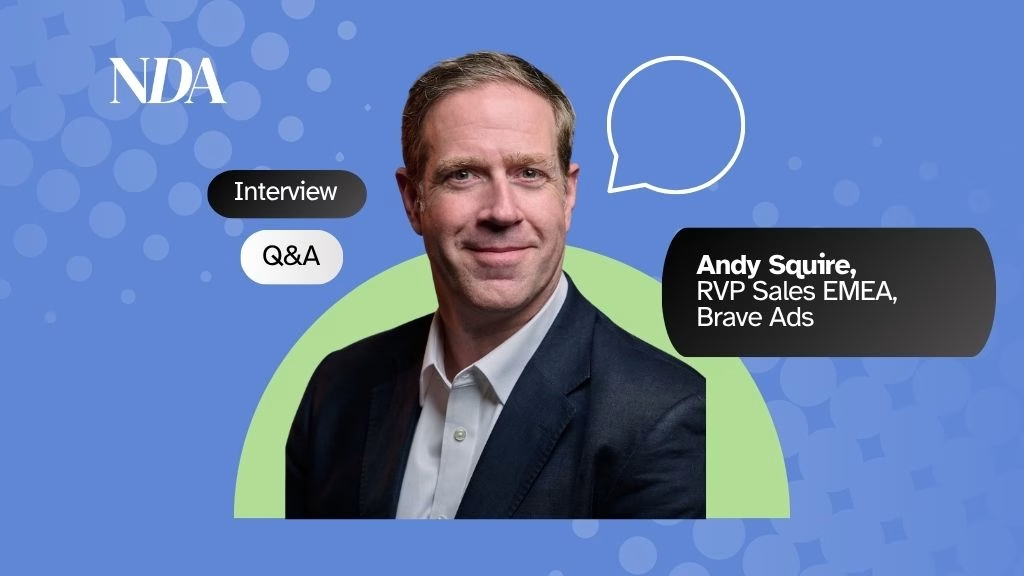
NDA spoke recently with Andy Squire, RVP Sales EMEA at Brave Ads, about the rapid evolution of the Search marketplace and how marketers can reassess their strategy for discoverability…
Tell me about your role and how your career to date led you to your current position.
I’ve been with Brave for about three years. The role has evolved as we’ve launched our paid search business. My main job is bringing on new search clients and generating advertising revenue. Most of my time is spent identifying potential clients, understanding where the opportunities are and engaging with everyone from marketing directors through to transactional paid search buyers. It’s really about outreach, communication and knowledge sharing.
I started my career as a media buyer when search first launched in 2000. Since then I’ve worked across media planning and buying, account management, publishing sales and programmatic sales. Working for an independent browser was particularly attractive because Brave has its own platform and technology and is carving out a unique position within the advertising ecosystem. It felt like a natural opportunity to combine my background in search with everything I’d learned across adtech.
Search is changing rapidly right now. What do you think are the biggest shifts advertisers need to be paying attention to right now?
When we talk about the evolution of search, there are really two different conversations. The first is transactional search – the traditional keyword model where someone searches for ‘buy shoes’ and receives an ad or a search listing. That’s the model the industry has known for years.
One of the biggest changes Brave has introduced is providing a genuinely independent search index. Historically, there were only two search indexes – Google’s and Microsoft’s. Brave created a third option, giving users and advertisers access to an audience they simply couldn’t reach elsewhere.
Because Brave Search has its own independent index, we’re not borrowing results from Google or Bing like many other browsers do. It’s a completely separate ecosystem, which means advertisers can reach incremental audiences that aren’t available anywhere else.
A large part of my role is educating advertisers because this is a market that simply didn’t exist before. We have to explain why an independent search engine matters and how it creates incremental revenue opportunities rather than simply duplicating existing search activity.
Privacy has become one of the defining issues in digital advertising. How do you see the relationship between privacy and performance evolving?
The growth of Brave over the last three to five years suggests consumers are becoming much more aware of digital privacy. When I joined three years ago we had around 70 million monthly active users. Today we’re approaching 118 million globally, which shows more people are actively choosing a privacy-focused browser.
Users are increasingly looking for alternatives to the mainstream model. GDPR and consent banners were an important starting point, but Brave takes privacy much further by blocking almost all third-party trackers while leaving first-party relationships intact.
If you’re logged into your bank, your shopping account or another website you’ve chosen to use, that’s a direct relationship between you and that business. What we’re focused on removing is third-party tracking rather than disrupting those first-party experiences.
With Brave Search, search queries stay on the user’s device. We don’t retain them for long-term profiling or retargeting. The objective is to provide search while protecting users’ privacy.
As awareness of digital privacy continues to grow, we believe Brave is well positioned because privacy isn’t something we’ve added later – it’s been fundamental to the product from the beginning.
Many brands are reassessing their search strategies. Where do you think advertisers are missing opportunities today?
Most advertisers are still allocating the majority of their budgets to traditional search because that’s where the volume is today. But they’re also beginning to test emerging platforms to understand how consumer behaviour is changing.
The important thing is that advertisers don’t assume every search platform behaves in exactly the same way. Different audiences use different search engines for different reasons, so it’s worth understanding where incremental reach and performance can come from.
For many brands, it’s less about replacing existing activity and more about extending it. They can continue investing in established platforms while exploring new environments that reach audiences they might otherwise miss.
AI is changing the way people discover information online. What do you think that means for the future of search advertising?
AI is changing search, but it’s changing it differently from traditional keyword search. Transactional search and conversational search represent two very different user mindsets.
Someone asking, ‘What’s the best place for a family of four to stay on holiday?’ is having a conversation. Someone searching to ‘buy a holiday’ is much closer to making a transaction. Those are fundamentally different behaviours.
Our approach has been to monetise the transaction first and the conversation second. We don’t want to interrupt the user journey with excessive advertising. Instead, we’re looking for the point where a conversation develops into genuine purchase intent.
It’s not about building a completely separate advertising product for AI. We’re still looking for the key signals that indicate somebody wants to complete a transaction, even if that comes after a much longer conversation.
Some AI platforms are monetising broad verticals such as travel, but we’ve taken a different approach. We want advertising to remain highly relevant to the user. Keeping monetisation lighter during conversational searches has resulted in stronger click-through rates and better overall performance.
The market is changing, but it isn’t moving at 100 miles an hour. We’re seeing growing adoption of AI-powered search, but we’re not seeing the entire market suddenly switch from transactional search to conversational search overnight.
What do you think is the biggest misconception advertisers still have about search today?
There’s a lot of discussion about AI replacing traditional search, but I don’t think it’s as simple as that. Different products serve different user needs.
If somebody wants a quick, transactional answer, they’ll often still use conventional search. If they’re researching something in more depth, AI can provide a richer conversational experience. I think those behaviours will coexist rather than one replacing the other.
The opportunity is to understand where advertising adds value without interrupting the experience. That’s true whether somebody is using a traditional search engine or an AI assistant.
Our philosophy has always been that advertising should be relevant and respectful. Users shouldn’t feel they’re being overwhelmed by ads simply because they’re searching.
We’re trying to create an experience where advertising supports the user’s intent rather than distracting from it. If somebody is ready to make a purchase, that’s the right moment to introduce a commercial message.
Because privacy is built into the browser, we’re approaching advertising differently from businesses that rely on extensive tracking. We think it’s possible to deliver effective advertising without collecting large amounts of personal data.
What advice would you give to marketers looking to future-proof their search strategies over the next few years?
Brands have an opportunity to reach audiences that may not be available through the larger search platforms. That’s particularly valuable for advertisers looking for incremental reach rather than simply competing for the same users.
As independent search continues to grow, marketers should be thinking about it as part of their broader search strategy rather than treating it as an experimental channel.
The search market is becoming more diverse. That’s good for consumers because it creates greater choice, and it’s good for advertisers because it creates new opportunities to engage different audiences.
AI will undoubtedly continue to evolve, but the fundamentals won’t change. Users still want trustworthy results, advertisers still want measurable outcomes and platforms still need to deliver a good user experience.
Search isn’t standing still. Consumer expectations are changing, technology is changing and advertising will continue to evolve alongside them. The challenge for the industry is making sure that evolution benefits users as well as advertisers.