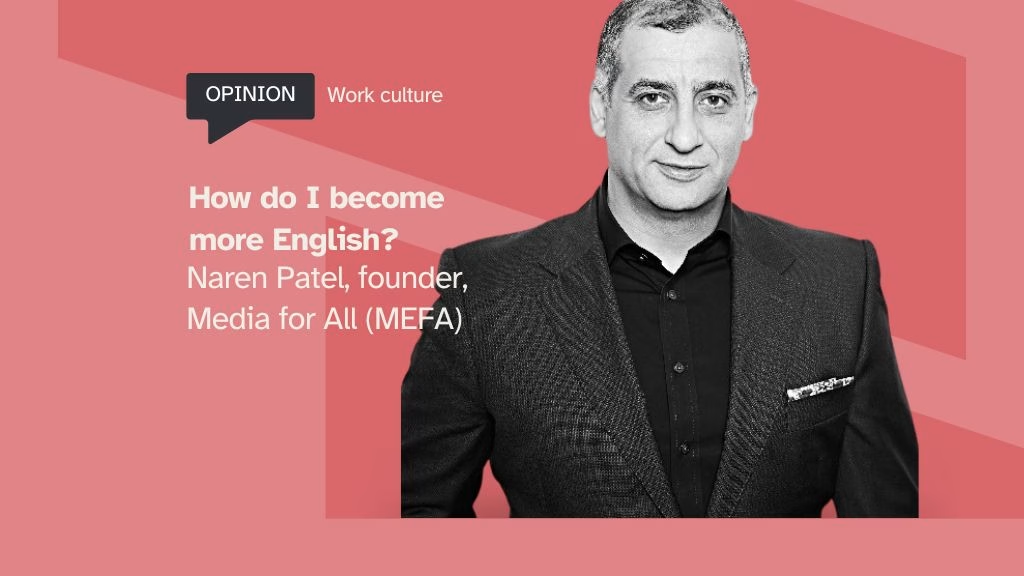
By Naren Patel, Partner at OOH Capital and founder of verification platform Geoprove and social enterprise Media for All (MEFA).
I was born in England. My mother was from Luton. She passed away a few years ago, but despite her white skin and my brown skin, there was never any doubt in our family about belonging. We didn’t sit around the dinner table and ask who was “really” English. We lived it.
I grew up in Christian schools. I said the Lord’s Prayer and sang Christmas carols in December. Yet I am not a Christian, a Hindu, or a Buddhist. I am simply someone who calls England home. And yet, time and again, I find myself asking: How do I become more English?
Because while my roots are here, my branches sometimes feel pushed aside.
Torn loyalties
I have no rights to live in India. I am not sure I would ever be accepted there as a citizen, however much I might enjoy parts of its culture. I support the Indian cricket team. But I also support the England football team. These dual loyalties don’t feel contradictory — they reflect the life I’ve lived.
But there are moments when those loyalties collide with the reality of being visibly different. At Wembley, during the Euro finals against Italy in 2021, far-right thuggery marred the night. It was meant to be a celebration of football, of unity, of possibility. Instead, it reminded me that there are those who see me, and others like me, as outsiders.
That same feeling returned this weekend.
A march against people like me
In London, over 100,000 people — mainly white men — took to the streets under banners of nationalism. They carried the Union Jack and the St George’s Cross. They invoked religion, reciting the Lord’s Prayer and declaring “Christ is King.” They claimed that migrants are overrunning the country, and by extension, that people like me do not belong.
I have always enjoyed seeing the St George’s Cross appear on the high street for St George’s Day. It can be a symbol of pride and tradition. But the sudden, orchestrated flood of flags as part of “Operation Raise the Colours” felt different. It felt like a warning rather than a celebration.
And yet, when you step back, the numbers tell another story. According to the last census, there are about 46 million white English people. Roughly 0.2% of them turned up to march. A tiny minority. But minorities can still be loud, intimidating, and destabilising. They can make colleagues, neighbours, and friends feel less secure in who they are.
The quiet power of reassurance
That is why words and actions inside workplaces matter so much. If you have minority colleagues in your team, check in with them. Don’t assume they are unaffected by what happens on the streets, on social media, or in politics. A simple acknowledgement that you don’t share the views of the far right — that you value them as part of your team — can mean more than you might realise.
Silence, on the other hand, speaks volumes. For those of us navigating dual identities, who feel “English but not English enough” in the eyes of others, silence can confirm our worst fears: that we are tolerated rather than embraced.
The role of Media for ALL
This is why organisations like Media for ALL are so important. They provide a safe space for people of colour in the media industry to share experiences, to be supported, and to push back against narratives that tell us we do not belong.
Media for ALL plays a vital role in offering reassurance, solidarity, and visibility for those who might otherwise be isolated. But it should not be left solely to advocacy groups or grassroots initiatives to make people feel safe at work.
Belonging is built, not bestowed
So, back to the question: How do I become more English?
The answer is that I already am. I was born here. I was raised here. I live and work here. My identity is not conditional on approval from a crowd waving flags and shouting slogans. But the sense of belonging is fragile. It can be chipped away by hostility and neglect.
That’s why it matters so much for colleagues, leaders, and organisations to step up. To say out loud what might otherwise go unsaid: that far-right nationalism does not speak for the majority. That England — and Britain more broadly — is bigger, richer, and stronger because of its diversity.
And that every person who calls this place home, who contributes to its culture, its industries, and its communities, is already part of the story of what it means to be English.