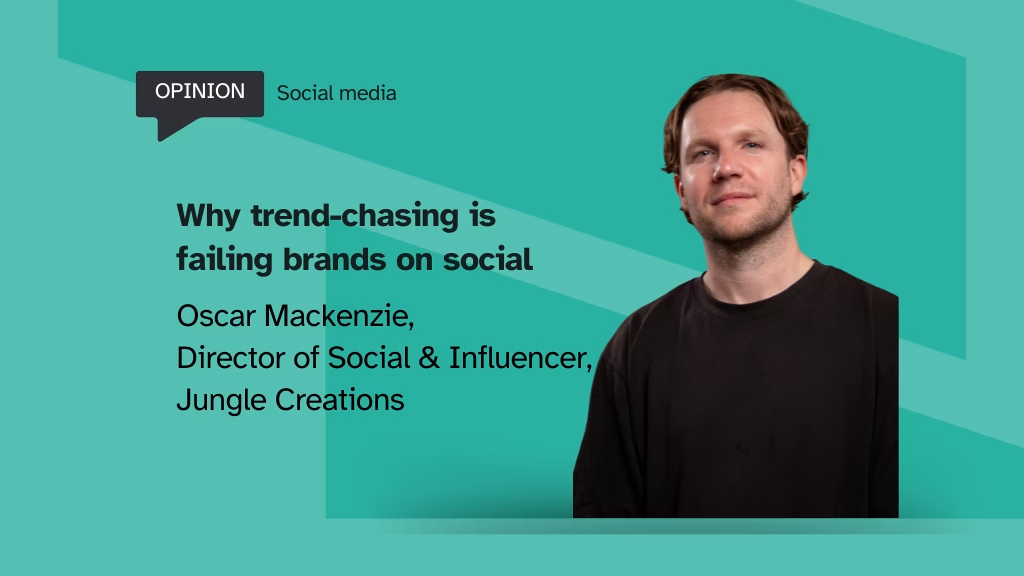
By Oscar Mackenzie, Director of Social & Influencer, Jungle Creations
Social media changed forever on the evening of February 3rd 2013.
As the Mercedes-Benz Superdome fell into darkness during Super Bowl XLVII, Oreo published “You Can Still Dunk in the Dark”. The tweet spread globally, won a Cannes Lion and crystallised a new belief: that brands could earn relevance by entering culture in real time.
Fast forward 10 years and reactive social has become the all-purpose hack for brands seeking cultural relevance, and participation is now table stakes for social cut through. But to what end?
There’s a school of thought that makes the case for reactive social inarguably potent. Brands can, and do, unlock exponential spikes in engagement by moving quickly around the right cultural moments. But in 2026, the pursuit of relevance has become a trap in itself. Used lazily, reactive social does more harm than good, particularly when a brand sacrifices distinctiveness and memorability in the process.
It’s a familiar scenario. A major cultural moment unfolds, competitors jump in, pressure builds to respond and the result lands flat.
The strategic imperative
Social is messy, so brands need a clear strategy to move from point A to B without losing direction. Audiences know when something feels off and scrutinise what shows up in their feed, rightly so. With social saturated, people are bombarded with content, so poor or inauthentic work stands out quickly.
It only takes a cursory glance at brands jumping on the same trends to see the problem. If every brand is talking about the same topics, in the same tone, with the same kinds of executions, outputs blend into a soup of sameness. It’s brand marketing at its lowest common denominator.
The deeper issue is that reactive social can win attention on platform terms while weakening the brand itself. Engagement does not equal equity. Visibility does not guarantee memorability. Speed without selectivity rarely builds anything durable.
The challenge for brands is deciding which moments are worth showing up in, and how to do so in a way that earns attention and builds long-term value.
Know the anatomy of a trend
Let’s be real: no one wakes up hoping that a brand has created reactive content. We need to earn the right to build relationships with audiences. That means developing a deeper understanding of what’s actually moving conversations.
TikTok’s framework of trend moments, trend signals and trend forces offers a useful way to think about this.
Trend moments are the opportunities most brands jump on, which is why they often deliver the least impact. The lifespan is short and competition is high. IKEA’s work around Bad Bunny’s Super Bowl halftime show shows how to do it well, responding at speed while integrating product in a way that felt natural and on-brand.
Trend signals run deeper. These are the patterns that indicate where behaviour is heading. The shift towards higher-quality content on TikTok, pioneered by accounts like McLaren F1 Team, created an early advantage for those who recognised it. Others stayed anchored in lo-fi formats that no longer resonated.
Trend forces sit deeper still. These reflect broader changes in how people engage with platforms. P. Louise’s $2M+ TikTok Live marathon demonstrates what happens when a brand aligns platform functionality, audience demand and its own positioning, then commits fully.
Lead, don’t follow
All of this is to say that reactive social, when executed with skill, can be a meaningful way for brands to show up with genuine relevance. Brands need to build intentional operating systems that help them understand which moments matter – specifically, which shifts are emerging and which behavioural forces are worth moving on.
System1 data paints a clear picture here. Brand building on social should follow the same cues that drive effectiveness above the line. Distinctive brand assets such as logos, colours, jingles and characters are instantly recognisable and can drive 88% higher memory lift.
That also means looking beyond what other brands are doing on social. Some of the richest signals sit in the conversations people are having on Reddit or in the behaviours emerging through Substack.
Synthesise an approach that marries what makes your brand distinctive with a considered view on the right moments to react to, moments that are relevant to your brand mission and what your audience cares about, and you are onto a winner. The point is not to react more. It’s to react better.
The brands that win on social will not be the ones that chase every moment. They will be the ones that know what to ignore, what to act on and how to show up in a way that feels both culturally relevant and unmistakably their own.