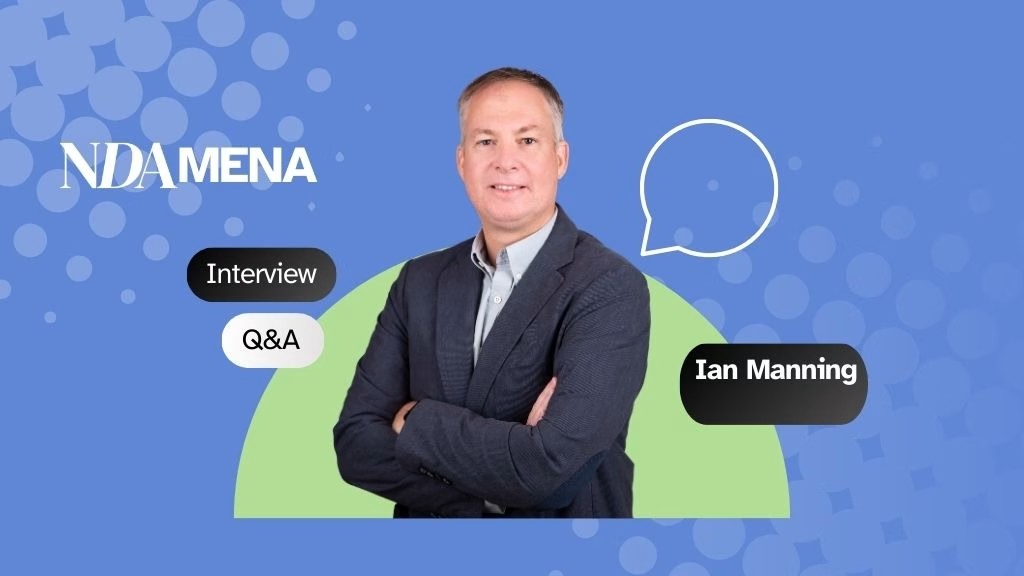
We sat down with Ian Manning, CEO of IAB MENA, to discuss the realities behind one of the world’s fastest growing advertising regions, why global companies underestimate its complexity, and how the organisation is moving from market mapping to setting standards.
The MENA region is often talked about as a major growth opportunity. How big is the digital advertising market today?
The scale surprises many people. Our most recent report pegged digital advertising spend at just under $7bn in 2024, with year on year growth just shy of 20 percent. That is substantial growth, but importantly it is growth from an already significant base.
If you compare it on a European scale, it would rank among the top five markets. Yet there is still a perception internationally that it is smaller or less mature than it really is. The UAE and Saudi Arabia dominate spend, alongside the wider GCC, but the broader region is highly active.
It is also a very social and video led market. Social media represents the majority of digital ad spend, and video is central to that. While MENA is sometimes described as a follower market, in areas like social and video penetration it is arguably ahead of many others.
To what extent should advertisers think of MENA as a single market?
That is one of the biggest misconceptions. MENA is not a homogeneous region. Each country has different consumer behaviour, regulatory environments, levels of digital maturity, and media ecosystems.
Historically, much planning has been centralised out of Dubai, which made sense in earlier stages of market development. But we are already seeing more localisation, with greater investment directly into markets such as Saudi Arabia, Egypt and Qatar. Over time, that will continue.
The Levant, North Africa and the GCC all operate at different speeds and with different needs. Treating the region as a single block is increasingly outdated. Companies that succeed tend to recognise and invest in those local nuances.
There is often talk of a gold rush mentality towards the region. How accurate is that perception?
There is definitely a perception outside the region that growth is easy to access. People look at spreadsheets, see high growth rates, and assume they can simply enter the market and succeed quickly.
In reality, it requires serious commitment. You need high quality people, strong products, and long term investment. It is fundamentally a relationship driven market, although I would argue all markets are relationship driven.
Trust takes time to build. You cannot simply arrive and expect immediate success, any more than you could in Germany or France. Companies that underestimate that tend to struggle.
What role does IAB MENA play in helping the market mature?
We only launched around 2020, so we are relatively young compared with other IAB organisations. Initially, the priority was foundational work, helping the industry understand itself and creating consistent, reliable benchmark data.
Ad spend measurement was a major focus. There was plenty of data available, but much of it was inconsistent or influenced by commercial interests. Establishing trusted benchmarks helped companies understand the real scale and trajectory of the market.
We have grown from a handful of founding companies to more than 85 members, including publishers, agencies and technology companies. That gives us a broad view of the ecosystem.
Now we are moving beyond data gathering towards setting standards, supporting transparency, and helping ensure the market develops in a way that is globally competitive in terms of quality, not just growth.
What challenges still need to be addressed?
Many challenges mirror those seen elsewhere. Brand safety, ad fraud, transparency and sustainability are all important issues here, just as they are globally. They have perhaps been less prominent in public discussion because the focus has been on growth, but they are absolutely priorities.
Measurement is also evolving. New channels such as connected TV, retail media and digital out of home are growing quickly. Digital out of home, in particular, has strong foundations in the region and is now seeing rapid programmatic expansion.
As these channels grow, the need for standards, consistent measurement and industry collaboration becomes more important.
Is the region able to move faster than more established markets when adopting new technologies or standards?
There is certainly a sense of pace and ambition. Governments are investing heavily in infrastructure and innovation, and there is a general openness to new technologies.
We are seeing rapid adoption of areas like AI, for example. But speed varies depending on the channel. Programmatic and search developed more slowly than in some Western markets, whereas social and video surged ahead.
Flexibility and willingness to evolve quickly are definite strengths. But many platforms and technologies are still developed globally, often in the US, so the region is not always prioritised immediately.
What about talent, which is a recurring challenge in most advertising markets?
Talent is a challenge everywhere, and MENA is no exception. There is strong demand for experienced professionals, particularly those who combine global expertise with local understanding.
Dubai and other major hubs are highly competitive. Simply having international experience is not enough, because many professionals in the region already have global backgrounds.
Employers increasingly value people who understand local market dynamics alongside global best practice. That combination is particularly powerful.
How is IAB MENA evolving as the ecosystem becomes more complex?
Initially, much of our focus was on the sell side, publishers, ad tech and platforms, helping them align on standards and transparency. Brands are represented by other organisations, although they do engage with us.
However, structural changes such as retail media and the creator economy are bringing buy side and sell side closer together. Data, commerce and media are converging.
As that continues, we expect broader participation across the ecosystem, including creators, measurement companies and retail platforms.
What advice would you give to UK companies or professionals looking to enter the region?
First, take the time to understand it properly. It is complex, diverse and evolving quickly. What works in London or New York may not translate directly.
Second, invest in relationships. Trust and credibility are critical, and those take time to develop.
Finally, approach the region with humility and openness. Global experience is valuable, particularly in emerging areas like retail media and connected TV, but it needs to be applied in a way that respects local market realities.
It is an ambitious region with enormous opportunity, but success comes to those willing to commit for the long term
This interview was carried out before the events in the Middle East over the last weekend