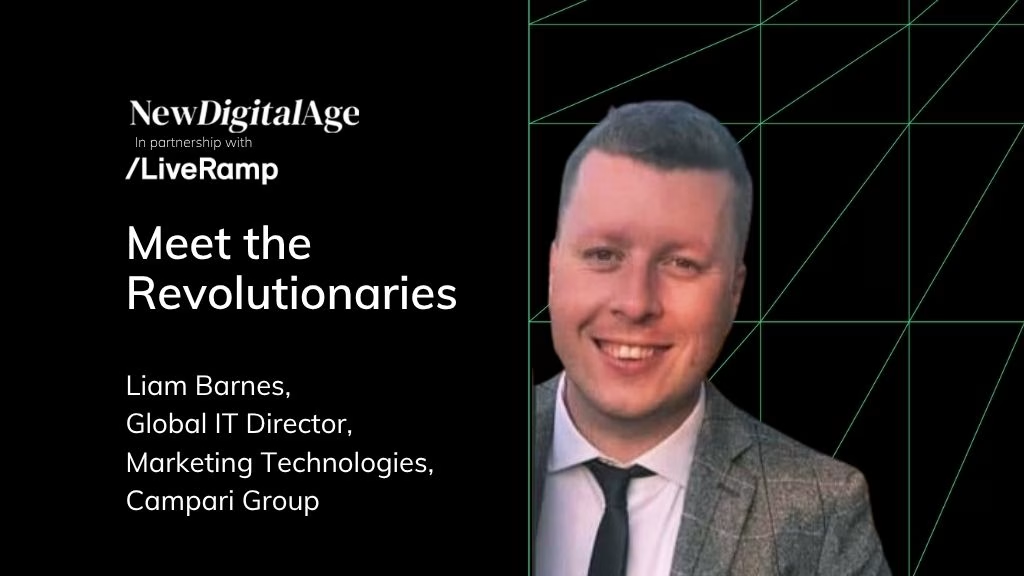
Justin Pearse interviews Liam Barnes, Global IT Director, Marketing Technologies at Campari Group. The interview is part of our Meet the Revolutionaries series, in partnership with LiveRamp, talking to the leaders driving digital marketing into a new era of data collaboration.
What does your current role involve today?
I lead global marketing technology across Campari Group’s portfolio of 72 brands. My remit covers identification, implementation, optimisation and value extraction across the entire stack.
Martech evolves rapidly, so a significant part of my role is working at least two years ahead. I set the vision that ensures we remain competitive and future proofed in the eyes of both executives and investors.
How do you balance that across such a broad brand portfolio?
The scale sounds complex, but the transformation principles are consistent across brands.
Whether it is a socially driven brand like Aperol or a heritage whisky such as Glen Grant, the architecture must be integrated and scalable. Strategic priorities may differ by audience and region.
However, the underlying requirement is seamless, connected systems that prove value.
Can you give an example of innovation you have delivered?
We connected our product information management system with our digital shelf analytics platform to create continuous optimisation. Rather than manually interpreting rankings and updating content, we built agentic workflows that automate insight to execution.
If a product drops from first to fourth in search rankings, the system identifies the issue and suggests improvements. Those improvements flow into approval workflows and then syndicate back out to retailers.
This reduces manual effort and creates measurable impact. It also ensures we are not already behind the curve by the time action is taken.
You said innovation can mean bringing the organisation along with you, how do you manage that?
In heritage-driven categories like spirits, the mindset is often rooted in history rather than automation. You have highly creative marketers who may not be data activated by default.
The key is translation rather than enforcement.
You must explain technology in commercial and creative language that resonates with them. Change management is the deciding factor.
If people do not feel ownership, the project will fail regardless of technical excellence.
What is your advice to others trying to drive innovation?
Friction and failure are not negative, they are part of progress.
I am a strong believer in getting something 80 percent right, learning quickly and iterating. We give our martech developers dedicated time every fortnight to experiment.
Around 70 percent of those ideas have progressed into production. Innovation must be a behaviour embedded across the organisation.
It cannot sit in a separate department.
Looking at the wider industry, what changes do you expect over the next few years?
AI-first marketing will become the default rather than the exception.
Agentic and systematic processes will increasingly operate on top of unified data sets. Real time personalisation will move from ambition to expectation.
That requires stronger first party data strategies combined with collaborative data partnerships.
Search behaviour is also evolving rapidly. Consumers are increasingly relying on AI generated summaries rather than traditional results pages.
How are consumer attitudes to data evolving?
Consumers are far more aware of how their data is collected and used. Trust has become transactional and value must be explicit.
It is no longer a question of what we can do with data, but what we should do. Purpose-led collection and clear governance are now fundamental.
We also recognise that our employees care deeply about ethical data use. Transparent decision making strengthens both consumer and internal trust.
Will data collaboration become more important to marketers?
Data collaboration is unavoidable because no organisation has a complete view of the consumer.
Retail partners, hospitality groups and platforms all hold complementary insights. Through clean room environments, anonymised joins and federated approaches, we can combine intelligence responsibly. That enables more relevant targeting and better mutual growth.
Barriers often stem from fear of losing control or misunderstanding legal implications. Clear architecture and streamlined workflows reduce those operational frictions.
Where do the biggest internal challenges tend to arise?
Resistance can occur at every level, from end users to the CEO.
The core issue is rarely the technology itself. It is about education, translation and demonstrating tangible value.
Messaging must remain consistent while being adapted to each audience’s perspective.
What has been your favourite innovation in recent years?
Our global insights hub stands out because it democratises intelligence across the organisation.
Teams can ask questions about sector trends or brand performance and receive immediate, cited outputs. It has improved consistency in decision making and strengthened global collaboration.
Most importantly, it has brought people together around shared insight. Technology enabled it, but the real success is human connection.
That blend of data capability and cultural cohesion is what meaningful innovation looks like.