If the first wave of AI adoption was about experimentation, the next is about execution. For independent agencies, that creates a complex mix of opportunities and existential threats.
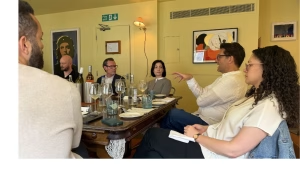
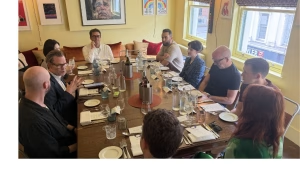
At the Indie Circle roundtable, hosted by MiQ in association with New Digital Age, agency leaders explored how AI is being used by independent agencies right now, as well as the ways that AI could be utilised tomorrow.
“AI isn’t just about saving time. It’s more about unlocking new capabilities and insights that weren’t possible before,” said Ed Cox, Partner at Beyond. “Building competitive intelligence across more clients and sectors is one of the biggest opportunities for AI.”
Cox added: “We’ve discovered that it’s not enough to have a small AI council deciding everything. We’ve put tools in the hands of our teams and encouraged experimentation.”
Matthew Sharkey, Head of Activation, Bicycle London, warned: “Indies are agile and flexible, but that’s only an advantage if we don’t lose it through over-engineering. Right now, we’re using AI to build tools internally to help with more arduous workflows like finance and reporting.”
Nick Smith, CDO, JAA Media commented: “There’s a fallacy that holdco tech is the best in market but it usually isn’t. AI isn’t eroding our income; it’s empowering our existing models and allowing us to offer services clients didn’t previously have.”
While the uptake of AI is undoubtedly on the rise among indie agencies, the tension between automation and understanding runs throughout the industry. AI can accelerate execution, but it also raises the bar for expertise. A number of participants argued that indie agencies must ensure that efficiency doesn’t come at the expense of credibility.
“You still need people who understand the tech, because APIs break, things fail, and you need to be able to explain what’s happening,” commented Gary King, Head of Display & Video, Incubeta. “I still go into DSPs and platforms myself, because I’m terrified of being in a client meeting, being asked ‘how does that work?’ and not knowing the answer.”
Facing the future
Meredith O’Brien, Group Agency Director, MiQ, described how she and her team are “constantly out in the market trying to find the gaps in support for indie agencies and figuring out how we can help fill them” with the MiQ Sigma.
O’Brien said: “One big focus for 2026 is the ‘local to global’ shift for indies. This means that a planner familiar with the UK market now has to know how to run CTV in the US, sometimes without a lot of local knowledge of that market. AI can help you gain that knowledge quickly.”
When invited to name the sort of support they’d most like from a tech partner such as MiQ in the future, the agency leaders did not hold back.
“I’d love to see more cultural alignment tools,” offered Dan Perry, Head of Digital Planning, Goodstuff. “Understanding what is culturally relevant to a brand’s audience at a specific moment, knowing what is trending and what we can align with, would be incredibly valuable for our planning.”
William Haydon, Head of Paid Media, Planit, meanwhile, named “audience and competitor intelligence that doesn’t cost tens of thousands” at the top of his wish-list: “I’d love the ability to show distinctive brand assets and ‘compound creativity’, illustrating how those assets work harder as they are distributed. We have reach and frequency metrics, but showing the memory coding of a brand would be a game-changer.”
Meanwhile, “self-serve audience profiling” and the ability to query on the fly were the big requests from Jonathan James, Digital Director, Cheeky Communications: “In a stressful, dynamic pitching environment, we need to be able to move quickly without waiting for a support ticket. That self-serve element is vital for the planning process.”
Bee Pearson, Founding Partner at Piqniq, echoed the need for “more autonomy to do this myself without putting in a request every time” and expressed an interest in creative maturity, i.e. “knowing not just what is working, but why.”
James Shoreland, CEO, VCCP Media, added: “My wish for the future is true omnichannel audience profiling: knowing where the audience is consuming content and what the ideal reach and frequency is across all channels. That would unlock so much more programmatic spending.”
From self-serve audience profiling to competitive intelligence, the wishlist for future AI tools reflects a desire for greater control and visibility. In 2026, agencies want to understand not just who they are reaching, but how those audiences behave across channels, and how those channels interact to create a holistic experience for the customer.
Whatever happens next, indies will remain on the frontline, trialling and testing the latest AI tools to deliver the results their clients need.
***********
MiQ Sigma has been built with these challenges in mind, giving indies a single, AI-powered view of how audiences behave across all channels so they can plan, test, and optimise without getting lost in fragmented tools and reports. Learn more about how MiQ Sigma is simplifying AI for indies.