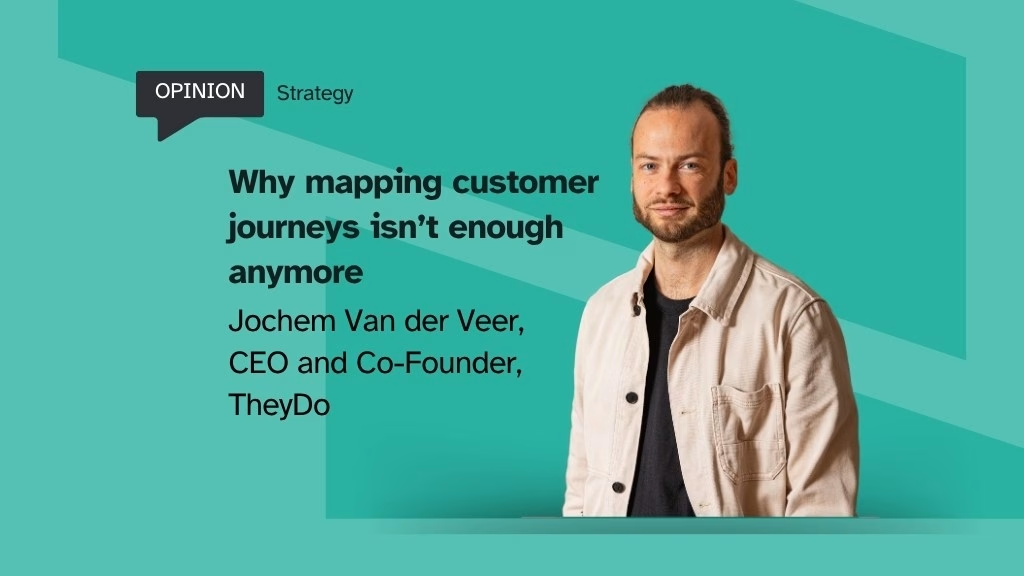
By Jochem Van der Veer, CEO and Co-Founder of TheyDo
Whether they work in marketing, product, operations, or finance, employees across the business play a role in shaping the customer experience.
Over the last decade, customer journey mapping has become a widely adopted practice among CX and marketing teams, helping organisations visualise key touchpoints and understand how customers experience them.
But journey maps are often static deliverables and, in today’s fast-moving, highly connected world, that is no longer enough. The result is a growing disconnect between insight, decision making, and execution, leaving organisations with clarity on paper but limited impact in practice.
Customer journeys themselves are not new. What is changing is how organisations use them.
Leading companies are moving beyond simply mapping journeys and instead managing them as dynamic, living systems. This shift creates a much closer connection between customer insight, operational decision making, and business outcomes, turning customer experience into a genuine competitive advantage.
The missing link in customer experience
Consider planning a trip: journey mapping identifies the route and the places you might stop along the way. Managing the experience takes this a step further. It not only plans the route, but actively responds as conditions change, anticipating fuel needs, adjusting for delays, and rerouting around traffic where needed.
This is the operational gap many organisations face today. Insight is generated, but it is not embedded into how decisions are made or how the business operates.
I saw this first-hand early in my career while running a strategic design firm. Customer journeys sat at the centre of every engagement, but once a project ended, the next team would often start from scratch. Valuable insights were lost, momentum disappeared, and the work rarely translated into long-term business impact. That was when it became clear to me that mapping alone was not enough.
Many organisations believe they are mature in customer experience when, in reality, they simply have a mature CX team rather than a customer-centric operating model. The difference lies in the ability to operationalise customer experience across the organisation, making it a shared responsibility rather than something confined to a single department.
Redesigning how organisations operate around the customer
In most organisations, improving the customer experience is not a coordinated effort. Different teams operate in silos, using separate tools and making decisions based on incomplete views of the customer. As a result, customer insight, operational data, and improvement initiatives become fragmented across the organisation.
Not only does this create duplication of effort, it also makes it far harder to identify and prioritise the improvements that will deliver the greatest impact.
A journey management approach changes this by creating a shared framework for how organisations understand, measure, and improve customer experiences. It connects customer research, operational data, and business KPIs within a single model, enabling teams to align around the same view of the customer.
Instead of working from isolated insights, organisations can build a unified view of the customer that connects experience data directly to business performance. Product teams can better understand customer pain points, operations teams gain visibility into their upstream and downstream impact, and leaders can evaluate decisions based on both customer and commercial outcomes.
This is not about introducing another tool into the stack. It is about redesigning how organisations operate around the customer and ensuring journey work becomes a continuous source of business value rather than a series of disconnected projects.
What sets journey management leaders apart?
Strong leaders recognise that journey management requires a fundamentally different approach to data. While it can initially appear tactical, it is ultimately a cross-functional strategic capability that helps organisations better understand how to acquire, retain, and grow customer value, with direct impact on both revenue and operational efficiency.
Across enterprises, the same challenge appears repeatedly: data remains fragmented across departments, systems, and individuals, making it difficult to build a complete picture of the customer experience. Metrics such as NPS and customer feedback alone are not enough to drive meaningful decisions. What matters is connecting customer insight directly to the KPIs that influence business performance, including growth, retention, and efficiency.
By enabling broader access to data and aligning disconnected sources, organisations can empower teams to make more informed decisions. This creates greater visibility into where action is needed and gives executives the confidence to prioritise initiatives that will have measurable business impact.
Kimberly-Clark, the global consumer goods company behind brands including Andrex, Kleenex, and Huggies, recognised the need to scale its CX globally. By creating shared frameworks, consistent terminology, and stronger cross-regional collaboration, the company embedded customer perspectives more deeply into decision-making and laid the foundations for a scalable operational model.
Turning customer insight into business impact
As pressure mounts on organisations to do more with less, and customer retention becomes increasingly critical, it is clear that mapping journeys alone is no longer enough.
The organisations pulling ahead are those that treat the customer journey as a core part of how the business operates. They align teams around shared priorities, connect customer insight directly to business performance, and make decisions based on a unified view of the customer experience.
This is what transforms customer experience from a reporting function into a driver of growth, efficiency, and competitive advantage.
Without this shift, valuable insight remains disconnected from action, and opportunities to improve retention, reduce costs, and drive growth are missed.