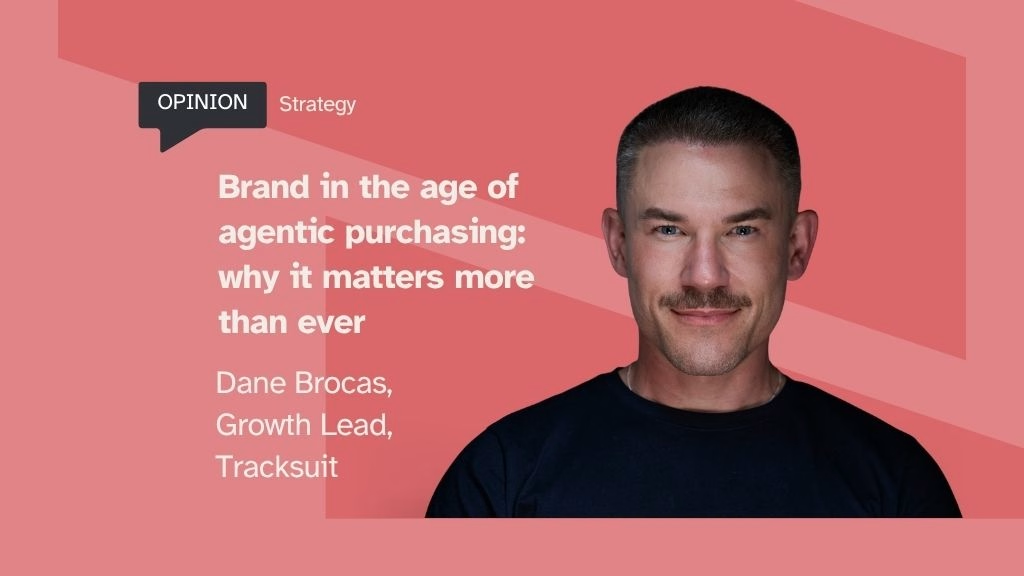
By Dane Brocas, Growth Lead at Tracksuit
Every few years, marketing gets a new “end of brand” headline. Programmatic was going to kill it. Performance marketing was going to kill it. Direct-to-consumer was going to kill it.
None of them did.
Now AI is getting its turn. If a chatbot can narrow a category down to two or three recommendations before a human has even started shopping, why bother with all that expensive, fuzzy brand-building?
It’s a fair question. But the evidence emerging points to a clear answer: AI is changing where brands are discovered, not what makes them worth discovering.
If anything, brand matters more than ever.
AI is rewriting the discovery layer
The shift is real. ChatGPT now reaches around 800 million weekly users, while Adobe reported AI-driven traffic to US retail sites jumping 805% year-on-year on Black Friday.
Discovery is moving from a list of links to an answer.
And increasingly, those answers are informed by something marketers have traditionally struggled to control: what real people say about brands when brands aren’t in the room.
That is why forums such as Reddit are becoming strategically important. AI models can draw on conversations where consumers describe what happened when they bought a product, dealt with a company or compared alternatives. These discussions offer first-hand experience and candid opinions that polished product pages often cannot.
For marketers, the question is no longer simply whether your website ranks in search. It is whether your brand is part of the wider conversation AI systems use to construct an answer.
Marketers are scrambling for the AI shelf
Brands are already adapting. Some are developing dedicated Reddit and community strategies. Others are monitoring how frequently they appear in ChatGPT, Gemini, Perplexity and Google’s AI answers. A growing ecosystem of “AI SEO” providers is helping brands track citations, identify the sources models rely on and find the questions where competitors are being recommended instead.
There is obvious logic to this. If consumers are asking AI, “Which running shoe should I buy?” or “What’s the best CRM for a small business?”, marketers want to know whether their brand appears in the answer.
But there is a danger in treating AI visibility as a technical problem that can be solved with more citations, content or mentions.
Research from Charlie Oscar, published by WARC in 2026, found that 63% of LLM visibility across 30 brands and six categories was explained by long-term brand equity, compared with just 11% from citation volume.
The goal isn’t to manufacture mentions, but to become the brand people naturally talk about.
AI needs to understand the occasions when brands matter
This is where Category Entry Points become particularly useful.
Consumers rarely describe their needs in the language of a product catalogue. They ask questions based on situations: “What should I wear for a rainy hike?” “What’s a good tent for two adults and a dog?” “Which CRM won’t overwhelm a six-person sales team?”
These are Category Entry Points: the needs, occasions and situations that trigger category consideration.
For brands, the opportunity is to make the connection between those moments and their brand unmistakable.
That means answering real consumer questions, encouraging authentic conversation, building credible third-party coverage and consistently associating the brand with the occasions it wants to own.
Reddit can be part of that ecosystem. So can PR, reviews, influencers, search, social and traditional advertising.
The important point is that AI visibility is becoming the output of the whole marketing system, not a separate channel sitting outside it.
The agent shortlists. The human still chooses.
There is another reason the death-of-brand argument falls short: consumers do not necessarily trust AI recommendations blindly.
Research commissioned by Idea Grove in 2026 found that just 2% of consumers would buy from an unfamiliar brand recommended by AI without further research. The other 98% verify the recommendation, often through Google, reviews and the brand’s own presence.
That verification step is where brand becomes critical.
An AI recommendation might put a brand on the shortlist. But what happens when the consumer clicks through? Does the website look credible? Is the brand recognisable? Does it feel trustworthy?
Ultimately, AI can create consideration, but brand is what gives consumers the confidence to convert.
And familiarity matters. Tracksuit’s research has found that brands with significantly higher awareness can convert at nearly three times the rate of those with much lower awareness.
AI does not erase those accumulated associations. It activates them.
How brands can win the AI shelf
Brands need to be both machine-readable and human-loveable: clear positioning, distinctive assets, credible reviews and authentic conversation all help. Track your share of model to see where competitors are gaining ground, and identify the Category Entry Points where AI will increasingly influence choice.
Most importantly, use AI to multiply brand-building, not replace it. The brands that win the AI shelf won’t be those with the cleverest tricks, but those people already know, talk about and trust.
AI may influence what gets considered, but brand still determines what gets chosen.