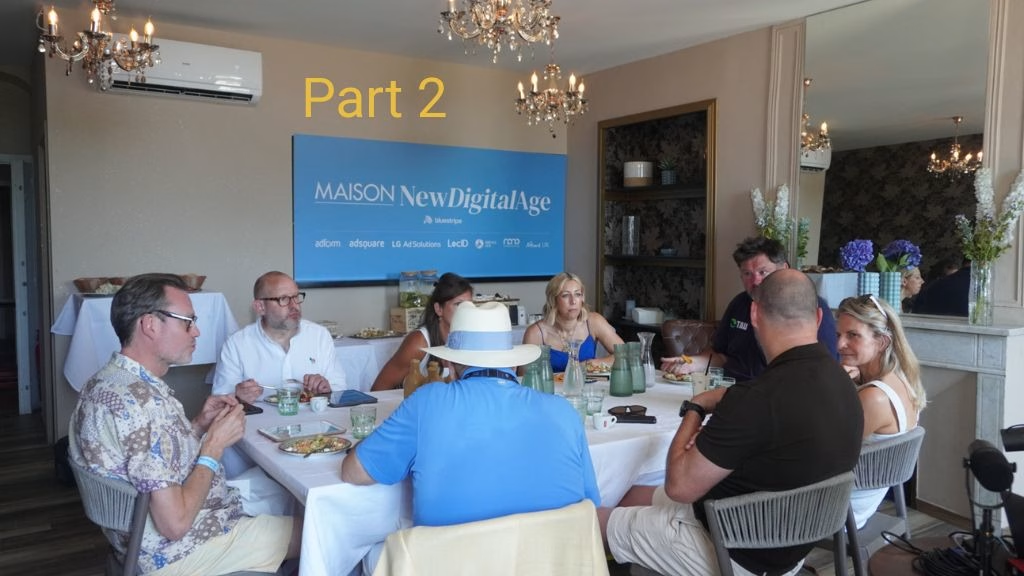
To explore how AI is reshaping business models, creative processes, and organisational structures, New Digital Age hosted an exclusive roundtable at Cannes Lions. This is the second part of the roundtable writeup.
The discussion, chaired by New Digital Age Editor-in-Chief Justin Pearse, brought together a panel of industry leaders to debate the current realities and future trajectories of AI. The participants included: Jon Mew, CEO, The IAB; Lindsay Barrett, Global VP of Data Driven Marketing & Communities, Mars; Lou Paskalis, CEO, AJL Advisory; Tara Hughes, VP Client Management, Jellyfish; Carren O’Keefe, Chief Creative Officer, Digitas UK; Niall Moody, CRO, Nano Interactive; and Rob Webster, Founder and CEO, TAU Marketing Solutions.
To counter the rise of generic, automated outputs, the panelists agreed that human judgment, instinct, and emotional intelligence remain irreplaceable. Trust in autonomous systems is still low, and the consensus is that human oversight is required not just for quality control, but for compliance, brand safety, and legal protection.
“The thing that I found quite interesting is, particularly for advertisers, having a human in the loop is still critical,” Mew says, referencing recent IAB research pieces. “They love AI, they don’t really trust it, but if there’s a human involved, then the trust increases massively.”
From a creative standpoint, defending the value of professional craft means shifting the focus from speed to original thinking. O’Keefe, who began her career as a copywriter, says that she has spent her professional life defending her craft against clients who think they can write lines.
From a creative standpoint, defending the value of professional craft means shifting the focus from pure speed to original problem-solving.
Carren O’Keefe, Chief Creative Officer at Digitas UK, says that the industry is currently trapped in a superficial cycle. “People keep saying that taste, judgment, and creativity are more important than ever, but they rarely explain why,” O’Keefe argues.
She says that the sector is currently losing ground because businesses are simply using AI to do what they have always done, just slightly faster. True creative value, she notes, lies in using these tools not for cheap shortcuts, but to fundamentally reframe and solve entirely new tiers of business problems.
Scaling institutional knowledge
Beyond individual productivity, the true transformative potential of AI lies in its ability to synthesise and scale institutional knowledge across an entire organisation. In large companies, valuable data, historic campaign insights, and analytical expertise are frequently trapped within specific teams, leading to repetitive mistakes and misinformed decision-making.
Rob Webster proposes that AI should be viewed as a mechanism to multiply collective expertise rather than just automate tasks. “For me, a lot of this is trying to take institutional knowledge and make it more readily available,” Webster explains.
He gives the example of a finance director cutting search spend based on a superficial reading of an analytics spreadsheet, ignoring the long-term lifetime value and econometric models carefully calculated by data analysts over months.
“Everyone should have an opinion, but not all opinions have equal weight,” Webster says. He explains that a cleverly-configured AI framework acts as a digital custodian of a company’s collective intelligence. By programming the system to absorb and respect months of deep econometric modelling and data analysis, it can actively prevent casual stakeholders from making surface-level, misinformed changes to a campaign strategy.
This internal application of AI is also helping brand teams overcome massive operational bottlenecks, particularly in highly regulated sectors like consumer goods or healthcare.
Barrett shares how Mars brought its legal and regulatory teams into the AI design process to solve an approvals bottleneck. By building the brand’s legal guidelines directly into the AI infrastructure, the company transformed a slow, email-heavy approval process into a streamlined system where the system automatically approves standard assets, leaving legal experts free to focus on high-risk cases.
The looming challenges: Governance, regulation, and the tech monopolies
As AI becomes deeply embedded in infrastructure, the industry must confront complex questions around data ownership, commercial models, and market dominance. The shift toward autonomous systems risks further concentrating power in the hands of a few dominant technology giants.
Webster raised concerns about the potential pitfalls of relying on autonomous platforms that operate as closed ecosystems. “I think the real risk here is that we put all of the power in the hands of those that own the analytics,” Webster warns, drawing a parallel to how search platforms function. He says that the industry must find ways to audit AI decisions objectively. “I don’t think you should ever trust, you need to validate, and the only way to audit an AI is another AI, or looking at the raw data.”
Furthermore, the commercial models underpinning agency-brand relationships are facing disruption. While agencies are experimenting with token-based billing models to account for AI compute time, clients are pushing for a return to value-driven, outcomes-based frameworks.
Barrett says that multinational businesses cannot operate with unpredictable, endless token costs. “I feel like the next wave will literally go back to an outcomes-based billing where they will not get paid until there is a registered outcome of my business,” Barrett predicts.
Looking ahead: The age of enlightenment or the age of beige?
As the roundtable drew to a close, Pearse asked the panelists to predict what the single biggest misconception about AI in marketing would be in a year’s time. The responses highlighted a collective hope that the industry will move past superficial hype and establish a mature, balanced partnership with the technology.
Mew predicts the biggest misconception would be “the fact that a human will never touch a media plan or be part of anything,” reinforcing that human agency remains central.
O’Keefe warns against the “false narrative around it replacing creativity,” predicting that a short-term rush to automation will result in a generic marketplace that ultimately forces brands to realise the value of distinct human ideas.
Hughes and Moody both emphasised that the fundamental nature of the industry will remain relational, regardless of technological shifts.
“Those relationships and that relationship building is going to be even more necessary going forward,” Hughes concludes.
Paskalis closed the session with a historical parallel, wondering if the industry is on the cusp of a marketing renaissance.
“People who lived through the Renaissance, first of all, they didn’t know they were in it,” Paskalis reflects. “But they were moving from the guilds and the church, which told them everything, to having the unlimited freedom to become an artisan, to become a craftsman. This time next year, we’ll be talking about AI as an empowerment for the craft that we have, it is not a replacement for it.”