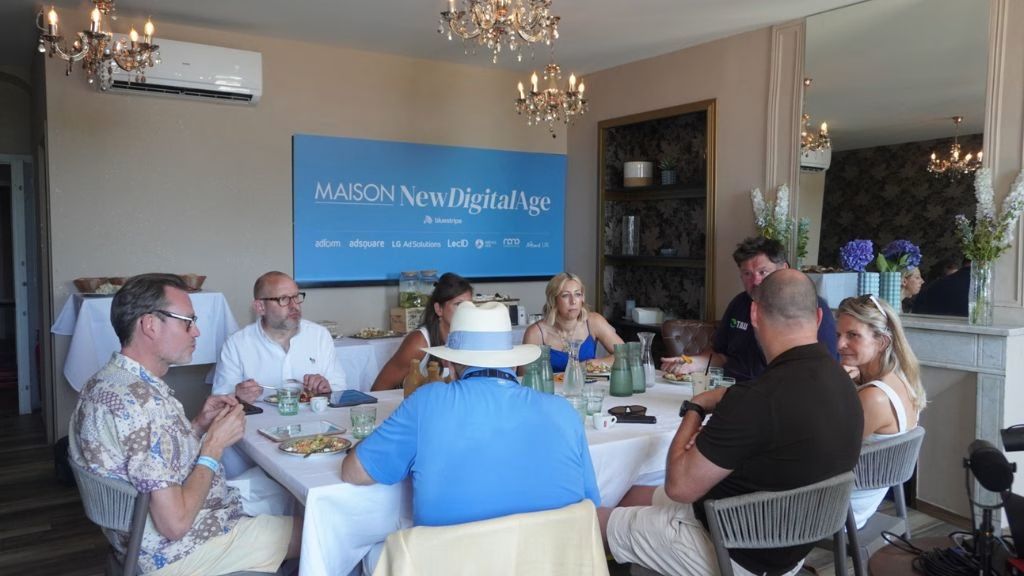
The annual Cannes Lions International Festival of Creativity has always served as a barometer for the shifting dynamics of the global advertising industry. This year, the overarching conversation across the Croisette focused heavily on artificial intelligence. To explore how this technology is reshaping business models, creative processes, and organisational structures, New Digital Age hosted an exclusive roundtable.
The discussion, chaired by New Digital Age Editor-in-Chief Justin Pearse, brought together a panel of industry leaders to debate the current realities and future trajectories of AI. The participants included: Jon Mew, CEO, The IAB; Lindsay Barrett, Global VP of Data Driven Marketing & Communities, Mars; Lou Paskalis, CEO, AJL Advisory; Tara Hughes, VP Client Management, Jellyfish; Carren O’Keefe, Chief Creative Officer, Digitas UK; Niall Moody, CRO, Nano Interactive; and Rob Webster, Founder and CEO, TAU Marketing Solutions.
From fear to fluency: The current state of play
A year ago, industry conversations around AI were dominated by existential dread, anxiety over immediate job losses, and widespread confusion. Today, that sentiment has evolved into something far more practical. Marketing leaders are no longer asking if they should use AI, but rather how deeply it can be integrated into their daily workflows and long-term structures.
Lou Paskalis opened the discussion by framing the current landscape as a fundamental shift in business operations, particularly from a client perspective.
“It’s a workflow impact, it’s an org design impact that really sits under the workflow, and it’s an opportunity to do two things at a very macro level,” Paskalis says. He argues that AI allows the industry to move toward genuine, outcomes-based buying, steering away from the flawed proxies, such as last-touch attribution, that have long plagued programmatic advertising. However, he expressed concern that many marketers are simply applying old rules to new agentic models.
For global brands, the practical application of AI is already yielding measurable results, particularly in terms of efficiency. Lindsay Barrett explains how Mars has scaled its internal capabilities by empowering a dedicated cohort of power users.
“We have over 150 super users who are building their own agents across multiple different marketing workflows,” Barrett says, adding that these agents handle everything from dashboards to content production engines.
While acknowledging that personal productivity has seen a massive boost, she emphasised that the runway for pure efficiency gains might have its limits, prompting the business to look deeper into creative applications.
Breaking down the silos
One of the recurring themes of the roundtable was the danger of viewing AI through a narrow, tactical lens. Too often, brands treat AI as an isolated tool for specific campaigns rather than an enterprise-wide enabler.
This siloed approach creates fragmentation and prevents companies from realising the technology’s full structural value.
Tara Hughes observes this pattern frequently in her work with creative clients across Europe. “Brands are looking at AI in silos, they’re doing a pilot process,” Hughes explains. “They’ll do a pilot on a specific campaign to get the efficiencies, and it will work, but then they’re like, ‘so what do we do now?’ because this doesn’t fit into the rest of the workflow.”
She argues that the conversation must pivot away from viewing AI as a temporary production output and toward treating it as a foundational enabler for the entire business architecture.
This shift toward democratisation and cross-functional collaboration is changing how agencies and corporate teams operate internally. Carren O’Keefe shares a recent experience from an internal global leadership summit that illustrated this changing dynamic.
“Yesterday, we did a builder day where everyone in the room brought laptops and we worked together and co-created agents,” O’Keefe says. She says that this democratised approach to problem-solving breaks down traditional corporate barriers, bringing financial officers and creative directors into the same technological sandbox.
Niall Moody echoes the importance of this collaborative approach, saying how it alters the core value proposition for technology providers.
Niall Moody, CRO at Nano Interactive, points to the rise of agentic AI and cloud-based “composability” as a massive driver for structural innovation. He explains that by moving away from rigid, monolithic systems and embedding directly within shared cloud sandboxes, businesses can instantly feed deep contextual, geographical, and measurement data sources straight into specialized machine learning models.
By bypassing traditional roadblocks like lengthy procurement cycles and massive corporate contracts, this fluid connectivity allows marketers to seamlessly plug different niche AI tools and data signals together. Ultimately, Moody says, this open architecture empowers teams to collaborate with new partners, think bigger, and deploy autonomous systems with an agility that was previously impossible.
While the democratisation of AI tools allows anyone to generate text, images, or data analysis, it poses a distinct challenge to traditional industry expertise. When powerful tools are placed in untrained hands, the line between amateur output and professional craft becomes dangerously blurred.
Paskalis illustrates this tension with an anecdote about a senior executive who bypassed his creative team after disliking a campaign proposal, choosing instead to generate a replacement ad via a generative AI prompt in 35 minutes.
“And you know what? She said to me in all honesty, ‘it was good.’ And what does that do to our craft?” Paskalis warns. “This is a craft, this is an expertise, and the democratisation is almost too democratic.”
This phenomenon raises the specter of a market flooded with mediocre, homogeneous content. Jon Mew highlights that IAB research indicates a significant gap between experimentation and structural maturity, with many companies talking a better game than they practice.
“I think we see an increasing growth to ‘good enough’ marketing, if it’s ‘good enough’ and it works,” Mew says. He says that while 75 per cent of their members are experimenting with generative AI, only 4 per cent consider themselves “agent-first,” suggesting that the industry has a long way to go before autonomous execution becomes mainstream.
The second part of this report will be published soon.